Comprehensive Guide to Conic Sections in Geometry
Understanding the Nature and Formation of Conic Sections
Introduction to Conic Curves
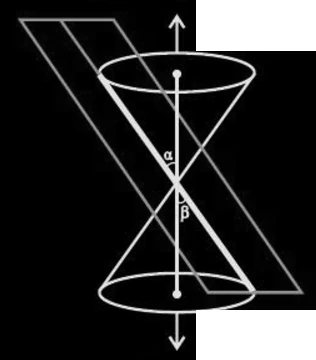
A conic section is a curve created by slicing a right circular cone with a plane. The shape of the curve depends on the angle between the plane and the cone's axis. This intersection produces four primary types of curves: circles, ellipses, parabolas, and hyperbolas. These curves have significant applications in fields such as astronomy, optics, and engineering.
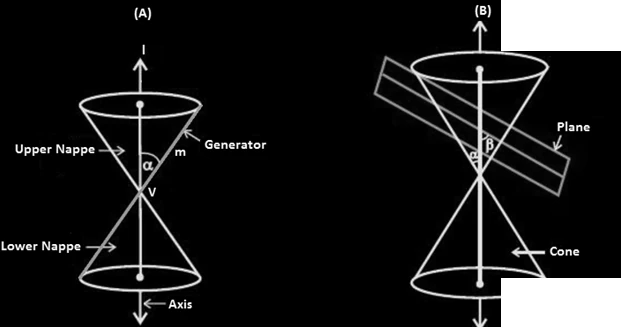
The cone is divided into two parts by its vertex, called nappes: the upper and lower nappes. The position and angle of the intersecting plane relative to the cone determine the type of conic section formed.
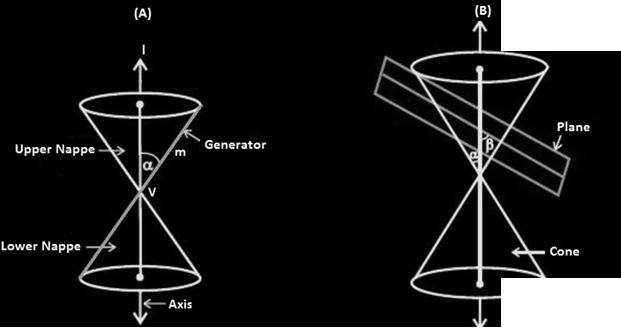
Depending on the angle of intersection \( \beta \), the conic sections are:
- Circle
- Ellipse
- Parabola
- Hyperbola
These curves are not only theoretical constructs but also appear in everyday objects such as car mirrors and satellite dishes, demonstrating their practical importance.
Example: Identifying a Conic Section
Problem: A plane intersects a right circular cone at an angle of \( 60^\circ \) to the axis, while the cone's surface makes an angle of \( 45^\circ \) with the axis. Determine the type of conic section formed.
Solution: The eccentricity \( e \) is given by:
\[ e = \frac{\cos \alpha}{\cos \beta} = \frac{\cos 60^\circ}{\cos 45^\circ} = \frac{0.5}{0.7071} \approx 0.707 \]
Since \( 0 < e < 1 \), the conic section is an ellipse.
Key Parameters and Properties of Conic Sections
Focus, Eccentricity, and Directrix Explained
Each conic section can be defined as the set of points \( P \) in a plane such that the ratio of the distance from \( P \) to a fixed point called the focus \( F \), to the distance from \( P \) to a fixed line called the directrix \( d \), is a constant \( e \), known as the eccentricity:
\[ e = \frac{\text{distance}(P, F)}{\text{distance}(P, d)} \]
The value of \( e \) characterizes the conic:
- If \( e = 0 \), the curve is a circle.
- If \( 0 < e < 1 \), it is an ellipse.
- If \( e = 1 \), the curve is a parabola.
- If \( e > 1 \), the curve is a hyperbola.
Here, \( \alpha \) is the angle between the cutting plane and the cone's axis, and \( \beta \) is the angle between the cone's surface and its axis. The eccentricity can also be expressed as:
\[ e = \frac{\cos \alpha}{\cos \beta} \]
Example: Calculating Eccentricity
Problem: A plane cuts a cone such that the angle between the plane and the axis is \( 50^\circ \), and the cone's surface makes an angle of \( 40^\circ \) with the axis. Find the eccentricity of the conic section.
Solution:
\[ e = \frac{\cos 50^\circ}{\cos 40^\circ} = \frac{0.6428}{0.7660} \approx 0.839 \]
Since \( 0 < e < 1 \), the conic section is an ellipse.
Additional Parameters of Conics
Besides focus, eccentricity, and directrix, several other important terms describe conic sections:
- Principal Axis: The line joining the two foci of an ellipse or hyperbola; its midpoint is the center.
- Linear Eccentricity: The distance between the center and a focus.
- Latus Rectum: A chord through a focus, parallel to the directrix.
- Focal Parameter: The distance from a focus to its corresponding directrix.
- Major Axis: The longest chord of an ellipse, connecting its vertices.
- Minor Axis: The shortest chord of an ellipse, perpendicular to the major axis.
Classification and Standard Equations of Conic Sections
Types of Conic Sections Based on Plane Intersection
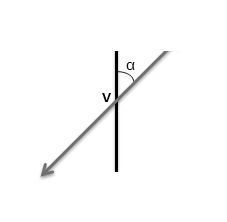
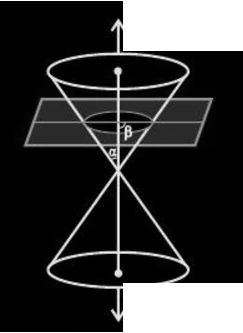
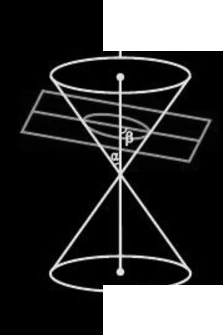
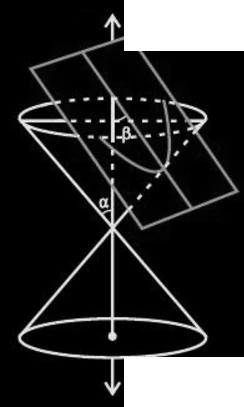
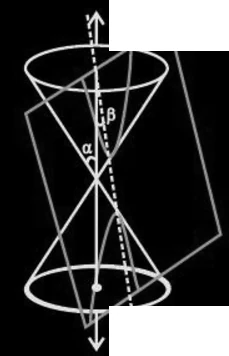
When a plane intersects a double-napped cone, the resulting curve depends on the angle \( \alpha \) between the plane and the cone's axis, and the cone's surface angle \( \beta \). The main cases are:
- Circle: When \( \beta = 90^\circ \), the intersection is a circle.
- Ellipse: When \( \alpha < \beta < 90^\circ \), the curve is an ellipse.
- Parabola: When \( \alpha = \beta \), the curve is a parabola.
- Hyperbola: When \( 0 \leq \beta < \alpha \), the curve is a hyperbola.
Standard Forms of Conic Equations
Using Cartesian coordinates and the focus-directrix property, the equations of conic sections can be expressed in standard forms. For ellipses and hyperbolas, the principal axis aligns with the x-axis, and the center is at the origin. The vertices are at \( (\pm a, 0) \) and foci at \( (\pm c, 0) \). The parameter \( b \) is defined by:
Ellipse: \[ c^2 = a^2 - b^2 \]
Hyperbola: \[ c^2 = a^2 + b^2 \]
For a circle, \( c = 0 \) and \( a^2 = b^2 \). The parabola's standard form places the focus at \( (a, 0) \) and the directrix at \( x = -a \), passing through the origin.
| Conic Type | Standard Equation |
|---|---|
| Circle | \( x^2 + y^2 = a^2 \) |
| Ellipse | \( \frac{x^2}{a^2} + \frac{y^2}{b^2} = 1 \) |
| Hyperbola | \( \frac{x^2}{a^2} - \frac{y^2}{b^2} = 1 \) |
| Parabola | \( y^2 = 4ax \) (for \( a > 0 \)) |
Example: Writing the Equation of an Ellipse
Problem: An ellipse has foci at \( (\pm 5, 0) \) and eccentricity \( \frac{1}{2} \). Find its equation.
Solution: Since the foci lie on the x-axis, the ellipse is horizontal. Using \( e = \frac{c}{a} \), we get:
\[ a = \frac{c}{e} = \frac{5}{\frac{1}{2}} = 10 \]
Calculate \( b^2 \):
\[ b^2 = a^2 - c^2 = 10^2 - 5^2 = 100 - 25 = 75 \]
The ellipse equation is:
\[ \frac{x^2}{100} + \frac{y^2}{75} = 1 \]
Practical Applications and Degenerate Cases of Conic Sections
Special Cases When Plane Passes Through the Vertex
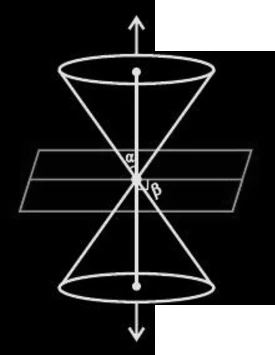
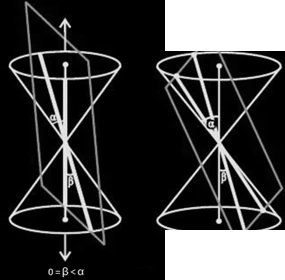
If the intersecting plane passes exactly through the cone's vertex, the conic section may degenerate into simpler forms:
- If \( \alpha < \beta \leq 90^\circ \), the intersection is a single point.
- If \( \alpha = \beta \), the intersection forms a straight line, a degenerate parabola.
- If \( 0 \leq \beta < \alpha \), the intersection is a pair of intersecting lines, a degenerate hyperbola.
Example: Identifying Degenerate Conics
Problem: A plane intersects a cone at its vertex and forms two intersecting straight lines. What type of conic section is this?
Solution: This is a degenerate form of a hyperbola, occurring when the plane passes through the vertex and the angle between the plane and axis is less than the cone's surface angle.
Worked Problems on Conic Sections
Problem 1: Parabola Characteristics
Question: For the parabola \( y^2 = 12x \), find the focus, vertex, directrix equation, axis of symmetry, and length of the latus rectum.
Solution: Comparing with standard form \( y^2 = 4ax \), we get \( 4a = 12 \Rightarrow a = 3 \).
- Focus: \( (a, 0) = (3, 0) \)
- Vertex: \( (0, 0) \)
- Directrix: \( x = -a = -3 \)
- Axis: x-axis (line \( y = 0 \))
- Length of latus rectum: \( 4a = 12 \)
Problem 2: Equation of an Ellipse
Question: An ellipse has foci at \( (\pm 3, 0) \) and eccentricity \( \frac{3}{5} \). Find its equation.
Solution:
\[ a = \frac{c}{e} = \frac{3}{\frac{3}{5}} = 5 \]
\[ b^2 = a^2 - c^2 = 25 - 9 = 16 \]
Equation:
\[ \frac{x^2}{25} + \frac{y^2}{16} = 1 \]
Problem 3: Hyperbola Parameters
Question: For the hyperbola \( \frac{x^2}{25} - \frac{y^2}{36} = 1 \), find:
- Lengths of transverse and conjugate axes
- Coordinates of vertices and foci
- Eccentricity
- Length of latus rectum
Solution:
- \( a^2 = 25 \Rightarrow a = 5 \), \( b^2 = 36 \Rightarrow b = 6 \)
- Vertices: \( (\pm 5, 0) \)
- Calculate \( c \): \[ c = \sqrt{a^2 + b^2} = \sqrt{25 + 36} = \sqrt{61} \approx 7.81 \]
- Foci: \( (\pm 7.81, 0) \)
- Transverse axis length: \( 2a = 10 \)
- Conjugate axis length: \( 2b = 12 \)
- Eccentricity: \[ e = \frac{c}{a} = \frac{7.81}{5} = 1.562 \]
- Length of latus rectum: \[ \frac{2b^2}{a} = \frac{2 \times 36}{5} = 14.4 \]
Summary Table for Quick Revision
| Conic Type | Eccentricity \( e \) | Standard Equation | Focus | Directrix |
|---|---|---|---|---|
| Circle | 0 | \( x^2 + y^2 = r^2 \) | Center | Not applicable |
| Ellipse | \( 0 < e < 1 \) | \( \frac{x^2}{a^2} + \frac{y^2}{b^2} = 1 \) | \( (\pm c, 0) \) | \( x = \pm \frac{a^2}{c} \) |
| Parabola | 1 | \( y^2 = 4ax \) | \( (a, 0) \) | \( x = -a \) |
| Hyperbola | \( e > 1 \) | \( \frac{x^2}{a^2} - \frac{y^2}{b^2} = 1 \) | \( (\pm c, 0) \) | \( x = \pm \frac{a^2}{c} \) |
Glossary of Important Terms
| Term | Definition |
|---|---|
| Conic Section | Curve formed by the intersection of a plane and a right circular cone. |
| Focus | A fixed point used to define a conic section. |
| Directrix | A fixed line used in the definition of conic sections. |
| Eccentricity | Ratio defining the shape of a conic section. |
| Vertex | Point where the conic section intersects its principal axis. |
| Principal Axis | Line joining the foci of an ellipse or hyperbola. |
| Latus Rectum | Chord through a focus, perpendicular to the principal axis. |
| Major Axis | Longest chord of an ellipse passing through its foci. |
| Minor Axis | Shortest chord of an ellipse perpendicular to the major axis. |
| Degenerate Conic | A conic section that reduces to simpler forms like points or lines. |
Frequently Asked Questions
What are the four main types of conic sections?
The four primary conic sections are circles, ellipses, parabolas, and hyperbolas, classified based on the angle of the intersecting plane with the cone.
Where do conic sections appear in real life?
Conic sections are found in planetary orbits (ellipses), satellite dishes and telescopes (parabolas), car mirrors (hyperbolas), and circular wheels.
How can you identify a conic section from its general equation?
The general quadratic equation \( Ax^2 + Bxy + Cy^2 + Dx + Ey + F = 0 \) represents a conic. The discriminant \( B^2 - 4AC \) determines the type: less than zero for ellipse, zero for parabola, greater than zero for hyperbola, and if \( A = C \) and \( B = 0 \), it is a circle.
What is the best way to define a conic section?
A conic section is the curve formed by the intersection of a plane with a right circular cone.
Who first discovered conic sections?
Ancient Greek mathematician Menaechmus is credited with the discovery and initial study of conic sections.