Comprehensive Guide to Circles: Definitions, Properties, and Formulas
Fundamentals of Circles and Their Geometric Significance
Understanding the Circle and Its Basic Definition
A circle is a perfectly round, two-dimensional shape where every point on its boundary is at the same distance from a fixed point called the center. This distance is known as the radius. The circle can be mathematically represented by the equation:
\[ (x - h)^2 + (y - k)^2 = r^2 \]
Here, \((h, k)\) denotes the coordinates of the center, and \(r\) is the radius. The circle exhibits both reflection symmetry across any line through its center and rotational symmetry for any angle about the center.
Visualize bending a straight line segment until its ends meet perfectly to form a loop; this loop is a circle. It divides the plane into two distinct regions: the interior (inside the circle) and the exterior (outside the circle).
Step-by-Step Method to Construct a Circle
To draw a circle accurately, follow these steps:
- Mark a point on a sheet of paper to serve as the center, label it as point \(O\).
- Decide on a radius length, for example, 4 cm.
- Using a ruler, measure 4 cm from point \(O\) in multiple directions and mark these points.
- Connect all these points smoothly to form a perfect circle.
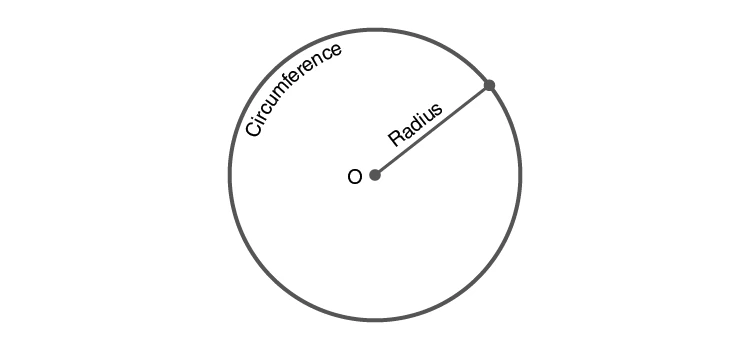
Example:
Draw a circle with center \(O\) and radius 5 cm using a ruler.
Solution:
- Mark point \(O\) on the paper.
- Using the ruler, measure 5 cm from \(O\) in various directions and mark points.
- Join these points smoothly to complete the circle.
Key Components and Terminology of a Circle
Identifying the Essential Parts of a Circle
A circle consists of several important parts, each with unique properties:
- Center: The fixed point equidistant from all points on the circle.
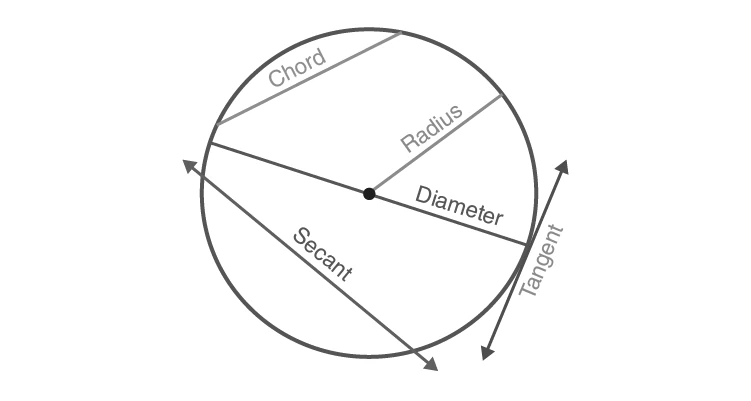
- Radius: A line segment from the center to any point on the circle.
- Diameter: The longest chord passing through the center, equal to twice the radius.
- Chord: A line segment with both endpoints on the circle.
- Secant: A line that intersects the circle at two points, extending beyond the chord.
- Tangent: A line touching the circle at exactly one point.
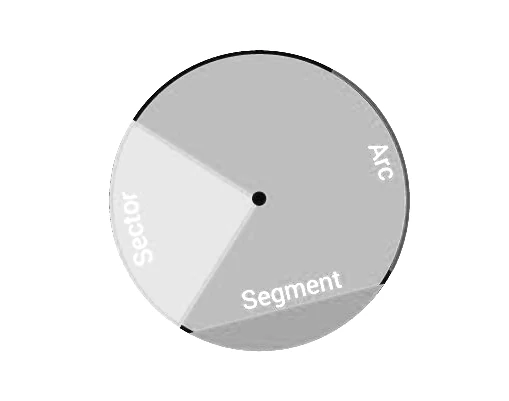
- Arc: A connected portion of the circle's circumference.
- Sector: The region bounded by two radii and the arc between them.
- Segment: The area bounded by a chord and the arc it subtends, excluding the center.
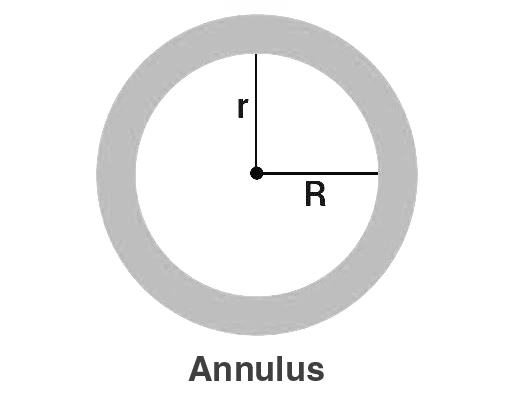
- Annulus: The ring-shaped area between two concentric circles.
Radius and Diameter Explained
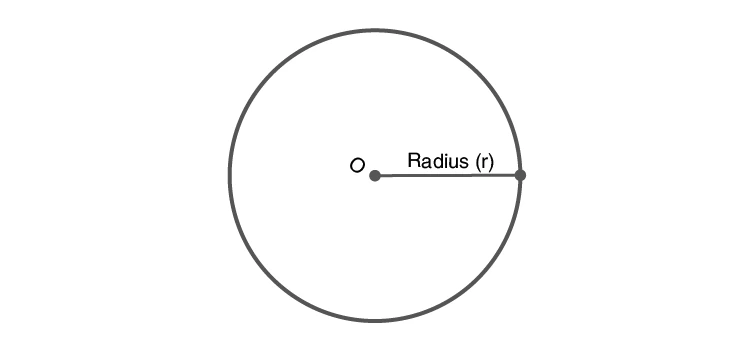
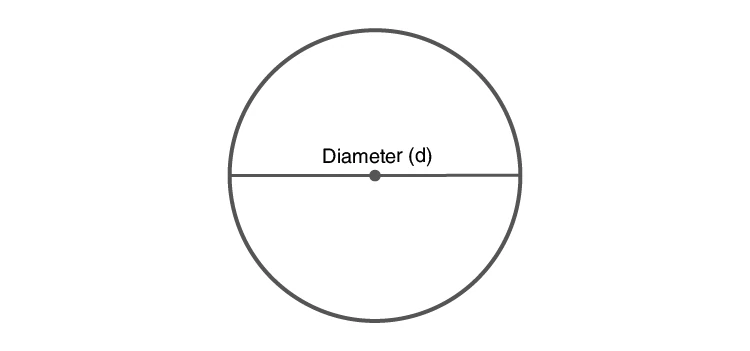
The radius (\(r\)) is the distance from the center to any point on the circle. The diameter (\(d\)) is the longest chord passing through the center and is twice the radius:
\[ d = 2r \]
Conversely, the radius can be found from the diameter as:
\[ r = \frac{d}{2} \]
Example:
If a circle has a diameter of 14 cm, find its radius.
Solution:
Using the relation \(r = \frac{d}{2}\),
\[ r = \frac{14}{2} = 7 \text{ cm} \]
Therefore, the radius is 7 cm.
Calculating Area and Circumference of Circles
Formulas for Circle's Area and Circumference
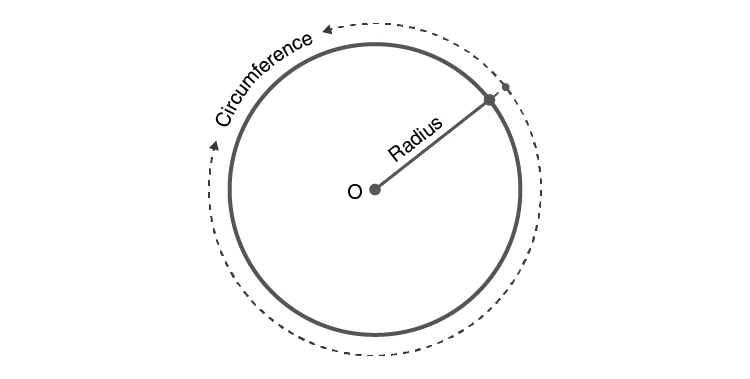
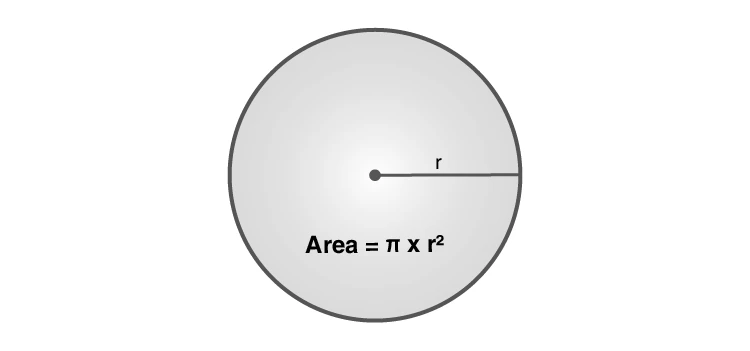
The two primary measurements of a circle are its area and circumference (perimeter). The circumference is the total distance around the circle, while the area is the space enclosed within it.
The formulas are:
\[ \text{Circumference} = C = 2 \pi r = \pi d \]
\[ \text{Area} = A = \pi r^2 \]
Here, \(\pi\) is approximately 3.1415.
Deriving the Area Formula Using Geometric Proof
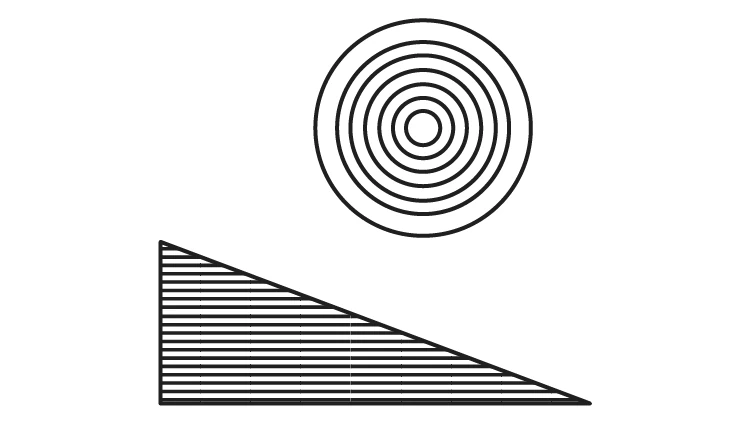
Consider a circle with radius \(r\). If we imagine cutting the circle into many thin concentric rings and rearranging them, they approximate a right-angled triangle with base equal to the circumference and height equal to the radius.
The base length is:
\[ 2 \pi r \]
The height is:
\[ r \]
Thus, the area of the triangle (and hence the circle) is:
\[ \text{Area} = \frac{1}{2} \times \text{base} \times \text{height} = \frac{1}{2} \times 2 \pi r \times r = \pi r^2 \]
Example 1:
Calculate the area and circumference of a circle with radius 8 cm. Use \(\pi = 3.14\).
Solution:
Given: \(r = 8 \text{ cm}\)
Area:
\[ A = \pi r^2 = 3.14 \times 8^2 = 3.14 \times 64 = 200.96 \text{ cm}^2 \]
Circumference:
\[ C = 2 \pi r = 2 \times 3.14 \times 8 = 50.24 \text{ cm} \]
Example 2:
A circle has a circumference of 18.84 cm. Find its area.
Solution:
Given: \(C = 18.84 \text{ cm}\)
Calculate radius:
\[ C = 2 \pi r \implies r = \frac{C}{2 \pi} = \frac{18.84}{2 \times 3.14} = 3 \text{ cm} \]
Calculate area:
\[ A = \pi r^2 = 3.14 \times 3^2 = 3.14 \times 9 = 28.26 \text{ cm}^2 \]
Essential Properties and Real-World Examples of Circles
Key Characteristics of Circles
- All points on the circumference are equidistant from the center.
- The diameter divides the circle into two equal halves.
- Circles with the same radius are congruent, while those with different radii are similar.
- The diameter is the longest chord and is exactly twice the radius.
- Every line through the center is a line of symmetry.
- Circles have infinite lines of symmetry and rotational symmetry for any angle.
Common Circular Objects in Daily Life
Many everyday items exhibit circular shapes, such as:
- Rings
- Compact discs (CDs)
- Bangles
- Coins
- Wheels
- Buttons
- Dartboards
- Hula hoops
Example:
Identify the radius and diameter of a bicycle wheel if the diameter is 70 cm.
Solution:
Given diameter \(d = 70 \text{ cm}\), radius is:
\[ r = \frac{d}{2} = \frac{70}{2} = 35 \text{ cm} \]
Summary Table for Quick Reference
| Term | Definition | Formula / Relation |
|---|---|---|
| Circle | Set of points equidistant from a center | \((x - h)^2 + (y - k)^2 = r^2\) |
| Radius (\(r\)) | Distance from center to circumference | — |
| Diameter (\(d\)) | Longest chord passing through center | \(d = 2r\) |
| Circumference (\(C\)) | Distance around the circle | \(C = 2 \pi r = \pi d\) |
| Area (\(A\)) | Space enclosed by the circle | \(A = \pi r^2\) |
| Chord | Line segment with endpoints on circle | — |
| Tangent | Line touching circle at one point | — |
| Secant | Line intersecting circle at two points | — |
| Sector | Region bounded by two radii and arc | — |
| Segment | Area bounded by chord and arc | — |
Glossary of Important Terms Related to Circles
| Term | Meaning |
|---|---|
| Center | The fixed point equidistant from all points on the circle |
| Radius | Line segment from center to any point on the circle |
| Diameter | Longest chord passing through the center |
| Chord | Line segment with endpoints on the circle |
| Secant | Line intersecting the circle at two points |
| Tangent | Line touching the circle at exactly one point |
| Arc | Connected part of the circle's circumference |
| Sector | Region bounded by two radii and the arc between them |
| Segment | Area bounded by a chord and the arc it subtends |
| Annulus | Ring-shaped area between two concentric circles |
Frequently Asked Questions (FAQs) on Circles
What defines a circle in geometry?
A circle is a closed curve where all points on the boundary are at an equal distance from a fixed center point.
What are the main parts of a circle?
The primary parts include the center, radius, diameter, chord, tangent, secant, arc, sector, and segment.
How do you calculate the circumference of a circle?
The circumference is calculated using \(C = 2 \pi r\) or \(C = \pi d\), where \(r\) is the radius and \(d\) is the diameter.
What is the formula for the area of a circle?
The area is given by \(A = \pi r^2\), where \(r\) is the radius of the circle.
How is the diameter related to the radius?
The diameter is twice the radius, expressed as \(d = 2r\).