Comprehensive Guide to Arithmetic Progressions
Understanding Arithmetic Progressions and Their Fundamentals
Introduction to Arithmetic Progressions
An arithmetic progression (AP) is a sequence of numbers arranged in a specific order where the difference between any two consecutive terms remains constant. This constant difference is known as the common difference. For instance, the sequence of natural numbers 1, 2, 3, 4, 5, ... forms an AP with a common difference of 1. Similarly, sequences like 2, 4, 6, 8, ... or 1, 3, 5, 7, ... have a common difference of 2.
Arithmetic progressions frequently appear in everyday contexts such as student roll numbers, days of the week, or months in a year, illustrating their practical significance.
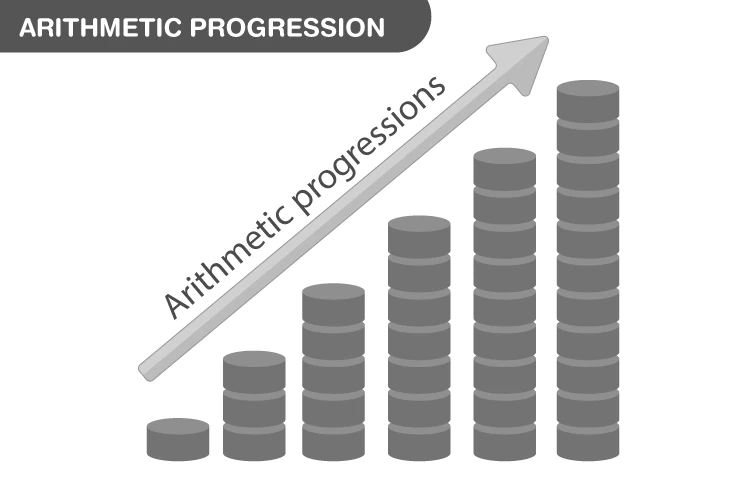
Visual representation of an arithmetic progression
Example Problem
Consider the sequence 2, 5, 8, 11, 14, ... Identify the common difference and verify if it forms an arithmetic progression.
Solution: The difference between consecutive terms is:
\[ 5 - 2 = 3, \quad 8 - 5 = 3, \quad 11 - 8 = 3 \]
Since the difference is constant and equals 3, the sequence is an arithmetic progression with common difference \( d = 3 \).
Key Components and Formulas in Arithmetic Progressions
Essential Terms and Notations in AP
In any arithmetic progression, the following terms are fundamental:
First term (a): The initial term of the sequence.
Common difference (d): The fixed amount added to each term to get the next term.
nth term (\(a_n\)): The term at position \(n\) in the sequence.
Sum of first n terms (\(S_n\)): The total of the first \(n\) terms.
The general form of an AP can be expressed as:
\[ a, \quad a + d, \quad a + 2d, \quad a + 3d, \quad \ldots, \quad a + (n-1)d \]
Calculating the nth Term
The formula to find the \(n\)-th term of an AP is:
\[ a_n = a + (n - 1)d \]
where:
\(a\) is the first term,
\(d\) is the common difference,
\(n\) is the term number.
Example Problem
Find the 12th term of the AP: 4, 7, 10, 13, ...
Solution:
Given \(a = 4\), \(d = 7 - 4 = 3\), and \(n = 12\).
Using the formula:
\[ a_{12} = 4 + (12 - 1) \times 3 = 4 + 11 \times 3 = 4 + 33 = 37 \]
Therefore, the 12th term is 37.
Determining the Sum of the First n Terms
The sum of the first \(n\) terms of an AP is given by:
\[ S_n = \frac{n}{2} \left[ 2a + (n - 1)d \right] \]
Alternatively, if the last term \(l\) is known, the sum can be calculated as:
\[ S_n = \frac{n}{2} (a + l) \]
Example Problem
Calculate the sum of the first 20 terms of the AP: 3, 6, 9, 12, ...
Solution:
Here, \(a = 3\), \(d = 3\), and \(n = 20\).
Using the sum formula:
\[ S_{20} = \frac{20}{2} \left[ 2 \times 3 + (20 - 1) \times 3 \right] = 10 \left[ 6 + 57 \right] = 10 \times 63 = 630 \]
The sum of the first 20 terms is 630.
Classification, Applications, and Practice with Arithmetic Progressions
Types of Arithmetic Progressions
Arithmetic progressions can be categorized based on the number of terms:
Finite AP: Contains a limited number of terms and has a last term. Example: 2, 4, 6, 8, 10.
Infinite AP: Continues indefinitely without an end term. Example: 5, 10, 15, 20, ...
Practical Uses of Arithmetic Progressions
Arithmetic progressions help model and predict patterns in real life, such as scheduling, numbering systems, and financial calculations. For example, if a cab arrives every 10 minutes, the waiting times form an AP with a common difference of 10 minutes.
Worked Examples for Mastery
Example 1: Finding the Number of Terms
Given an AP with first term \(a = 7\), common difference \(d = 4\), and the 15th term \(a_{15} = 63\), find the number of terms \(n\) if the last term is 63.
Solution:
Using the nth term formula:
\[ a_n = a + (n - 1)d \]
Substitute values:
\[ 63 = 7 + (n - 1) \times 4 \]
\[ (n - 1) \times 4 = 63 - 7 = 56 \]
\[ n - 1 = \frac{56}{4} = 14 \]
\[ n = 15 \]
Thus, the number of terms is 15.
Example 2: Sum of Multiples
Find the sum of the first 25 multiples of 6.
Solution:
First term \(a = 6\), common difference \(d = 6\), number of terms \(n = 25\).
Sum formula:
\[ S_{25} = \frac{25}{2} \left[ 2 \times 6 + (25 - 1) \times 6 \right] = \frac{25}{2} [12 + 144] = \frac{25}{2} \times 156 = 25 \times 78 = 1950 \]
The sum of the first 25 multiples of 6 is 1950.
Example 3: Finding a Specific Term
Determine the 18th term of the AP: 5, 9, 13, 17, ...
Solution:
Here, \(a = 5\), \(d = 4\), \(n = 18\).
Using the nth term formula:
\[ a_{18} = 5 + (18 - 1) \times 4 = 5 + 17 \times 4 = 5 + 68 = 73 \]
The 18th term is 73.
Summary of Key Arithmetic Progression Formulas
Concept | Formula | Description |
|---|---|---|
General Term | \(a_n = a + (n - 1)d\) | Finds the \(n\)-th term of the AP |
Sum of First n Terms | \(S_n = \frac{n}{2} [2a + (n - 1)d]\) | Sum of the first \(n\) terms when first term and common difference are known |
Sum Using Last Term | \(S_n = \frac{n}{2} (a + l)\) | Sum of \(n\) terms when first and last terms are known |
Common Difference | \(d = a_{n} - a_{n-1}\) | Difference between consecutive terms |
Glossary of Important Terms in Arithmetic Progressions
Term | Definition |
|---|---|
Arithmetic Progression (AP) | A sequence where the difference between consecutive terms is constant. |
Common Difference (d) | The fixed amount added to each term to get the next term in an AP. |
First Term (a) | The initial term of the arithmetic progression. |
nth Term (\(a_n\)) | The term at position \(n\) in the sequence. |
Sum of n Terms (\(S_n\)) | The total of the first \(n\) terms of the AP. |
Finite AP | An arithmetic progression with a limited number of terms. |
Infinite AP | An arithmetic progression that continues indefinitely. |
Sequence | An ordered list of numbers following a specific pattern. |
Series | The sum of the terms of a sequence. |
General Form | The expression representing all terms of an AP. |
Frequently Asked Questions on Arithmetic Progressions
What is the general structure of an arithmetic progression?
An arithmetic progression is structured as \(a, a + d, a + 2d, a + 3d, \ldots\), where \(a\) is the first term and \(d\) is the common difference.
Can you provide an example of an arithmetic progression?
Yes, the sequence 5, 8, 11, 14, 17, ... is an arithmetic progression with a common difference of 3.
How do you calculate the sum of the first n terms of an AP?
Use the formula \(S_n = \frac{n}{2} [2a + (n - 1)d]\), where \(a\) is the first term, \(d\) is the common difference, and \(n\) is the number of terms.
What are the different types of progressions in mathematics?
There are three main types: Arithmetic Progression (AP), Geometric Progression (GP), and Harmonic Progression (HP).
How is arithmetic progression useful in real life?
Arithmetic progressions help model situations with constant incremental changes, such as scheduling events, predicting sequences, and financial calculations.