Understanding Complex Numbers on the Argand Plane
Visualizing Complex Numbers Using the Argand Diagram
Mapping Complex Numbers to a Coordinate System
Just as points in a plane are identified by coordinates \((x, y)\) where \(x\) is the horizontal coordinate and \(y\) the vertical, complex numbers can also be represented graphically. The Argand plane, also known as the complex plane, serves this purpose by assigning the real part of a complex number to the horizontal axis and the imaginary part to the vertical axis.
The horizontal axis is called the real axis, while the vertical axis is known as the imaginary axis. A complex number \(z = x + iy\) corresponds to the point \((x, y)\) on this plane, where \(x\) and \(y\) are real numbers.
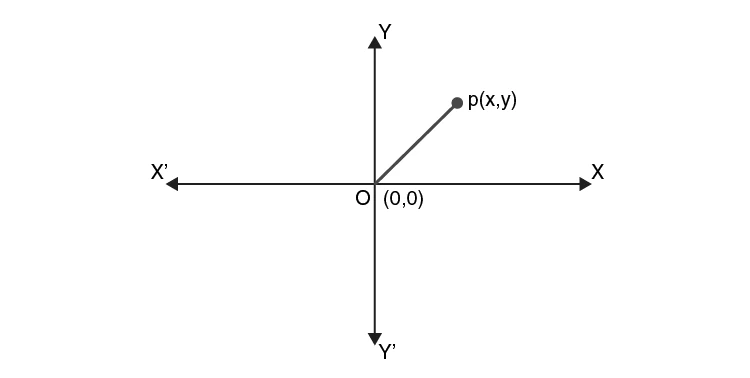
For instance, the complex number \(2 + 3i\) is represented by the point \((2, 3)\), while \(-3 + 2i\) corresponds to \((-3, 2)\). Complex numbers purely imaginary, such as \(0 + ai\), lie on the imaginary axis, and purely real numbers like \(a + 0i\) lie on the real axis.
The distance from the origin \((0,0)\) to the point \((x,y)\) on the Argand plane is the modulus of the complex number, calculated as \(\sqrt{x^2 + y^2}\).
Reflection and Conjugates in the Argand Plane
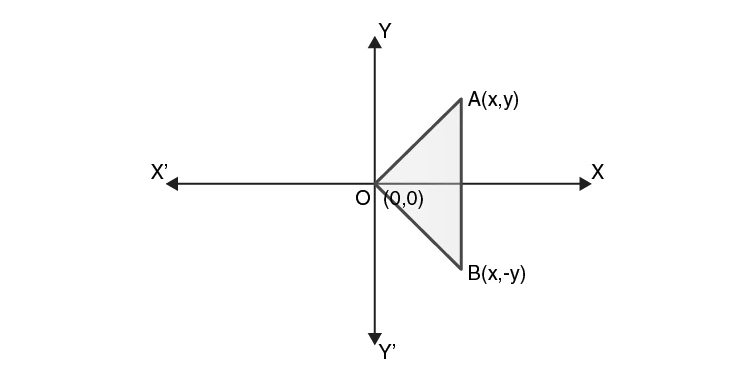
The conjugate of a complex number \(z = x + iy\) is given by \(\overline{z} = x - iy\). Geometrically, this corresponds to reflecting the point \((x, y)\) across the real axis to \((x, -y)\).
Example: Calculating the Distance of a Complex Number from the Origin
Find the distance between the complex number \(z = 4 - 5i\) and the origin on the Argand plane.
Solution:
The distance from the origin to the point representing \(z\) is the modulus of \(z\):
\[ |z| = \sqrt{4^2 + (-5)^2} = \sqrt{16 + 25} = \sqrt{41} \]
Thus, the distance is \(\sqrt{41}\) units.
Expressing Complex Numbers in Polar Coordinates
Converting Cartesian Form to Polar Form
Every non-zero complex number \(z = x + iy\) can also be described using polar coordinates. In this representation, the point corresponding to \(z\) is located by its distance \(r\) from the origin and the angle \(\theta\) it makes with the positive real axis.
Here, \(r\) is the modulus of \(z\), given by \(r = \sqrt{x^2 + y^2}\), and \(\theta\) is the argument (or amplitude) of \(z\), denoted as \(\arg z\). The coordinates relate as:
\[ x = r \cos \theta, \quad y = r \sin \theta \]
Thus, the complex number can be rewritten as:
\[ z = r(\cos \theta + i \sin \theta) \]
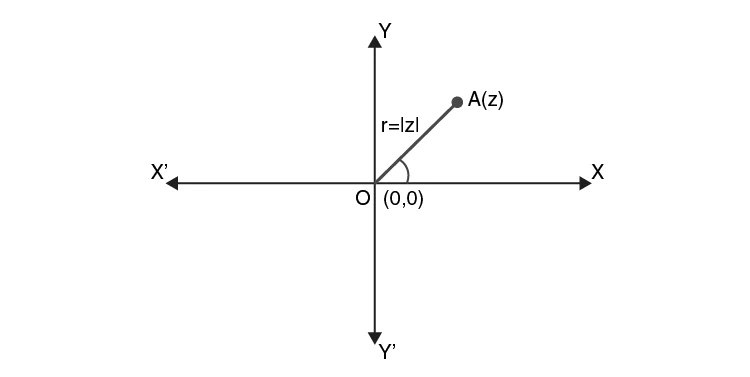
The angle \(\theta\) is usually taken in the interval \([0, 2\pi)\). Alternatively, the principal argument can be defined in \(-\pi < \theta \leq \pi\).
Converting a Complex Number to Polar Form: An Example
Example: Expressing \(z = 1 + \sqrt{3}i\) in Polar Form
Solution:
Given \(z = 1 + \sqrt{3}i\), identify \(x = 1\) and \(y = \sqrt{3}\).
Calculate the modulus:
\[ r = \sqrt{1^2 + (\sqrt{3})^2} = \sqrt{1 + 3} = \sqrt{4} = 2 \]
Find the argument \(\theta\):
\[ \cos \theta = \frac{x}{r} = \frac{1}{2}, \quad \sin \theta = \frac{y}{r} = \frac{\sqrt{3}}{2} \]
These values correspond to \(\theta = \frac{\pi}{3}\).
Therefore, the polar form is:
\[ z = 2 \left( \cos \frac{\pi}{3} + i \sin \frac{\pi}{3} \right) \]
Key Concepts and Summary of Complex Number Representations
| Concept | Description | Formula / Note |
|---|---|---|
| Real Axis | Horizontal axis representing the real part of complex numbers | Corresponds to \(x\) in \(x + iy\) |
| Imaginary Axis | Vertical axis representing the imaginary part | Corresponds to \(y\) in \(x + iy\) |
| Modulus | Distance from origin to the point representing the complex number | \(|z| = \sqrt{x^2 + y^2}\) |
| Conjugate | Reflection of the complex number across the real axis | \(\overline{z} = x - iy\) |
| Argument | Angle made with the positive real axis | \(\theta = \arg z\), usually in \([0, 2\pi)\) |
| Polar Form | Representation using modulus and argument | \(z = r(\cos \theta + i \sin \theta)\) |
| Purely Real Number | Complex number with zero imaginary part | Points on real axis: \(a + 0i\) |
| Purely Imaginary Number | Complex number with zero real part | Points on imaginary axis: \(0 + ai\) |
| Principal Argument | Argument restricted to \(-\pi < \theta \leq \pi\) | Used for unique angle representation |
| Origin (Pole) | Reference point for modulus and argument | Coordinates \((0,0)\) |
Glossary of Important Terms
| Term | Definition |
|---|---|
| Argand Plane | A two-dimensional plane used to represent complex numbers graphically. |
| Real Axis | The horizontal axis representing the real part of complex numbers. |
| Imaginary Axis | The vertical axis representing the imaginary part of complex numbers. |
| Modulus | The distance of a complex number from the origin in the Argand plane. |
| Argument | The angle a complex number makes with the positive real axis. |
| Conjugate | The complex number obtained by changing the sign of the imaginary part. |
| Polar Coordinates | A coordinate system where points are determined by distance and angle from the origin. |
| Principal Argument | The unique value of the argument restricted to \(-\pi < \theta \leq \pi\). |
| Modulus-Argument Form | Another name for the polar form of a complex number. |
| Origin (Pole) | The reference point \((0,0)\) in the Argand plane. |
Frequently Asked Questions
What does the Argand plane represent?
The Argand plane is a graphical representation of complex numbers, where the horizontal axis shows the real part and the vertical axis shows the imaginary part.
How is the modulus of a complex number calculated?
The modulus is the distance from the origin to the point representing the complex number, calculated as \(|z| = \sqrt{x^2 + y^2}\).
What is the geometric meaning of the conjugate of a complex number?
The conjugate reflects the point representing the complex number across the real axis, changing the sign of the imaginary part.
How do you convert a complex number to polar form?
Find the modulus \(r = \sqrt{x^2 + y^2}\) and the argument \(\theta = \tan^{-1}(y/x)\), then express as \(z = r(\cos \theta + i \sin \theta)\).
What is the principal argument of a complex number?
It is the unique angle \(\theta\) representing the argument of a complex number, restricted to the interval \(-\pi < \theta \leq \pi\).