Comprehensive Guide to Evaluating Limits in Algebra
Fundamental Properties of Limits
Understanding Limit Operations and Their Rules
Limits play a crucial role in algebra, especially when dealing with functions whose values approach a specific point. When two functions, say \( A(x) \) and \( B(x) \), have limits as \( x \) approaches a point \( p \), denoted by \( l = \lim_{x \to p} A(x) \) and \( m = \lim_{x \to p} B(x) \), several important properties govern their combined limits.
These properties allow us to simplify complex limit expressions by breaking them down into sums, products, quotients, and compositions of limits, provided the individual limits exist and certain conditions are met.
Example: Suppose \( \lim_{x \to 2} A(x) = 3 \) and \( \lim_{x \to 2} B(x) = 5 \). Find the limit of \( (A + B)(x) \) as \( x \to 2 \).
Solution: Using the sum rule,
\[ \lim_{x \to 2} (A + B)(x) = \lim_{x \to 2} A(x) + \lim_{x \to 2} B(x) = 3 + 5 = 8 \]
Key rules include:
Sum/Difference: \( \lim_{x \to p} (A \pm B)(x) = l \pm m \)
Product: \( \lim_{x \to p} (A \times B)(x) = l \times m \)
Quotient: \( \lim_{x \to p} \frac{A(x)}{B(x)} = \frac{l}{m} \), provided \( m \neq 0 \)
Constant Multiple: \( \lim_{x \to p} k A(x) = k l \), where \( k \) is constant
Absolute Value: \( \lim_{x \to p} |A(x)| = |l| \)
Power: \( \lim_{x \to p} A(x)^{B(x)} = l^m \)
Composition: If \( A \) is continuous at \( m \), then \( \lim_{x \to p} A(B(x)) = A(m) \)

Illustration of limit properties for functions \( A(x) \) and \( B(x) \)
Evaluating Limits Using Various Techniques
Direct Substitution and Algebraic Manipulations
One of the simplest methods to find a limit is by directly substituting the value of \( x \) into the function, provided the function is defined at that point and the denominator is not zero. When direct substitution leads to indeterminate forms like \( \frac{0}{0} \), algebraic techniques such as factorization and rationalization become essential.
These methods help simplify the expression to a form where substitution becomes possible.
Example: Evaluate \( \lim_{x \to 3} \frac{x^2 - 9}{x - 3} \).
Solution: Direct substitution yields \( \frac{9 - 9}{3 - 3} = \frac{0}{0} \), an indeterminate form. Factorize numerator:
\[ \frac{x^2 - 9}{x - 3} = \frac{(x - 3)(x + 3)}{x - 3} \]
Cancel \( (x - 3) \) terms:
\[ = x + 3 \]
Now substitute \( x = 3 \):
\[ \lim_{x \to 3} (x + 3) = 3 + 3 = 6 \]
Standard Limits and Their Applications
Several standard limits serve as foundational tools for evaluating more complex limits. Familiarity with these helps in quickly resolving limits involving trigonometric, exponential, and logarithmic functions.
Some key standard limits include:
\( \lim_{x \to a} \frac{x^n - a^n}{x - a} = n a^{n-1} \)
\( \lim_{x \to 0} \sin x = 0 \)
\( \lim_{x \to 0} \frac{\sin x}{x} = 1 \)
\( \lim_{x \to 0} \frac{1 - \cos x}{x} = 0 \)
\( \lim_{x \to 0} \frac{\sin^{-1} x}{x} = 1 \)
\( \lim_{x \to 0} e^x = 1 \)
\( \lim_{x \to \infty} \left(1 + \frac{1}{x}\right)^x = e \)
Graphical depiction of standard limits involving trigonometric and exponential functions
Advanced Limit Concepts: Limits at Infinity and the Squeeze Theorem
Evaluating Limits as \( x \to \infty \)
Limits at infinity describe the behavior of functions as the input grows without bound. Often, these limits can be transformed by substituting \( y = \frac{1}{x} \), converting the problem into a limit as \( y \to 0 \).
For example, since \( \lim_{x \to +\infty} \frac{1}{x} = 0 \), we can analyze limits at infinity by examining the function's behavior near zero.
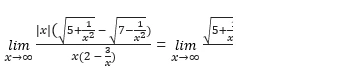
Example: Find \( \lim_{x \to \infty} \frac{\sqrt{6x^2 + 2} - \sqrt{8x^2 - 3}}{3x - 4} \).
Solution: Divide numerator and denominator by \( x \):
\[ \lim_{x \to \infty} \frac{\sqrt{6 + \frac{2}{x^2}} - \sqrt{8 - \frac{3}{x^2}}}{3 - \frac{4}{x}} \]
As \( x \to \infty \), terms with \( \frac{1}{x} \) vanish:
\[ = \frac{\sqrt{6} - \sqrt{8}}{3} = \frac{\sqrt{6} - 2\sqrt{2}}{3} \]
Using the Squeeze (Sandwich) Theorem
When direct algebraic methods fail, the squeeze theorem helps by bounding a function between two others whose limits are known and equal at a point. If \( f(x) \leq g(x) \leq h(x) \) near \( x = a \), and \( \lim_{x \to a} f(x) = \lim_{x \to a} h(x) = L \), then \( \lim_{x \to a} g(x) = L \).
Example: Calculate \( \lim_{x \to \infty} \frac{x - 4 \sin x}{-4x - 6} \).
Solution: Since \( \sin x \) oscillates between -1 and 1,
\[ -1 \leq \sin x \leq 1 \implies -4 \leq 4 \sin x \leq 4 \]
Adding \( x \) to all parts:
\[ x - 4 \leq x - 4 \sin x \leq x + 4 \]
Dividing by \( -4x - 6 \) (negative for large \( x \), so inequalities reverse):
\[ \frac{x + 4}{-4x - 6} \leq \frac{x - 4 \sin x}{-4x - 6} \leq \frac{x - 4}{-4x - 6} \]
Taking limits as \( x \to \infty \):
\[ \lim_{x \to \infty} \frac{x + 4}{-4x - 6} = \lim_{x \to \infty} \frac{x - 4}{-4x - 6} = -\frac{1}{4} \]
By squeeze theorem,
\[ \lim_{x \to \infty} \frac{x - 4 \sin x}{-4x - 6} = -\frac{1}{4} \]
Quick Reference: Essential Limit Formulas and Properties
Concept | Formula / Property |
|---|---|
Sum/Difference of Limits | \( \lim_{x \to p} (A \pm B)(x) = \lim_{x \to p} A(x) \pm \lim_{x \to p} B(x) \) |
Product of Limits | \( \lim_{x \to p} (A \times B)(x) = \lim_{x \to p} A(x) \times \lim_{x \to p} B(x) \) |
Quotient of Limits | \( \lim_{x \to p} \frac{A(x)}{B(x)} = \frac{\lim_{x \to p} A(x)}{\lim_{x \to p} B(x)} \), if denominator limit \( \neq 0 \) |
Constant Multiple | \( \lim_{x \to p} k A(x) = k \lim_{x \to p} A(x) \) |
Absolute Value | \( \lim_{x \to p} |A(x)| = |\lim_{x \to p} A(x)| \) |
Power of Limits | \( \lim_{x \to p} A(x)^{B(x)} = (\lim_{x \to p} A(x))^{\lim_{x \to p} B(x)} \) |
Composition of Limits | If \( A \) continuous at \( m \), \( \lim_{x \to p} A(B(x)) = A(m) \) |
Standard Limit | \( \lim_{x \to 0} \frac{\sin x}{x} = 1 \) |
Limit at Infinity | \( \lim_{x \to \infty} \left(1 + \frac{1}{x}\right)^x = e \) |
Squeeze Theorem | If \( f(x) \leq g(x) \leq h(x) \) and \( \lim_{x \to a} f(x) = \lim_{x \to a} h(x) = L \), then \( \lim_{x \to a} g(x) = L \) |
Glossary of Key Terms
Term | Definition |
|---|---|
Limit | The value a function approaches as the input approaches a certain point. |
Indeterminate Form | An expression like \( \frac{0}{0} \) that does not directly determine a limit. |
Factorization | Breaking down an expression into products of simpler expressions. |
Rationalization | Multiplying numerator and denominator by a conjugate to simplify expressions. |
Standard Limits | Commonly known limits used as references for evaluating other limits. |
Squeeze Theorem | A method to find limits by bounding a function between two others with the same limit. |
Continuity | A function is continuous at a point if its limit equals the function's value there. |
Composition of Functions | Applying one function to the result of another function. |
Limit at Infinity | The behavior of a function as the input grows without bound. |
Direct Substitution | Evaluating a limit by plugging the point directly into the function. |
Frequently Asked Questions
How is the sum of limits of two functions determined?
The sum of the limits of two functions equals the limit of their sum, provided both individual limits exist.
What is the rule for the product of limits?
The limit of the product of two functions is the product of their limits, assuming both limits exist.
When can the quotient of limits be used?
The quotient of limits applies if the limit of the denominator is not zero; then the limit of the quotient equals the quotient of the limits.
What is the value of \( \lim_{x \to 0} \frac{\tan x}{x} \)?
This limit equals 1, a standard trigonometric limit.
How does the squeeze theorem help in limit evaluation?
It allows finding the limit of a function trapped between two others with the same limit at a point, even if direct methods fail.