Understanding Zero Order Reactions in Chemical Kinetics
Fundamentals of Zero Order Reaction Kinetics
Mathematical Description and Rate Expression
In zero order reactions, the reaction rate remains constant regardless of changes in the reactant concentration. This means the rate is independent of the concentration of the reactant species involved. The rate can be expressed as:
\[ \text{Rate} = -\frac{d[A]}{dt} = k \]
Here, \(k\) is the rate constant, and \([A]\) represents the concentration of the reactant at time \(t\). This differential equation can be rearranged and integrated to find the concentration of the reactant at any time:
Multiplying both sides by \(-dt\), we get:
\[ d[A] = -k\,dt \]
Integrating from the initial concentration \([A]_0\) at \(t=0\) to \([A]\) at time \(t\):
\[ \int_{[A]_0}^{[A]} d[A] = -\int_0^t k\,dt \]
Solving the integrals yields the integrated rate law:
\[ [A] = [A]_0 - kt \]
This equation allows calculation of the reactant concentration at any given time during the reaction.
Example Problem
A zero order reaction starts with an initial reactant concentration of 0.80 mol/L. If the rate constant \(k\) is \(0.025 \text{ mol L}^{-1} \text{s}^{-1}\), calculate the concentration after 20 seconds.
Solution:
Using the integrated rate law:
\[ [A] = [A]_0 - kt = 0.80 - (0.025)(20) = 0.80 - 0.50 = 0.30 \text{ mol/L} \]
Therefore, after 20 seconds, the reactant concentration is \(0.30 \text{ mol/L}\).
Graphical Representation of Zero Order Reactions
Plotting Concentration Versus Time
The integrated rate law for zero order reactions can be rearranged to resemble the equation of a straight line:
\[ [A] = -kt + [A]_0 \]
Here, plotting \([A]\) against time \(t\) produces a straight line with a slope of \(-k\) and a y-intercept of \([A]_0\). This linear relationship is a key characteristic of zero order kinetics and helps in determining the rate constant experimentally.
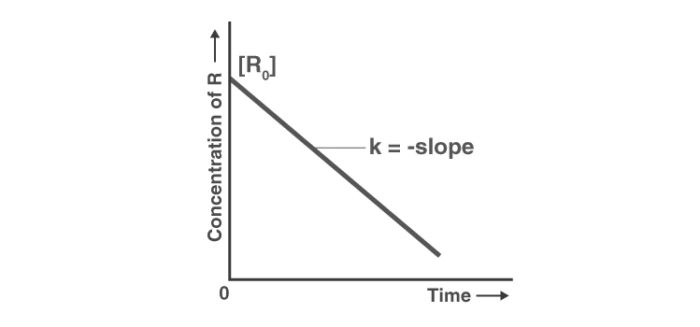
Linear plot of reactant concentration versus time for a zero order reaction
Example Problem
A zero order reaction has an initial concentration of 1.2 mol/L and a rate constant of \(0.04 \text{ mol L}^{-1} \text{s}^{-1}\). Sketch the concentration at 0, 10, and 20 seconds and determine the slope of the graph.
Solution:
At \(t=0\), \([A] = 1.2 \text{ mol/L}\)
At \(t=10\), \([A] = 1.2 - 0.04 \times 10 = 0.8 \text{ mol/L}\)
At \(t=20\), \([A] = 1.2 - 0.04 \times 20 = 0.4 \text{ mol/L}\)
The slope of the line is \(-k = -0.04 \text{ mol L}^{-1} \text{s}^{-1}\).
Determining Half-Life in Zero Order Reactions
Calculating the Time for 50% Reactant Consumption
The half-life (\(t_{1/2}\)) of a reaction is the time required for the reactant concentration to reduce to half its initial value. For zero order reactions, the half-life depends on both the initial concentration and the rate constant, unlike first order reactions where it is constant.
Starting from the integrated rate law:
\[ [A] = [A]_0 - kt \]
At half-life, \([A] = \frac{1}{2}[A]_0\), so substituting:
\[ \frac{1}{2}[A]_0 = [A]_0 - k t_{1/2} \]
Rearranging to solve for \(t_{1/2}\):
\[ k t_{1/2} = \frac{1}{2}[A]_0 \implies t_{1/2} = \frac{[A]_0}{2k} \]
This shows that the half-life increases with higher initial concentration and decreases with a larger rate constant.
Example Problem
For a zero order reaction with an initial concentration of 0.60 mol/L and a rate constant of \(0.03 \text{ mol L}^{-1} \text{s}^{-1}\), calculate the half-life.
Solution:
\[ t_{1/2} = \frac{[A]_0}{2k} = \frac{0.60}{2 \times 0.03} = \frac{0.60}{0.06} = 10 \text{ seconds} \]
The half-life of the reaction is 10 seconds.
Common Examples of Zero Order Reactions
Real-World Reactions Exhibiting Zero Order Kinetics
Zero order reactions often occur when a catalyst is saturated with reactants, making the rate independent of reactant concentration. Some typical examples include:
Photochemical reaction between hydrogen and chlorine gases:
\[ H_2(g) + Cl_2(g) \xrightarrow{hv} 2HCl(g) \]
Thermal decomposition of nitrous oxide on a heated platinum surface:
\[ 2N_2O \xrightarrow{Pt(hot)} 2N_2 + O_2 \]
Iodination of acetone in an acidic medium:
\[ CH_3COCH_3 + I_2 \xrightarrow{H^+} ICH_2COCH_3 + HI \]
In these reactions, the catalyst surface becomes saturated, causing the reaction rate to remain constant regardless of reactant concentration changes.
Catalyst surface saturation leading to zero order kinetics
Note: The unit of the rate constant \(k\) in zero order reactions is concentration per unit time, typically expressed as \(\text{mol L}^{-1} \text{s}^{-1}\) or M/s.
Quick Reference: Key Points on Zero Order Reactions
Aspect | Details |
|---|---|
Rate Law | \(\text{Rate} = k\) (independent of reactant concentration) |
Integrated Rate Equation | \([A] = [A]_0 - kt\) |
Graph | Linear plot of \([A]\) vs. \(t\) with slope \(-k\) |
Half-Life | \(t_{1/2} = \frac{[A]_0}{2k}\) (depends on initial concentration) |
Units of \(k\) | \(\text{mol L}^{-1} \text{s}^{-1}\) or M/s |
Typical Examples | Photochemical reactions, catalytic surface reactions |
Effect of Concentration | No effect on rate |
Glossary of Important Terms
Term | Definition |
|---|---|
Zero Order Reaction | A reaction whose rate is independent of reactant concentration. |
Rate Constant (k) | A proportionality constant in the rate law with units of concentration/time for zero order. |
Integrated Rate Law | Equation relating reactant concentration to time during the reaction. |
Half-Life (\(t_{1/2}\)) | Time taken for the reactant concentration to reduce to half its initial value. |
Catalyst Saturation | Condition where catalyst surface is fully occupied, causing zero order kinetics. |
Photochemical Reaction | Reaction initiated or accelerated by light energy. |
Concentration | Amount of substance per unit volume, usually in mol/L. |
Reaction Rate | Speed at which reactants are converted to products. |
Graph Slope | Rate constant \(k\) represented as the slope in zero order concentration-time graph. |
Decomposition Reaction | A reaction where a compound breaks down into simpler substances. |
Frequently Asked Questions (FAQs)
What defines a zero order reaction?
A zero order reaction is characterized by a reaction rate that remains constant and does not depend on the concentration of the reactants.
What are the units of the rate constant in zero order kinetics?
For zero order reactions, the rate constant \(k\) has units of concentration per time, such as \(\text{mol L}^{-1} \text{s}^{-1}\) or M/s.
How can you identify a zero order reaction experimentally?
If increasing the reactant concentration does not change the reaction rate, and the plot of concentration versus time is linear with a negative slope, the reaction is zero order.
Does the half-life of a zero order reaction depend on concentration?
Yes, unlike first order reactions, the half-life in zero order reactions depends on the initial concentration and rate constant, given by \(t_{1/2} = \frac{[A]_0}{2k}\).
Are zero order reactions generally fast or slow?
Zero order reactions can vary in speed, but their rate is unaffected by changes in reactant concentration, often controlled by catalyst saturation or surface processes.