Understanding the Transformations of Matter
Fundamentals of Matter's Phase Transitions
Defining Physical State Changes
When matter shifts from one physical form to another without altering its chemical identity, it undergoes a physical state change. These transformations are reversible and include processes such as melting, freezing, sublimation, deposition, condensation, and vaporization. Such changes are driven primarily by energy exchange, typically in the form of heat, which affects the motion and arrangement of particles.
As substances absorb heat, their particles gain kinetic energy, moving more vigorously and potentially breaking intermolecular forces to change state. Conversely, releasing heat slows particles, allowing them to settle into more ordered structures.
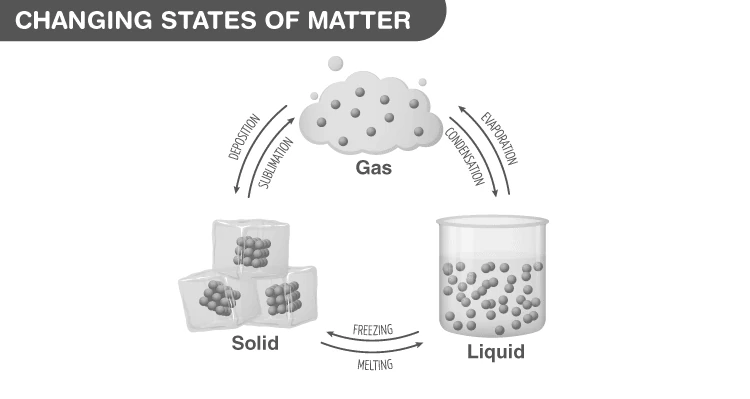
Illustration showing different states of matter and their transformations
Example: A block of wax melts when heated. Explain why this is a physical change and not a chemical one.
Solution:
The wax changes from solid to liquid due to heat absorption.
No new substances are formed; the chemical composition remains the same.
The process is reversible by cooling, which solidifies the wax again.
Causes Behind Phase Transitions
Phase changes occur primarily due to variations in temperature or pressure. Increasing temperature supplies energy to particles, enhancing their movement and weakening intermolecular attractions. This can cause solids to melt or liquids to vaporize. Conversely, lowering temperature reduces particle energy, allowing them to form more rigid arrangements, such as freezing liquids into solids.
Pressure changes also influence particle proximity and interactions, affecting the state of matter. For example, increasing pressure can force gases into liquids or solids.
Example: Why does water freeze at 0°C under normal atmospheric pressure but at a lower temperature at higher altitudes?
Solution:
At higher altitudes, atmospheric pressure is lower.
Lower pressure reduces the freezing point of water.
Thus, water requires a colder temperature to freeze at high altitudes.
Transformations Between Solid and Liquid Phases
Process of Freezing
Freezing is the transition where a liquid becomes a solid as it loses heat. When a liquid cools, its particles lose kinetic energy and slow down, allowing intermolecular forces to lock them into fixed positions. This results in a solid structure. The temperature at which this occurs is called the freezing point.
For example, water turns into ice when cooled below 0°C under standard pressure. The energy loss prevents particles from sliding past each other, solidifying the substance.
Example: A 150 g sample of water at 5°C is placed in a freezer at -10°C. Calculate the heat lost when the water freezes completely.
Given: Specific heat capacity of water \( c = 4.18 \text{ J/g°C} \), latent heat of fusion of ice \( L_f = 334 \text{ J/g} \).
Solution:
Step 1: Cool water from 5°C to 0°C:
\[ Q_1 = m c \Delta T = 150 \times 4.18 \times (0 - 5) = -3135 \text{ J} \]
Step 2: Freeze water at 0°C:
\[ Q_2 = m L_f = 150 \times 334 = 50100 \text{ J} \]
Total heat lost:
\[ Q_{total} = Q_1 + Q_2 = -3135 + (-50100) = -53235 \text{ J} \]
The negative sign indicates heat is released.
Melting Explained
Melting is the change from solid to liquid when a substance absorbs heat. As heat energy increases, particles vibrate more intensely, weakening the forces holding them in place. Once enough energy is absorbed to overcome these forces, the solid becomes a liquid. The temperature at which this occurs is the melting point.
For instance, ice melts at 0°C under normal pressure, turning into liquid water.
Ice cubes melting into liquid water
Example: Calculate the heat required to melt 200 g of ice at 0°C.
Given: Latent heat of fusion of ice \( L_f = 334 \text{ J/g} \).
Solution:
\[ Q = m L_f = 200 \times 334 = 66800 \text{ J} \]
This is the energy needed to convert ice at 0°C to water at 0°C without temperature change.
Transitions Between Liquid and Gas States
Vaporization Process
Vaporization is the transformation of a liquid into a gas when particles gain sufficient energy to break free from intermolecular forces. This can occur via evaporation at the surface or boiling throughout the liquid. The boiling point is the temperature at which vaporization happens rapidly.
For example, water boils at 100°C at standard atmospheric pressure, producing steam.
Example: How much heat is needed to convert 500 g of water at 100°C to steam at 100°C?
Given: Latent heat of vaporization of water \( L_v = 2260 \text{ J/g} \).
Solution:
\[ Q = m L_v = 500 \times 2260 = 1,130,000 \text{ J} \]
This energy is required to change water to steam without temperature change.
Condensation Explained
Condensation is the reverse of vaporization, where gas particles lose energy and transition into liquid form. When warm vapor contacts a cooler surface, it cools down, and particles slow enough to rejoin as liquid droplets. This process is commonly observed as fogging on mirrors after a hot shower.
Water droplets formed by condensation on a cold surface
Example: Explain why condensation forms on a cold glass when warm air contacts it.
Solution:
Warm air contains water vapor with high kinetic energy.
When it touches the cold glass, vapor loses heat and slows down.
Particles cluster together, forming liquid droplets on the glass surface.
Direct Changes Between Solid and Gas Phases
Sublimation Phenomenon
Sublimation is a unique phase change where a solid transforms directly into a gas without passing through the liquid phase. This occurs when the solid absorbs enough energy to overcome intermolecular forces completely. The reverse process, deposition, involves gas turning directly into solid.
Dry ice (solid carbon dioxide) is a classic example, sublimating at room temperature and pressure.
Dry ice undergoing sublimation
Example: Describe why dry ice sublimates instead of melting under normal conditions.
Solution:
Dry ice has a sublimation point at -78.5°C at atmospheric pressure.
At room temperature, it absorbs heat and changes directly to gas.
The pressure and temperature conditions prevent it from becoming liquid.
Summary of Key Phase Changes
Transition | Definition | Typical Example | Characteristic Temperature |
|---|---|---|---|
Melting | Solid to liquid | Ice to water | Melting point (e.g., 0°C for water) |
Freezing | Liquid to solid | Water to ice | Freezing point (e.g., 0°C for water) |
Evaporation/Vaporization | Liquid to gas | Boiling water to steam | Boiling point (e.g., 100°C for water) |
Condensation | Gas to liquid | Steam to water droplets | Below boiling point |
Sublimation | Solid to gas directly | Dry ice to CO₂ gas | Depends on substance (e.g., -78.5°C for dry ice) |
Glossary of Important Terms
Term | Meaning |
|---|---|
Freezing Point | The temperature at which a liquid turns into a solid. |
Melting Point | The temperature at which a solid becomes a liquid. |
Boiling Point | The temperature at which a liquid changes to gas throughout the liquid. |
Vaporization | The process of liquid turning into gas. |
Condensation | The process of gas turning into liquid. |
Sublimation | Direct transition from solid to gas without becoming liquid. |
Deposition | Direct transition from gas to solid without becoming liquid. |
Latent Heat | Energy absorbed or released during a phase change without temperature change. |
Specific Heat Capacity | Amount of heat required to raise the temperature of 1 gram of a substance by 1°C. |
Phase | A distinct form of matter such as solid, liquid, or gas. |
Frequently Asked Questions
What happens to solids when they reach their melting point?
At the melting point, solids absorb enough heat to break intermolecular bonds and transform into liquids without changing their chemical composition.
How is the boiling point defined?
The boiling point is the temperature at which a liquid's vapor pressure equals the external pressure, causing it to change into gas throughout the liquid.
What is the significance of the melting point?
The melting point indicates the temperature at which a solid becomes a liquid, marking the energy required to overcome solid-state forces.
Which process describes solids turning directly into gases?
This process is called sublimation, where solids bypass the liquid phase and become gases directly upon absorbing sufficient energy.
How does evaporation differ from boiling?
Evaporation occurs at the surface of a liquid at temperatures below boiling, while boiling happens throughout the liquid at its boiling point.