Fundamentals and Applications of Surface Chemistry
Understanding Surface Chemistry and Its Significance
Defining Surface Chemistry and Its Scope
Surface chemistry explores the chemical processes that take place at the boundary between two phases, such as solid-liquid, solid-gas, or liquid-gas interfaces. This branch of chemistry is crucial for understanding phenomena that occur on the surfaces of materials, which have practical implications in both industrial applications and everyday life.
Key surface phenomena include adsorption, heterogeneous catalysis, corrosion, and crystallization, all of which influence the behavior and properties of materials.
Example: Activated charcoal adsorbs gases like oxygen and nitrogen on its surface, demonstrating a common surface chemistry process.
Exploring Adsorption and Its Varieties
Role and Mechanism of Adsorption
Adsorption refers to the accumulation of molecules or atoms (adsorbate) on the surface of a solid or liquid (adsorbent) due to intermolecular forces. This process is fundamental in surface chemistry and is widely utilized in purification, catalysis, and sensor technologies.
The heat released during adsorption per mole of gas on a unit surface area is termed the enthalpy of adsorption, which varies depending on the type of adsorption.
Example: When hydrogen gas is adsorbed onto a metal catalyst surface, heat is released, indicating an exothermic adsorption process.
Distinguishing Physical and Chemical Adsorption
Adsorption is classified into two main types based on the nature of forces involved:
Physical Adsorption (Physisorption): Involves weak van der Waals forces, is generally reversible, non-specific, and can form multiple layers. The enthalpy of adsorption ranges from 20 to 40 kJ/mol.
Chemical Adsorption (Chemisorption): Involves strong chemical bonds, is highly specific, usually irreversible, and forms a single molecular layer. The enthalpy of adsorption is significantly higher, between 40 and 400 kJ/mol.
Example: Oxygen molecules physically adsorb on activated charcoal with low heat release, whereas hydrogen forms chemical bonds on a metal catalyst surface with higher heat release.
Influence of Pressure and Temperature on Adsorption
Pressure Effects on Gas Adsorption
The amount of gas adsorbed on a solid surface generally increases with pressure until saturation is reached, beyond which no further adsorption occurs. This relationship is crucial for designing adsorption-based separation and purification systems.
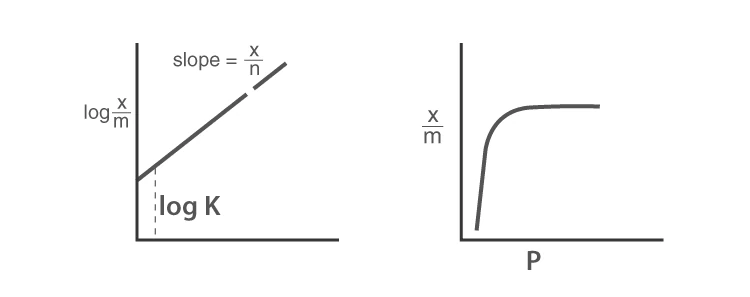
Variation of gas adsorption with pressure
Example: At 25°C, nitrogen gas adsorption on activated charcoal increases with pressure up to 2 atm, after which it plateaus, indicating saturation of adsorption sites.
Temperature Effects on Adsorption Behavior
Since adsorption is exothermic, increasing temperature generally reduces physical adsorption due to Le Chatelier's principle. However, chemisorption may initially increase with temperature due to activation energy requirements before decreasing at higher temperatures.
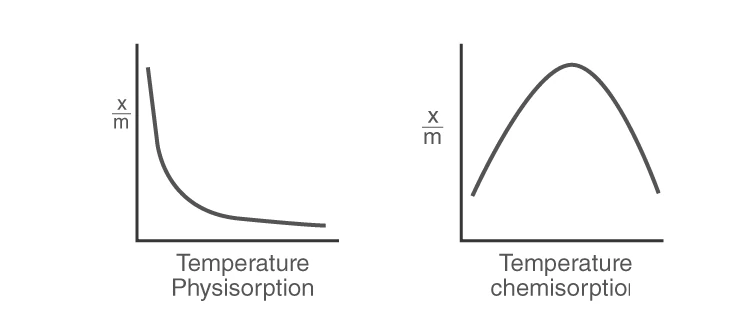
Effect of temperature on adsorption at constant pressure
Example: Carbon monoxide chemisorption on a metal surface increases up to 150°C and then declines as temperature rises further.
Adsorption Isotherms and Their Applications
Freundlich Adsorption Isotherm
The Freundlich isotherm describes adsorption on heterogeneous surfaces and is expressed as:
\[ \frac{x}{m} = K P^{1/n} \]
where \( x \) is the mass of adsorbate, \( m \) is the mass of adsorbent, \( P \) is the pressure, and \( K \), \( n \) are constants. Taking logarithms,
\[ \log \frac{x}{m} = \frac{1}{n} \log P + \log K \]
This model is valid at low to moderate pressures but fails at high pressures where adsorption saturates.
Example: For a gas adsorbed on activated charcoal, if \( K = 0.5 \) and \( n = 2 \), calculate \( \frac{x}{m} \) at \( P = 0.8 \text{ atm} \).
Solution:
\[ \frac{x}{m} = 0.5 \times (0.8)^{1/2} = 0.5 \times 0.894 = 0.447 \text{ units} \]
Langmuir Adsorption Isotherm
This model assumes monolayer adsorption on a uniform surface with no interaction between adsorbed molecules. It is represented as:
\[ \theta = \frac{K P}{1 + K P} \]
where \( \theta \) is the fraction of surface coverage and \( K \) is the adsorption equilibrium constant.
Example: If \( K = 3 \text{ atm}^{-1} \) and pressure \( P = 0.2 \text{ atm} \), find the surface coverage \( \theta \).
Solution:
\[ \theta = \frac{3 \times 0.2}{1 + 3 \times 0.2} = \frac{0.6}{1.6} = 0.375 \]
Emulsions: Types and Practical Uses
Nature and Classification of Emulsions
Emulsions are colloidal systems where both the dispersed phase and the dispersion medium are liquids. They are commonly found in products like paints, milk, and creams.
Based on the dispersed and continuous phases, emulsions are categorized as:
Oil-in-Water (O/W): Oil droplets dispersed in water, e.g., milk.
Water-in-Oil (W/O): Water droplets dispersed in oil, e.g., vanishing cream.
Emulsions are inherently unstable and require emulsifiers to enhance their stability. For instance, casein in milk acts as a natural emulsifier.
Types of emulsions based on dispersion medium
Example: Identify the type of emulsion in mayonnaise, which consists of oil droplets dispersed in vinegar (water-based).
Answer: Mayonnaise is an oil-in-water emulsion.
Applications of Emulsions in Daily Life and Industry
Emulsions play vital roles in various products and processes, including:
Pharmaceutical syrups
Paint formulations
Toothpaste composition
Fat digestion in biological systems
Pigment and dye manufacturing
Quick Reference: Key Points on Surface Chemistry
Concept | Details |
|---|---|
Surface Chemistry | Study of chemical phenomena at interfaces between phases |
Adsorption | Accumulation of molecules on a surface due to intermolecular forces |
Physisorption | Weak van der Waals forces, reversible, multilayer, enthalpy 20-40 kJ/mol |
Chemisorption | Strong chemical bonds, irreversible, monolayer, enthalpy 40-400 kJ/mol |
Effect of Pressure | Adsorption increases with pressure until saturation |
Effect of Temperature | Physisorption decreases with temperature; chemisorption may increase then decrease |
Freundlich Isotherm | Empirical model for heterogeneous surfaces, valid at low pressure |
Langmuir Isotherm | Monolayer adsorption on uniform surfaces, no interaction between adsorbates |
Emulsions | Colloidal mixtures of two immiscible liquids, stabilized by emulsifiers |
Applications | Used in catalysis, purification, pharmaceuticals, paints, and food products |
Glossary of Important Terms
Term | Definition |
|---|---|
Adsorbate | The substance that accumulates on the surface during adsorption |
Adsorbent | The material on whose surface adsorption occurs |
Physisorption | Adsorption involving weak van der Waals forces |
Chemisorption | Adsorption involving strong chemical bonds |
Enthalpy of Adsorption | Heat released during adsorption per mole of adsorbate |
Monolayer | A single molecular layer adsorbed on a surface |
Emulsion | A colloidal system of two immiscible liquids |
Emulsifier | Substance that stabilizes emulsions by preventing phase separation |
Langmuir Isotherm | Model describing monolayer adsorption on uniform surfaces |
Freundlich Isotherm | Empirical model for adsorption on heterogeneous surfaces |
Frequently Asked Questions
What is surface chemistry?
Surface chemistry studies the chemical reactions and phenomena occurring at the interface between two phases, such as solid-liquid or solid-gas boundaries.
What is the enthalpy range for physical adsorption?
Physical adsorption typically has an enthalpy of adsorption between 20 and 40 kJ/mol, indicating weak interactions.
How does chemical adsorption differ in enthalpy?
Chemisorption involves stronger chemical bonds with enthalpy values ranging from 40 to 400 kJ/mol, reflecting higher energy changes.
Define adsorbate and adsorbent.
The adsorbate is the molecule that accumulates on a surface, while the adsorbent is the material providing the surface for adsorption.
Why are emulsifiers important in emulsions?
Emulsifiers stabilize emulsions by preventing the dispersed droplets from coalescing, thus maintaining the mixture's uniformity.