Understanding Solubility and Its Influencing Factors
Fundamentals of Solubility and Its Quantification
Defining Solubility and Solution Formation
Solubility refers to the highest amount of a solute that can dissolve in a specific volume of solvent at a particular temperature, resulting in a homogeneous mixture called a solution. For instance, when sugar cubes dissolve in tea, the sugar molecules disperse uniformly due to their solubility in the liquid. The solute is the substance that dissolves, which can be solid, liquid, or gas, while the solvent is the medium in which dissolution occurs.
Understanding Solubility Product for Sparingly Soluble Compounds
The solubility product constant, often denoted as \(K_{sp}\), applies to salts that dissolve only slightly in water. It represents the maximum product of the molar concentrations of the dissociated ions, each raised to the power of their stoichiometric coefficients, at equilibrium. At a fixed temperature, \(K_{sp}\) remains constant. A smaller \(K_{sp}\) value indicates lower solubility, whereas a larger value suggests higher solubility.
Example:
Consider a salt \(AB_2\) that dissociates as:
\[ AB_2 (s) \rightleftharpoons A^{2+} (aq) + 2B^- (aq) \]
If the molar solubility of \(AB_2\) is \(s\), then the ion concentrations are:
\[ [A^{2+}] = s, \quad [B^-] = 2s \]
Therefore, the solubility product is:
\[ K_{sp} = [A^{2+}][B^-]^2 = s \times (2s)^2 = 4s^3 \]
If \(K_{sp} = 1.08 \times 10^{-6}\), find the molar solubility \(s\).
Solution:
\[ 4s^3 = 1.08 \times 10^{-6} \implies s^3 = \frac{1.08 \times 10^{-6}}{4} = 2.7 \times 10^{-7} \]
\[ s = \sqrt[3]{2.7 \times 10^{-7}} \approx 6.5 \times 10^{-3} \text{ mol/L} \]
Solubility Characteristics of Liquids Dissolved in Liquids
Mechanism and Quantitative Aspects of Liquid-Liquid Solubility
Water is often called a universal solvent because it dissolves many substances, though some exceptions exist. Solubility in liquids involves the formation of new interactions between solute and solvent molecules. Quantitatively, solubility is expressed as the maximum grams of solute dissolved per litre of solvent at a given temperature. Solutes are classified as soluble if at least 0.1 g dissolves in 100 mL of solvent; otherwise, they are sparingly soluble or insoluble.
Solutions can be saturated, where no more solute dissolves at a given temperature, or supersaturated, where excess solute precipitates out after exceeding solubility limits.
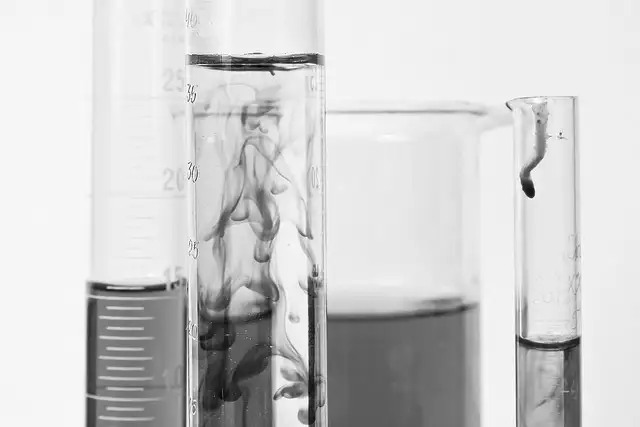
Solubility - Liquids in Liquids
Influences on Liquid Solubility: Temperature, Pressure, and Molecular Forces
The solubility of liquids in liquids depends on several factors:
Temperature: Increasing temperature generally enhances solubility of solids and liquids by providing energy to overcome intermolecular forces. However, gases become less soluble as temperature rises because they tend to escape from the solvent.
Intermolecular Forces: Solubility is favored when solute and solvent have similar polarity and bonding types, summarized by the phrase "like dissolves like." For example, polar solvents like water dissolve polar solutes such as ethanol effectively.
Pressure: Pressure has minimal effect on liquids but significantly affects gases dissolved in liquids.
Example:
At 25°C, 0.15 g of a liquid solute dissolves in 100 mL of water. When temperature is increased to 50°C, the solubility rises to 0.25 g per 100 mL. Calculate the percentage increase in solubility.
Solution:
Initial solubility = 0.15 g/100 mL
Final solubility = 0.25 g/100 mL
Percentage increase = \(\frac{0.25 - 0.15}{0.15} \times 100 = \frac{0.10}{0.15} \times 100 = 66.67\%\)
Behavior of Solid Solutes Dissolving in Liquids
Nature of Solute and Solvent Governing Solid Solubility
The solubility of solids in liquids depends largely on the polarity and chemical nature of both solute and solvent. Polar solids dissolve well in polar solvents like water, while non-polar solids dissolve better in non-polar solvents. This principle is summarized as "like dissolves like." For example, sugar and salt dissolve readily in water, whereas naphthalene does not.
Dissolution involves solute particles dispersing into the solvent, while crystallization is the reverse process where solute particles come out of solution. At equilibrium, these two processes occur at equal rates, maintaining a constant solute concentration known as the solubility at that temperature and pressure.
A solution with maximum dissolved solute is saturated; if more solute can dissolve, it is unsaturated.

Solubility - Solids in Liquids
Temperature and Pressure Effects on Solid Solubility
Temperature influences solid solubility depending on the heat exchange during dissolution:
If dissolution is endothermic, solubility increases with temperature, following Le Chatelier’s Principle.
If dissolution is exothermic, solubility decreases as temperature rises.
Pressure has negligible impact on solid solubility because solids and liquids are nearly incompressible.
Example:
The solubility of a salt increases from 20 g/L at 25°C to 30 g/L at 50°C. Assuming the dissolution is endothermic, explain this observation using Le Chatelier’s Principle.
Answer:
The dissolution absorbs heat (endothermic).
Increasing temperature adds heat to the system.
According to Le Chatelier’s Principle, the equilibrium shifts to absorb the added heat by dissolving more salt.
Hence, solubility increases with temperature.
Gas Solubility in Liquids and Its Dependence on External Conditions
Principles Governing Gas Dissolution in Liquids
Gas solubility in liquids is defined as the maximum amount of gas that can dissolve in a liquid solvent at a specific temperature and pressure. This solubility is influenced strongly by temperature, pressure, and the chemical nature of the gas and solvent. Some gases like ammonia dissolve readily in water, while others like oxygen are only sparingly soluble.

Solubility - Gases in Liquids
Impact of Pressure and Temperature on Gas Solubility
Pressure: Increasing the pressure of a gas above a liquid increases its solubility. This is explained by the dynamic equilibrium between gas molecules entering and leaving the solution. When pressure rises, more gas molecules are forced into the liquid until a new equilibrium is reached.
Henry’s Law quantifies this relationship:
\[ P = K_H x \]
where \(P\) is the partial pressure of the gas, \(x\) is the mole fraction of the gas dissolved, and \(K_H\) is Henry’s law constant.
Temperature: Gas solubility decreases with increasing temperature because gas dissolution is exothermic. According to Le Chatelier’s Principle, raising temperature shifts equilibrium to release gas, reducing solubility.
Example:
At 20°C, the solubility of oxygen in water is 8 mg/L at 1 atm pressure. If the pressure is increased to 3 atm, what is the expected solubility, assuming Henry’s law applies?
Solution:
Since solubility is proportional to pressure:
\[ S_2 = S_1 \times \frac{P_2}{P_1} = 8 \times \frac{3}{1} = 24 \text{ mg/L} \]
Thus, oxygen solubility triples when pressure is tripled.
Quick Reference: Summary of Solubility Concepts
Aspect | Effect on Solubility | Notes |
|---|---|---|
Solubility Product (\(K_{sp}\)) | Constant at fixed temperature | Lower \(K_{sp}\) means less soluble salt |
Temperature (Solids/Liquids) | Generally increases solubility if endothermic | Depends on dissolution enthalpy |
Temperature (Gases) | Increases temperature decreases solubility | Gas dissolution is exothermic |
Pressure (Gases) | Higher pressure increases solubility | Described by Henry’s Law |
Intermolecular Forces | “Like dissolves like” principle | Polar solvents dissolve polar solutes |
Supersaturated Solution | Contains more solute than saturation point | Unstable; solute precipitates out |
Dynamic Equilibrium | Rate of dissolution equals crystallization | Maintains constant solute concentration |
Solubility Units | Expressed in g/L or mol/L | Quantitative measure of solubility |
Effect of Pressure (Solids/Liquids) | Negligible effect | Due to incompressibility |
Supersaturation | Temporary state beyond saturation | Leads to precipitation |
Glossary of Key Terms
Term | Definition |
|---|---|
Solubility | Maximum amount of solute dissolved in solvent at a given temperature |
Solute | Substance dissolved in a solvent |
Solvent | Medium in which solute dissolves |
Solution | Homogeneous mixture of solute and solvent |
Solubility Product (\(K_{sp}\)) | Equilibrium constant for dissociation of sparingly soluble salts |
Saturated Solution | Solution containing maximum dissolved solute at equilibrium |
Supersaturated Solution | Solution with solute concentration beyond saturation, unstable |
Dynamic Equilibrium | State where dissolution and crystallization rates are equal |
Henry’s Law | Relation between gas solubility and partial pressure above solution |
Le Chatelier’s Principle | System shifts equilibrium to counteract changes in conditions |
Frequently Asked Questions
Why is testing solubility important in chemistry?
Solubility tests help identify the polarity, size, and functional groups of compounds by observing their behavior in different solvents, aiding in compound characterization.
What factors primarily determine solubility?
Temperature, pressure, and the nature of solute and solvent molecules, especially their polarity and intermolecular forces, are key determinants of solubility.
How does pH influence solubility?
The pH can affect the ionization state of solutes, altering their solubility. At certain pH levels, solutes may precipitate if they carry no net charge.
Does increasing temperature always increase solubility?
For solids and liquids, solubility often increases with temperature if dissolution is endothermic. However, for gases, solubility typically decreases as temperature rises.
How do temperature and pressure together affect gas solubility?
Higher pressure increases gas solubility by forcing more gas into solution, while higher temperature decreases solubility due to the exothermic nature of gas dissolution.