Understanding Soaps and Detergents: Composition and Cleansing Mechanism
Fundamentals of Soap: Composition and Key Features
Formation and Nature of Soap
Soaps are water-soluble substances produced through a chemical process called saponification. This involves reacting sodium hydroxide or potassium hydroxide with fats or oils derived from plants or animals. The resulting compounds possess both water-attracting and oil-attracting properties, enabling effective cleaning.
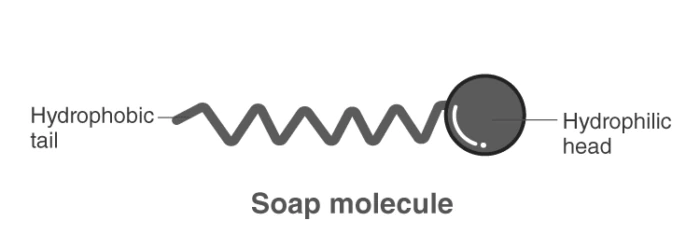
Soap molecules have a long carbon chain with a hydrophobic tail that binds to oils and a hydrophilic head that interacts with water, making them excellent cleansing agents.
Essential Characteristics of Soap
Several properties determine the quality and effectiveness of soap:
- Durability: Soaps with greater hardness form dense bars that last longer during use.
- Cleaning Efficiency: The balance between the oil-attracting and water-attracting parts of the molecule is crucial. Too much or too little cleansing agent can reduce effectiveness.
- Skin Conditioning: Emollients in soap act as conditioners, helping to retain moisture and prevent dryness after washing.
- Lather Production: A desirable soap produces a rich foam, combining cleansing power with a soothing texture.
- Fragrance: Pleasant aromas enhance the washing experience and help mask body odors.
Example Problem
A soap bar contains 70% fatty acid salts and 30% emollients. If a user prefers a soap that balances cleansing and moisturizing, what percentage of the soap is dedicated to conditioning agents?
Solution:
The emollients act as conditioning agents. Given the soap composition:
\[ \text{Conditioning agents} = 30\% \]
Thus, 30% of the soap is responsible for moisturizing and preventing skin dryness, ensuring a balanced cleansing experience.
Detergents: Structure and Functional Properties
Molecular Composition and Surfactant Behavior
Detergents are amphipathic molecules composed of a charged hydrophilic head and a long hydrophobic hydrocarbon tail. This dual nature allows them to reduce water's surface tension, earning them the name surfactants. The hydrophilic head interacts with water, while the hydrophobic tail binds to oils and grease.
These molecules aggregate in water to form micelles, which trap oily dirt inside, facilitating its removal.
Key Properties of Detergents
Understanding detergent behavior involves several important parameters:
- Critical Micelle Concentration (CMC): The minimum concentration at which detergent molecules start forming micelles.
- Aggregation Number: The average count of detergent monomers within a single micelle.
- Micelle Size: Indicated by the molecular weight of the micelle, reflecting its relative size.
- Cloud Point: The temperature at which a detergent solution near or above its CMC separates into two distinct phases.
Example Problem
A detergent solution has a CMC of 0.01 mol/L. If the solution concentration is 0.05 mol/L, explain whether micelles will form and estimate the number of monomers per micelle if the aggregation number is 60.
Solution:
Since the concentration (0.05 mol/L) is greater than the CMC (0.01 mol/L), micelles will form.
The aggregation number indicates each micelle contains approximately 60 monomers.
Therefore, micelles are present and each consists of 60 detergent molecules, enabling effective cleaning action.
Mechanism of Cleaning: How Soaps and Detergents Remove Dirt
Interaction of Soap Molecules with Dirt and Water
Most dirt is oily and does not dissolve in water. Soap molecules, which are sodium or potassium salts of long-chain carboxylic acids, have a hydrophobic tail that dissolves in oil and a hydrophilic head that dissolves in water. This dual affinity allows soap molecules to surround oil droplets, forming spherical structures called micelles.
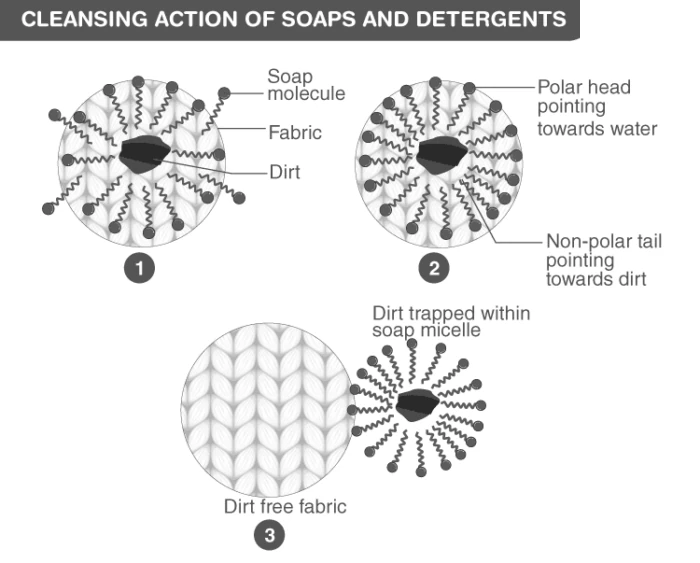
In micelles, the hydrophobic tails point inward towards the oil droplet, while the hydrophilic heads face outward towards the water, creating an emulsion that can be rinsed away easily.
Formation and Role of Micelles in Cleaning
When soap molecules cluster in water, their hydrophobic tails aggregate inside, shielding themselves from water, while the ionic heads remain on the surface. This arrangement forms micelles, which trap oily dirt at the center, allowing it to be washed away as a colloidal solution.
The colloidal nature of micelles causes the soap solution to appear cloudy due to light scattering.
Example Problem
Explain why soap molecules align at the water surface with their hydrophobic tails away from water and how this arrangement aids in cleaning.
Solution:
- The hydrophobic tails repel water and thus orient away from it, aligning along the water surface.
- The hydrophilic heads remain in contact with water, stabilizing the molecule's position.
- This orientation reduces surface tension and allows soap molecules to surround oily dirt, forming micelles.
- Micelles trap oil inside, enabling it to be emulsified and washed away with water.
Quick Reference: Summary of Soaps and Detergents
| Aspect | Soap | Detergent |
|---|---|---|
| Composition | Sodium or potassium salts of fatty acids | Amphipathic molecules with charged hydrophilic heads and hydrocarbon tails |
| Formation Process | Saponification of fats/oils with alkali | Synthetic or natural surfactants |
| Cleaning Mechanism | Forms micelles trapping oily dirt for removal | Forms micelles reducing surface tension and emulsifying dirt |
| Critical Micelle Concentration (CMC) | Not applicable | Defined concentration where micelles form |
| Effect on Water Hardness | Forms scum with hard water | Effective in hard water without scum formation |
Glossary of Key Terms
| Term | Definition |
|---|---|
| Saponification | Chemical reaction producing soap from fats/oils and alkali |
| Amphipathic | Molecules having both hydrophilic and hydrophobic parts |
| Hydrophilic | Water-attracting part of a molecule |
| Hydrophobic | Water-repelling, oil-attracting part of a molecule |
| Micelle | Cluster of soap/detergent molecules trapping oil inside |
| Critical Micelle Concentration (CMC) | Minimum concentration for micelle formation in detergents |
| Aggregation Number | Average number of monomers in a micelle |
| Cloud Point | Temperature where detergent solution separates into phases |
| Emollient | Substance in soap that moisturizes and softens skin |
| Surfactant | Compound that lowers surface tension of water |
Frequently Asked Questions
What distinguishes soap from detergent?
Soap is made from natural fats and alkali via saponification, while detergents are synthetic surfactants with charged heads and hydrocarbon tails, effective even in hard water.
Why do soaps form scum in hard water?
Soap reacts with calcium and magnesium ions in hard water, forming insoluble salts called scum, which reduces cleaning efficiency.
How do micelles help in cleaning oily dirt?
Micelles trap oily dirt inside their hydrophobic core, allowing it to be emulsified and rinsed away with water.
What is the role of emollients in soap?
Emollients moisturize the skin by preventing water loss, making soap suitable for dry or sensitive skin.
What does the critical micelle concentration indicate?
CMC is the detergent concentration threshold above which micelles form, enabling effective cleaning action.