Insights into Rutherford’s Atomic Structure Model
Alpha Particle Scattering: The Groundbreaking Experiment
Design and Execution of the Alpha Scattering Test
Ernest Rutherford revolutionized atomic theory by directing a beam of high-energy alpha particles at an ultra-thin gold foil approximately 100 nanometers thick. To detect the paths of these particles after interaction, a fluorescent zinc sulphide screen was arranged around the foil. This setup allowed Rutherford to observe how alpha particles behaved when encountering atomic structures, challenging the then-prevailing atomic models.
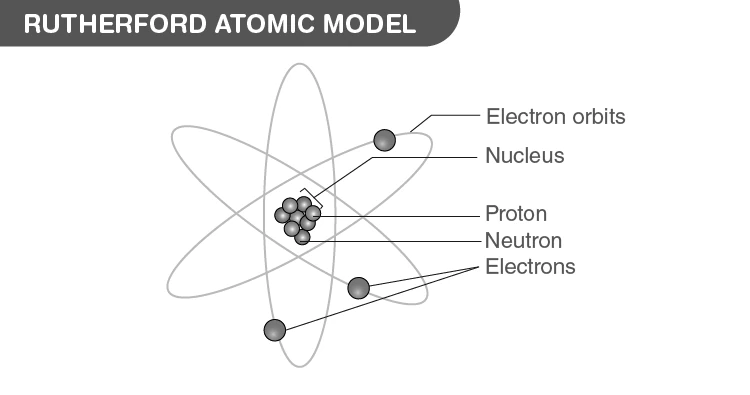
Diagram depicting Rutherford's atomic model and its experimental limitations
Example Problem
In a similar experiment, alpha particles with kinetic energy of \( 5.0 \times 10^{-13} \text{J} \) are fired at a thin silver foil. If the foil thickness is \( 120 \text{ nm} \), explain what observations would indicate the presence of a concentrated positive charge within the atom.
Solution:
Most alpha particles pass through without deflection, suggesting atoms are mostly empty space.
Some particles deflect at small angles, indicating positive charge is localized, not spread out.
A very small fraction bounce back, implying a dense, positively charged nucleus occupies a tiny volume.
These observations confirm the existence of a compact nucleus, consistent with Rutherford’s findings.
Key Observations from the Alpha Scattering Study
Interpreting the Behavior of Alpha Particles
Rutherford’s experiment revealed three critical insights about atomic structure:
The majority of alpha particles passed straight through the foil, indicating that atoms consist largely of empty space.
Some particles experienced slight deflections, showing that positive charge is concentrated in a small region rather than uniformly spread.
A very few particles were deflected backward at angles close to \(180^\circ\), suggesting the nucleus occupies a minuscule volume compared to the entire atom.
Example Problem
During an alpha scattering experiment, if 98% of alpha particles pass through undeflected, 1.9% deflect at small angles, and 0.1% bounce back, what can be inferred about the atomic structure?
Solution:
The 98% passing through indicates atoms are mostly empty space.
The 1.9% small deflections imply positive charge is concentrated, causing minor repulsion.
The 0.1% large deflections confirm a dense, positively charged nucleus exists.
Thus, the atom has a tiny nucleus surrounded by mostly empty space.
Rutherford’s Atomic Model: Structure and Dynamics
Conceptualizing the Atom’s Core and Electron Orbits
Building on his experimental results, Rutherford proposed that an atom’s positive charge and most of its mass are concentrated in a tiny central region called the nucleus. Electrons, bearing negative charge, orbit this nucleus at high speeds along defined circular paths termed orbits. The electrostatic attraction between the positively charged nucleus and negatively charged electrons maintains this orbital motion.
Schematic representation of Rutherford’s atomic model with nucleus and electron orbits
Example Problem
Consider an electron revolving around a nucleus in a circular orbit of radius \( 5.0 \times 10^{-11} \text{ m} \) with a speed of \( 2.0 \times 10^{6} \text{ m/s} \). Calculate the centripetal force acting on the electron. (Electron mass \( m = 9.11 \times 10^{-31} \text{ kg} \))
Solution:
The centripetal force \( F_c \) is given by:
\[ F_c = \frac{m v^2}{r} \]
Substituting values:
\[ F_c = \frac{9.11 \times 10^{-31} \times (2.0 \times 10^{6})^2}{5.0 \times 10^{-11}} = \frac{9.11 \times 10^{-31} \times 4.0 \times 10^{12}}{5.0 \times 10^{-11}} = \frac{3.644 \times 10^{-18}}{5.0 \times 10^{-11}} = 7.29 \times 10^{-8} \text{ N} \]
Therefore, the centripetal force acting on the electron is \( 7.29 \times 10^{-8} \text{ N} \).
Shortcomings of the Rutherford Atomic Framework
Challenges in Explaining Atomic Stability and Electron Arrangement
Despite its groundbreaking nature, Rutherford’s model could not address some fundamental issues. According to classical electromagnetism, an accelerating charged particle, such as an electron in circular motion, should emit electromagnetic radiation, losing energy continuously. This would cause the electron to spiral into the nucleus rapidly, making atoms unstable. Calculations indicate this collapse would occur in less than \( 10^{-8} \) seconds, contradicting observed atomic stability.
Additionally, Rutherford’s model did not clarify how electrons are arranged or why they occupy specific orbits, leaving the atomic structure incomplete.
Visual representation of the limitations in Rutherford’s atomic model
Example Problem
Explain why, according to classical physics, an electron revolving around the nucleus should lose energy and collapse into the nucleus, and why this contradicts observed atomic behavior.
Solution:
Electrons in circular orbits are accelerating charges.
Accelerating charges emit electromagnetic radiation, losing energy.
Energy loss would cause electrons to spiral inward, collapsing the atom.
However, atoms are stable, indicating classical physics cannot fully explain atomic structure.
This contradiction highlights the need for quantum theory to explain atomic stability.
Summary Table: Rutherford’s Atomic Model Essentials
Aspect | Details |
|---|---|
Experiment | Alpha particle scattering on thin gold foil |
Key Observation | Most alpha particles passed through; few deflected at large angles |
Atomic Structure | Small, dense, positively charged nucleus; electrons orbit around it |
Electron Motion | Electrons revolve in circular orbits at high speed |
Limitations | Could not explain atomic stability or electron arrangement |
Glossary of Key Terms
Term | Definition |
|---|---|
Alpha Particles | Helium nuclei consisting of two protons and two neutrons, emitted in radioactive decay |
Nucleus | Central, dense region of an atom containing protons and neutrons |
Orbit | Fixed circular path in which electrons revolve around the nucleus |
Electrostatic Force | Attractive force between oppositely charged particles |
Deflection | Change in direction of a particle due to interaction with another particle or field |
Fluorescent Screen | Surface that emits light when struck by charged particles |
Atomic Model | Theoretical representation of the structure of an atom |
Electromagnetic Radiation | Energy emitted in the form of waves due to accelerating charges |
Accelerated Charge | A charged particle undergoing a change in velocity or direction |
Atomic Stability | Condition where atoms maintain their structure without collapsing |
Frequently Asked Questions
What distinguished Rutherford’s atomic model from earlier theories?
Rutherford was the first to identify a tiny, dense nucleus at the center of the atom, overturning the idea of a uniform positive charge distribution.
How did Rutherford describe the arrangement of electrons?
He proposed that electrons orbit the nucleus in circular paths, held by electrostatic attraction, but did not specify their exact arrangement.
Why is Rutherford’s model considered incomplete?
It could not explain why electrons do not spiral into the nucleus despite accelerating and emitting radiation, nor did it clarify electron configurations.
What was the main experimental method used by Rutherford?
He performed the alpha particle scattering experiment, bombarding thin metal foils with alpha particles and observing their deflections.
What key conclusion was drawn about atomic structure from Rutherford’s experiment?
That atoms have a small, positively charged nucleus containing most of the mass, surrounded by mostly empty space where electrons move.
Additional Visuals Supporting Rutherford’s Model
Visual explanation of Rutherford’s atomic model
Diagram showing the nucleus and electron orbits
Illustration of the limitations of Rutherford’s model
Conceptual diagram of atomic structure
Graphical representation of atomic model interpretations
Student testimonial appreciating the clarity of Rutherford’s model explanation
BYJU'S registration and free PDF download promotion