Understanding Resonance in Chemical Bonding
Fundamentals of Resonance Structures
Concept and Significance of Resonance
Resonance in chemistry refers to the phenomenon where a molecule or ion cannot be accurately represented by a single Lewis structure. Instead, multiple Lewis structures, known as resonance forms or canonical structures, collectively describe the true electronic structure. These forms combine to form a resonance hybrid, which better represents the delocalization of electrons within the molecule or ion.
When a single Lewis structure fails to explain observed properties such as bond lengths or partial charges, resonance structures provide a more comprehensive picture by illustrating electron delocalization. This concept is essential in valence bond theory to understand bonding in molecules with conjugated pi systems or polyatomic ions.
Example Problem
Consider a polyatomic ion where two Lewis structures differ only in the placement of a double bond and a lone pair. Explain why neither structure alone fully describes the bonding and how resonance resolves this.
Solution:
Each Lewis structure shows electrons localized differently, leading to different bond orders.
Experimental data often shows bond lengths intermediate between single and double bonds.
Resonance hybrid represents a weighted average of these structures, indicating electron delocalization.
This explains equal bond lengths and partial charges observed experimentally.
Illustrations of Resonance in Common Ions and Molecules
Delocalization in Carbonate Ion
The carbonate ion (CO32−) exhibits resonance through three equivalent Lewis structures where the double bond shifts among the oxygen atoms. This delocalization results in equal bond lengths and partial charges distributed over the oxygen atoms, which cannot be explained by a single Lewis structure.
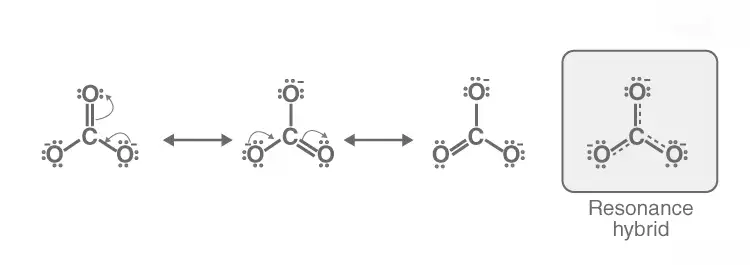
Various resonance forms of the carbonate ion showing electron delocalization.
Example Problem
Given the resonance structures of carbonate ion, calculate the formal charge on each oxygen atom in one canonical form where one oxygen is double bonded to carbon.
Solution:
For the double bonded oxygen: Formal charge = Valence electrons - (Lone pairs + ½ Bonding electrons) = 6 - (4 + ½×4) = 6 - 6 = 0.
For each single bonded oxygen: Formal charge = 6 - (6 + ½×2) = 6 - 7 = -1.
Carbon has formal charge 0 in this structure.
The sum of formal charges equals the ion charge of -2.
Resonance in Nitrite Ion (NO2−)
The nitrite ion has two resonance structures where the double bond alternates between the two nitrogen-oxygen bonds. Experimentally, both N–O bonds have equal lengths, which is explained by the resonance hybrid where the double bond character is shared equally.
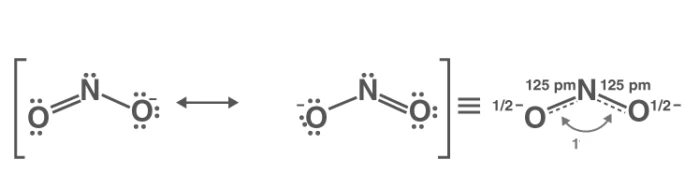
Resonance forms of the nitrite ion illustrating equal bond character.
Example Problem
Explain why the bond length of both N–O bonds in NO2− is approximately 125 pm despite differing bond orders in individual resonance forms.
Solution:
Each resonance form has one double and one single N–O bond.
The resonance hybrid averages these, giving both bonds partial double bond character.
This results in equal bond lengths intermediate between typical single and double bonds.
Partial charges of approximately -½ on each oxygen atom also support this delocalization.
Resonance in Nitrate Ion (NO3−)
The nitrate ion features three resonance structures where the double bond rotates among the three oxygen atoms bonded to nitrogen. This leads to equal bond lengths and partial negative charges distributed evenly across the oxygen atoms, with the nitrogen atom carrying a positive charge.

Three resonance forms of nitrate ion showing shifting double bonds.
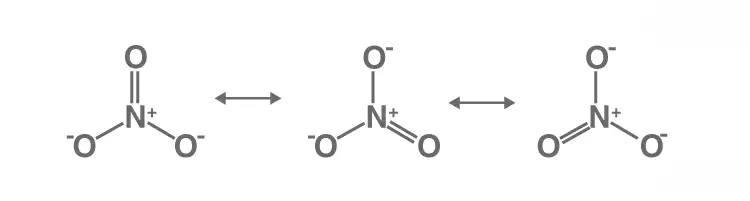
Resonance hybrid of nitrate ion illustrating delocalized charges and bonds.
Example Problem
Calculate the average formal charge on each oxygen atom in the nitrate ion resonance hybrid.
Solution:
Each resonance structure has one double bonded oxygen (formal charge 0) and two single bonded oxygens (formal charge -1 each).
Since there are three resonance forms, each oxygen is double bonded once and single bonded twice.
Average formal charge per oxygen = \( \frac{0 + (-1) + (-1)}{3} = -\frac{2}{3} \).
Nitrogen carries a formal charge of +1, balancing the overall -1 charge of the ion.
Ozone (O3) Resonance Characteristics
The ozone molecule consists of a central oxygen atom bonded to two others, with resonance structures showing alternating single and double bonds. The resonance hybrid explains the equal bond lengths and partial charges observed experimentally, with the central oxygen bearing a positive charge and the terminal oxygens sharing negative partial charges.
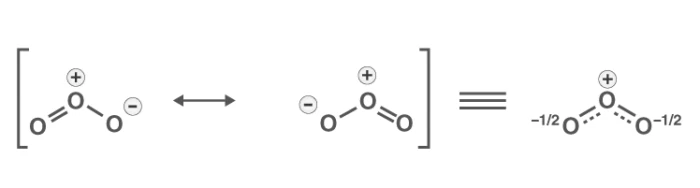
Resonance hybrid of ozone showing charge distribution and bond delocalization.
Example Problem
Describe the charge distribution on the oxygen atoms in ozone based on its resonance structures.
Solution:
One resonance form places a positive charge on the central oxygen and a negative charge on one terminal oxygen.
The other resonance form reverses the positions of these charges.
The resonance hybrid averages these, resulting in a +1 charge on the central oxygen and partial negative charges of approximately -½ on each terminal oxygen.
This explains the equal bond lengths and observed molecular properties.
Resonance in Aromatic Compounds and Organic Molecules
Electron Delocalization in Benzene
Benzene (C6H6) is a classic example of resonance in aromatic hydrocarbons. It has two Kekulé structures with alternating single and double bonds. The actual molecule is a resonance hybrid where the pi electrons are delocalized evenly around the ring, resulting in equal bond lengths and enhanced stability.
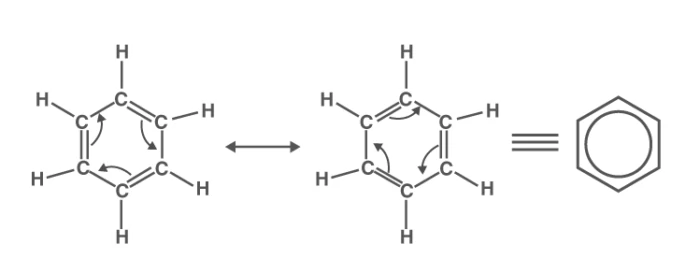
Two Kekulé resonance forms of benzene and their hybrid representation.
Example Problem
Explain why all carbon-carbon bonds in benzene have bond order 1.5 instead of alternating single and double bonds.
Solution:
Benzene’s resonance forms alternate double bonds around the ring.
The resonance hybrid averages these, delocalizing the pi electrons evenly.
Each C–C bond has partial double bond character, giving a bond order of 1.5.
This delocalization stabilizes the molecule and results in equal bond lengths.
Resonance Effects in Nitrobenzene
Nitrobenzene contains a nitro group attached to a benzene ring. The nitro group is an electron-withdrawing substituent that affects the electron density of the aromatic ring. Resonance structures show that the ortho and para positions carry positive charges, making these sites less reactive to electrophilic substitution, which instead favors the meta position.
Example Problem
Why does electrophilic substitution in nitrobenzene predominantly occur at the meta position?
Solution:
The nitro group withdraws electron density via resonance, creating positive charges at ortho and para positions.
Electrophiles are repelled by these positive sites, reducing reactivity there.
The meta position remains relatively electron-rich and is favored for substitution.
Resonance structures explain this directing effect clearly.
Summary and Quick Reference
Term | Definition | Example |
|---|---|---|
Resonance | Delocalization of electrons represented by multiple Lewis structures. | Carbonate ion (CO32−) |
Resonance Hybrid | Actual structure combining all resonance forms. | Benzene molecule with delocalized pi electrons |
Canonical Structures | Individual Lewis structures contributing to resonance. | Nitrate ion resonance forms |
Formal Charge | Charge assigned to atoms in Lewis structures to predict stability. | Oxygen atoms in nitrite ion |
Delocalization | Spreading of electron density over several atoms. | Pi electrons in benzene ring |
Electrophilic Substitution | Reaction where an electrophile replaces a hydrogen atom in aromatic rings. | Meta substitution in nitrobenzene |
Octet Rule | Atoms tend to have eight electrons in their valence shell. | Carbon in carbonate ion |
Partial Charge | Fractional charge due to electron delocalization. | Oxygen atoms in nitrate ion |
Bond Order | Average number of bonds between two atoms in resonance hybrid. | 1.5 in benzene C–C bonds |
Electron-Withdrawing Group | Substituent that pulls electron density away from a molecule. | Nitro group in nitrobenzene |
Glossary of Key Terms
Term | Meaning |
|---|---|
Resonance | Phenomenon where multiple Lewis structures represent a molecule’s bonding. |
Resonance Hybrid | The actual structure formed by combining resonance forms. |
Canonical Structure | One of the contributing Lewis structures in resonance. |
Formal Charge | Charge assigned to an atom in a Lewis structure based on electron count. |
Delocalization | Distribution of electrons across several atoms rather than localized bonds. |
Octet Rule | Atoms tend to have eight electrons in their valence shell for stability. |
Bond Order | Average number of bonds between two atoms in resonance structures. |
Electrophilic Substitution | Reaction where an electrophile replaces a hydrogen atom in an aromatic ring. |
Electron-Withdrawing Group | Group that pulls electron density away from the rest of the molecule. |
Partial Charge | Fractional charge on atoms due to electron delocalization. |
Frequently Asked Questions
What defines a resonance structure in chemistry?
Resonance structures are multiple Lewis diagrams that collectively represent the electron distribution in a molecule or ion, showing delocalized bonding that cannot be captured by a single structure.
Why are resonance structures important?
They provide a more accurate depiction of molecules with delocalized electrons, explaining properties like equal bond lengths and partial charges that single Lewis structures cannot.
How does resonance affect bond lengths?
Resonance causes bond lengths to be intermediate between single and double bonds due to electron delocalization, resulting in bonds of equal length in symmetric molecules.
Is ozone an example of a molecule with resonance?
Yes, ozone has two major resonance forms that contribute equally to its resonance hybrid, explaining its bond lengths and charge distribution.
Can resonance structures have different stability?
Yes, resonance forms with lower formal charges and full octets are more stable and contribute more to the resonance hybrid.