Understanding Resonance and Mesomeric Effects in Organic Chemistry
Fundamentals of Electron Delocalization in Organic Molecules
Concept of Electron Delocalization and Resonance
In organic chemistry, certain molecules exhibit a phenomenon where electrons are not confined to a single bond or atom but are spread over several atoms. This electron delocalization is described by the concept of resonance, also known as mesomerism. Instead of representing such molecules with a single Lewis structure, multiple resonance forms are drawn to depict the distribution of electrons more accurately. These resonance structures collectively describe the true electronic structure of the molecule, enhancing its stability.
Resonance is particularly important in molecules where pi bonds and lone pairs interact, leading to a more stable electronic arrangement than any single structure can represent.
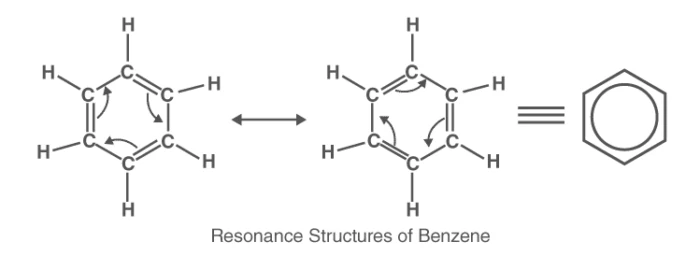
Illustration of Resonance Effect in Organic Molecules
Example Problem
Consider the nitrate ion \( \text{NO}_3^- \). Draw the resonance structures and explain how resonance contributes to its stability.
Solution:
The nitrate ion has three equivalent resonance structures where the double bond between nitrogen and oxygen shifts among the three oxygen atoms. Each resonance form shows one N=O double bond and two N–O single bonds with a negative charge on the single-bonded oxygens.
Because the actual structure is a hybrid of these forms, the negative charge and double bond character are delocalized equally over all three oxygens, resulting in equal bond lengths and enhanced stability.
Thus, resonance explains the equivalence of the N–O bonds and the ion's stability beyond what a single Lewis structure can depict.
Distinguishing Resonance and Mesomeric Effects
Clarifying the Differences and Their Chemical Significance
While resonance and mesomeric effects are closely related concepts involving electron delocalization, they differ in their focus and application. Resonance refers to the representation of molecules by multiple Lewis structures to illustrate electron delocalization. In contrast, the mesomeric effect describes the influence of substituent groups on the electron distribution within a molecule, affecting its polarity and reactivity.
The mesomeric effect arises from the interaction between pi bonds and lone pairs or between adjacent pi bonds, leading to either electron donation or withdrawal through conjugation. This effect plays a crucial role in stabilizing molecular structures and influencing chemical behavior.
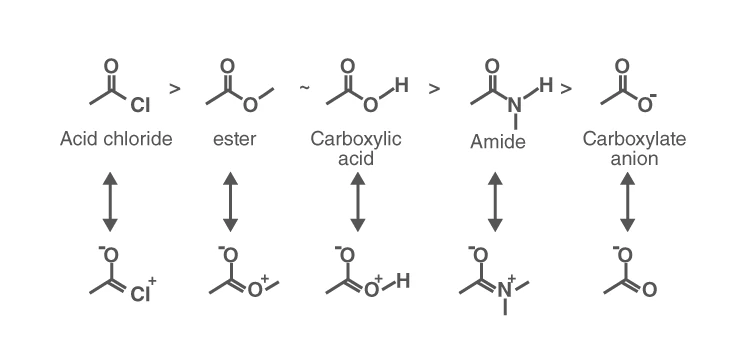
Various Resonance Structures of Functional Groups
Example Problem
Explain how the mesomeric effect of the -OH group influences the acidity of phenol compared to benzene.
Solution:
The -OH group exhibits a positive mesomeric effect (+M), donating electron density into the aromatic ring through resonance.
This electron donation increases the electron density on the ring, stabilizing the phenol molecule but destabilizing the phenolate ion formed after deprotonation.
As a result, phenol is more acidic than benzene because the resonance stabilization of the phenolate ion is less effective due to the +M effect of -OH.
Thus, the mesomeric effect of substituents directly impacts the acid-base properties of aromatic compounds.
Classification of Resonance Effects: Electron Donation and Withdrawal
Understanding Positive and Negative Mesomeric Influences
Resonance effects are categorized based on the direction of electron flow between substituents and the conjugated system. The two primary types are the positive mesomeric effect (+M) and the negative mesomeric effect (−M).
The +M effect involves substituents that push electron density away from themselves into the conjugated system, enhancing electron richness. Common groups exhibiting +M include -OH, -SH, -OR, and -SR.
Conversely, the −M effect involves substituents that pull electron density towards themselves from the conjugated system, reducing electron density in the rest of the molecule. Examples include -NO₂, carbonyl groups (C=O), -COOH, and -C≡N.
Example Problem
Identify the mesomeric effect of the -NO₂ group in nitrobenzene and explain its impact on the reactivity of the benzene ring.
Solution:
The -NO₂ group exhibits a negative mesomeric effect (−M), withdrawing electron density from the benzene ring through resonance.
This electron withdrawal decreases the electron density on the ring, making it less reactive towards electrophilic substitution reactions.
As a result, nitrobenzene is less reactive than benzene in such reactions due to the −M effect of the nitro group.
This effect also directs substitution to the meta position relative to the -NO₂ group.
Quick Reference: Summary of Resonance and Mesomeric Effects
Concept | Description | Effect on Molecule | Examples |
|---|---|---|---|
Resonance | Delocalization of electrons represented by multiple Lewis structures | Increases molecular stability | Nitrate ion, benzene |
Mesomeric Effect (+M) | Electron donation through conjugation by substituents | Increases electron density in conjugated system | -OH, -OR, -SH, -SR |
Mesomeric Effect (−M) | Electron withdrawal through conjugation by substituents | Decreases electron density in conjugated system | -NO₂, C=O, -COOH, -C≡N |
Glossary of Key Terms
Term | Definition |
|---|---|
Resonance | Electron delocalization represented by multiple Lewis structures. |
Mesomeric Effect | Influence of substituents on electron distribution via conjugation. |
Pi Bond (π bond) | A covalent bond formed by the sideways overlap of p orbitals. |
Lone Pair | Non-bonding pair of electrons localized on an atom. |
Conjugation | Alternating single and multiple bonds allowing electron delocalization. |
Electrophilic Substitution | A reaction where an electrophile replaces a hydrogen atom in an aromatic ring. |
Functional Group | Specific group of atoms responsible for characteristic reactions of a molecule. |
Electron Donating Group | Substituent that donates electron density into a conjugated system (+M effect). |
Electron Withdrawing Group | Substituent that withdraws electron density from a conjugated system (−M effect). |
Lewis Structure | Diagram showing bonding between atoms and lone pairs of electrons. |
Frequently Asked Questions
What is the main difference between resonance and the mesomeric effect?
Resonance refers to the depiction of electron delocalization using multiple structures, while the mesomeric effect describes how substituents influence electron distribution within a molecule through conjugation.
How does the positive mesomeric effect affect molecular stability?
Positive mesomeric effect (+M) involves electron donation into the conjugated system, which can increase electron density and stabilize certain molecular structures.
Can a molecule have both +M and −M effects simultaneously?
Yes, different substituents on a molecule can exert opposing mesomeric effects, influencing the overall electron distribution and reactivity.
Why are resonance structures important in organic chemistry?
They provide a more accurate representation of electron distribution, explaining molecular stability and reactivity better than a single Lewis structure.
How does the mesomeric effect influence acidity?
Substituents with +M or −M effects can stabilize or destabilize conjugate bases, thereby increasing or decreasing the acidity of a compound.