Understanding Molecular Polarity and Its Effects
Fundamentals of Polarity in Chemistry and Physics
Conceptualizing Polarity and Its Origins
Polarity describes a condition where an atom or molecule exhibits contrasting properties or charges at opposite ends. This phenomenon is crucial in determining physical characteristics such as melting and boiling points, as well as solubility behavior. The root cause of polarity lies in the uneven distribution of electrical charge due to differences in electronegativity between bonded atoms.
When two atoms of the same element bond, like in hydrogen gas (H2), the electrons are shared equally, resulting in a nonpolar bond. However, when atoms of different elements form a bond, the electrons tend to be drawn more towards the atom with higher electronegativity, creating an electrical imbalance and thus polarity.
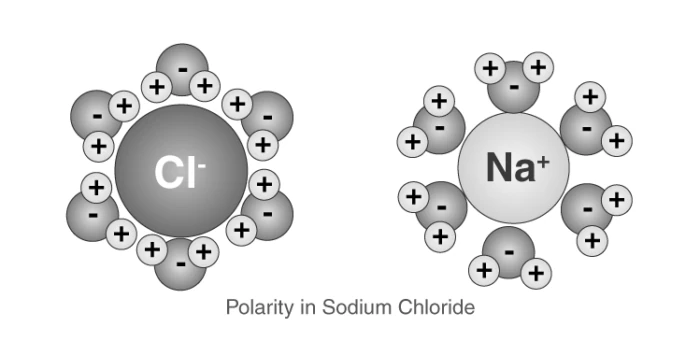
Beyond chemistry, polarity also applies to fields like magnetism and electronics, where poles with excess electrons are negatively charged, and those with fewer electrons are positively charged. This difference in charge creates an electromotive force (EMF) between two points, essential for electric current flow.
Example Problem: Determining Polarity in a Simple Molecule
Consider a diatomic molecule XY where atom X has an electronegativity of 2.1 and atom Y has 3.0. Explain which atom will carry a partial negative charge and why.
Solution:
Since atom Y has a higher electronegativity (3.0) compared to atom X (2.1), it attracts the bonding electrons more strongly. This causes the electron density to shift towards Y, making it partially negative (\( \delta^- \)) and atom X partially positive (\( \delta^+ \)). This uneven electron distribution results in a polar bond.
How Molecular Polarity Arises and Its Classification
Understanding Polar and Nonpolar Molecules
Molecular polarity depends on the nature of the bonds and the geometry of the molecule. When a molecule has regions with unequal electrical charges, it is termed polar. This occurs when one end of the molecule has a partial positive charge and the opposite end has a partial negative charge, creating a dipole moment.
Conversely, nonpolar molecules have an even distribution of electrical charge, often due to symmetrical arrangements where individual bond dipoles cancel out. Such molecules do not exhibit distinct poles.
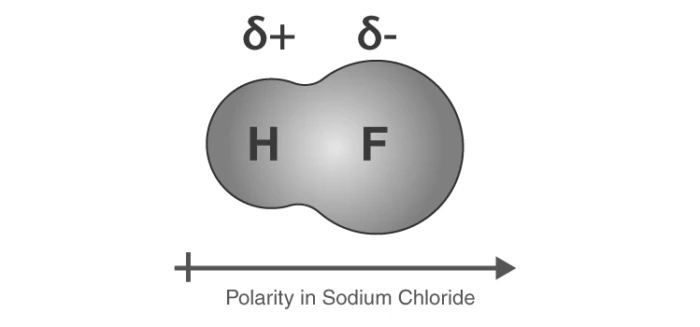
For example, in the hydrogen-fluoride (H-F) bond, fluorine is more electronegative than hydrogen, causing electrons to spend more time near fluorine. This results in fluorine carrying a slight negative charge and hydrogen a slight positive charge, making HF a polar molecule.
Example Problem: Classifying a Molecule as Polar or Nonpolar
Given a molecule AB2 where atom A has electronegativity 2.5 and atoms B have 2.0, and the molecule is linear, determine if the molecule is polar or nonpolar.
Solution:
Since the molecule is linear and the two B atoms are identical, the bond dipoles are equal in magnitude but opposite in direction. These dipoles cancel each other out, resulting in no net dipole moment. Therefore, the molecule is nonpolar despite having polar bonds.
Examples and Implications of Molecular Polarity
Recognizing Polar and Nonpolar Substances in Everyday Life
The shape and electronegativity differences in molecules determine their polarity. Molecules with bent or pyramidal shapes often have net dipole moments, making them polar. Linear molecules with symmetrical charge distribution tend to be nonpolar.
Water (H2O) is a classic example of a polar molecule due to the bent shape and the difference in electronegativity between oxygen and hydrogen. This polarity explains water's high boiling point and its ability to dissolve many substances.
On the other hand, substances like oils, fats, and gasoline are nonpolar, which is why they do not mix with water. Their molecules have symmetrical structures and similar electronegativities among atoms, leading to no significant dipole moment.
Glucose is another polar molecule, with multiple oxygen and hydrogen atoms arranged to create several polar bonds, contributing to its solubility in water.
Example Problem: Calculating Dipole Moment of a Polar Molecule
A molecule has a bond length of 0.12 nm and a charge separation of \( 1.6 \times 10^{-19} \) C. Calculate the dipole moment in Debye units. (1 Debye = \( 3.336 \times 10^{-30} \) C·m)
Solution:
The dipole moment \( \mu \) is given by:
\[ \mu = q \times d \]
Where \( q = 1.6 \times 10^{-19} \text{ C} \) and \( d = 0.12 \times 10^{-9} \text{ m} \).
Calculating:
\[ \mu = (1.6 \times 10^{-19}) \times (0.12 \times 10^{-9}) = 1.92 \times 10^{-29} \text{ C·m} \]
Converting to Debye:
\[ \mu = \frac{1.92 \times 10^{-29}}{3.336 \times 10^{-30}} \approx 5.76 \text{ Debye} \]
Thus, the molecule has a dipole moment of approximately 5.76 Debye, indicating significant polarity.
Quick Reference: Summary of Molecular Polarity
| Aspect | Polar Molecules | Nonpolar Molecules |
|---|---|---|
| Charge Distribution | Unequal, with distinct positive and negative ends | Evenly distributed, no distinct poles |
| Electronegativity Difference | Significant difference between bonded atoms | Minimal or no difference between bonded atoms |
| Molecular Shape | Asymmetrical (e.g., bent, pyramidal) | Symmetrical (e.g., linear, tetrahedral with identical atoms) |
| Examples | Water (H2O), Hydrogen Fluoride (HF), Glucose | Oxygen (O2), Carbon Dioxide (CO2), Oils |
| Solubility | Mixes well with polar solvents like water | Mixes well with nonpolar solvents like oils |
Glossary of Key Terms Related to Polarity
| Term | Definition |
|---|---|
| Electronegativity | The tendency of an atom to attract electrons towards itself in a chemical bond. |
| Dipole Moment | A measure of the separation of positive and negative charges in a molecule. |
| Polar Molecule | A molecule with an uneven distribution of charge, resulting in positive and negative poles. |
| Nonpolar Molecule | A molecule with an even distribution of electrical charge, lacking distinct poles. |
| Bond Polarity | The polarity arising from the difference in electronegativity between two bonded atoms. |
| Electromotive Force (EMF) | The voltage generated by a source that causes current to flow in a circuit. |
| Partial Charge | A slight positive or negative charge on an atom within a molecule due to unequal electron sharing. |
| Symmetry | The balanced arrangement of atoms in a molecule affecting its polarity. |
| Solubility | The ability of a substance to dissolve in a solvent. |
| Electroneutral | Having no net electrical charge. |
Frequently Asked Questions on Molecular Polarity
What is meant by polarity in chemical bonds?
Polarity in chemical bonds refers to the uneven distribution of electrical charge between atoms due to differences in electronegativity, resulting in partial positive and negative charges.
What factors determine whether a molecule is polar or nonpolar?
The polarity of a molecule depends on the electronegativity difference between atoms and the molecule's shape, which affects how bond dipoles combine or cancel out.
How does polarity affect solubility of substances?
Polar molecules tend to dissolve in polar solvents like water, while nonpolar molecules dissolve in nonpolar solvents such as oils, due to similar intermolecular forces.
What is the difference between positive and negative polarity?
Negative polarity indicates a region with excess electrons, while positive polarity refers to a region with a deficiency of electrons, creating an electric potential difference.
Can a molecule have polar bonds but be nonpolar overall?
Yes, if the molecular geometry causes the bond dipoles to cancel each other out, the molecule can be nonpolar despite having polar bonds.