Comprehensive Guide to Oxidation and Reduction Reactions
Fundamentals of Oxidation and Reduction
Understanding Oxidation Processes
Oxidation traditionally refers to the chemical process where a substance gains oxygen or an electronegative element, or loses hydrogen or an electropositive element. From a modern electronic perspective, oxidation is defined as the loss of electrons by an atom, ion, or molecule during a chemical reaction. This electron loss results in an increase in the oxidation state of the species involved.
For example, when carbon reacts with oxygen to form carbon dioxide, carbon undergoes oxidation by gaining oxygen:
C + O2 → CO2
Example: Consider the reaction of iron with sulfur to form iron sulfide. Identify the oxidation process involved.
Solution: Iron reacts with sulfur:
\[ \text{Fe} + \text{S} \rightarrow \text{FeS} \]
Here, iron combines with sulfur, an electronegative element, indicating iron is oxidized by gaining sulfur.
Exploring Reduction Reactions
Reduction is the converse of oxidation. Classically, it involves the addition of hydrogen or an electropositive element, or the removal of oxygen or an electronegative element. Electronically, reduction is the gain of electrons by an atom, ion, or molecule, leading to a decrease in its oxidation state.
For instance, nitrogen is reduced when it reacts with hydrogen to form ammonia:
N2 + 3H2 → 2NH3
Example: Analyze the reduction in the reaction of zinc oxide with carbon.
Solution: The reaction is:
\[ \text{ZnO} + \text{C} \rightarrow \text{Zn} + \text{CO} \]
Zinc oxide loses oxygen (an electronegative element), so zinc oxide is reduced to zinc metal.
Electron Transfer in Redox Reactions
Redox reactions are characterized by the transfer of electrons between substances. Oxidation involves losing electrons, while reduction involves gaining electrons. This interdependence means oxidation and reduction always occur simultaneously. A helpful mnemonic to remember this is OIL RIG: Oxidation Is Loss, Reduction Is Gain.
For example, magnesium metal reacts with oxygen, where magnesium loses electrons (oxidized) and oxygen gains electrons (reduced):
\[ \text{Mg} \rightarrow \text{Mg}^{2+} + 2e^{-} \quad \text{(oxidation)} \]
\[ \text{O}_2 + 4e^{-} \rightarrow 2\text{O}^{2-} \quad \text{(reduction)} \]
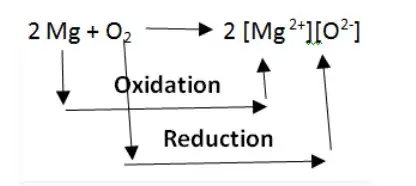
Diagram illustrating electron transfer in oxidation and reduction
Example: Identify the oxidizing and reducing agents in the reaction between magnesium and oxygen.
Solution: Magnesium loses electrons and is oxidized, so it acts as the reducing agent. Oxygen gains electrons and is reduced, so it is the oxidizing agent.
Common Types of Redox Reactions and Their Characteristics
Combustion Reactions as Redox Processes
Combustion involves a substance reacting with molecular oxygen to produce oxides, releasing energy. This is a classic redox reaction where the fuel is oxidized and oxygen is reduced.
For example, the combustion of octane:
\[ 2\text{C}_8\text{H}_{18} + 25\text{O}_2 \rightarrow 16\text{CO}_2 + 18\text{H}_2\text{O} \]
Example: Write the balanced combustion reaction for propane (C3H8).
Solution: The balanced equation is:
\[ \text{C}_3\text{H}_8 + 5\text{O}_2 \rightarrow 3\text{CO}_2 + 4\text{H}_2\text{O} \]
Disproportionation Reactions Explained
Disproportionation is a special redox reaction where a single species undergoes simultaneous oxidation and reduction, producing two different products. This is also called auto-oxidation.
For example, the reaction of hypochlorite ions:
\[ 3\text{ClO}^- \rightarrow \text{ClO}_3^- + 2\text{Cl}^- \]
Example: Identify the species oxidized and reduced in the disproportionation of chlorine gas in water.
Solution: Chlorine reacts with water:
\[ \text{Cl}_2 + \text{H}_2\text{O} \rightarrow \text{HCl} + \text{HClO} \]
Chlorine is both oxidized (to HClO) and reduced (to HCl).
Single Displacement Reactions in Redox Chemistry
Single displacement reactions involve one element replacing another in a compound, resulting in oxidation and reduction simultaneously.
For example, zinc reacting with hydrochloric acid:
\[ \text{Zn} + 2\text{HCl} \rightarrow \text{ZnCl}_2 + \text{H}_2 \]
Example: Predict the products when iron reacts with copper sulfate solution.
Solution: Iron displaces copper:
\[ \text{Fe} + \text{CuSO}_4 \rightarrow \text{FeSO}_4 + \text{Cu} \]
Techniques for Balancing Redox Equations
Balancing Using Oxidation Number Changes
The oxidation number method balances redox reactions by equating the total increase and decrease in oxidation states of atoms involved. This ensures mass and charge conservation.
Consider the reaction:
\[ \text{CuO} + \text{NH}_3 \rightarrow \text{Cu} + \text{N}_2 + \text{H}_2\text{O} \]

Assigning oxidation numbers to atoms in the reaction
Steps include identifying atoms with changing oxidation states, calculating total increase and decrease, and balancing accordingly.

Atoms undergoing oxidation and reduction
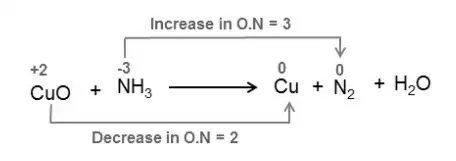
Quantifying oxidation number changes

Equating oxidation and reduction changes

Balancing copper and nitrogen atoms

Adjusting hydrogen and oxygen atoms by trial
Note: In acidic solutions, balance oxygen by adding H2O and hydrogen by adding H+. In basic solutions, balance charges with OH− and then add H2O accordingly.
Example: Balance the reaction of permanganate ion with iron(II) ion in acidic medium using oxidation number method:
\[ \text{MnO}_4^- + \text{Fe}^{2+} \rightarrow \text{Mn}^{2+} + \text{Fe}^{3+} \]
Solution: Assign oxidation numbers, calculate changes, and balance electrons and atoms accordingly.
Ion-Electron (Half-Reaction) Method for Balancing
This method separates the redox reaction into oxidation and reduction half-reactions, balances each for mass and charge, then combines them to form the balanced overall equation.
Example reaction:
\[ \text{Cr}_2\text{O}_7^{2-} + \text{Fe}^{2+} + \text{H}^+ \rightarrow \text{Cr}^{3+} + \text{Fe}^{3+} + \text{H}_2\text{O} \]

Oxidation states in reactants and products
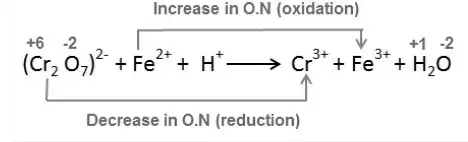
Separating oxidation and reduction half-reactions
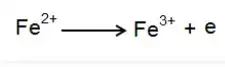
Balancing electrons in oxidation half-reaction

Balancing electrons, hydrogen, and oxygen in reduction half-reaction
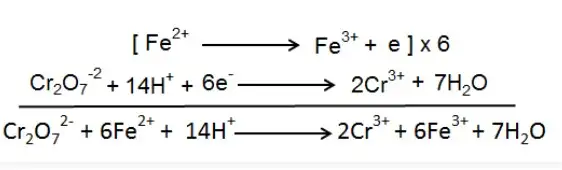
Final balanced redox equation after combining half-reactions
Example: Balance the reaction of permanganate ion with oxalate ion in acidic medium using half-reaction method.
Solution: Write oxidation and reduction half-reactions, balance atoms and charges, then combine.
Distinguishing Oxidation from Reduction and Their Roles
Key Differences Between Oxidation and Reduction
Oxidation involves the loss of electrons, leading to an increase in oxidation state, while reduction involves the gain of electrons, causing a decrease in oxidation state. These processes are complementary and always occur together in redox reactions.
For example, when metals react with acids, the metal atoms lose electrons (oxidized) and hydrogen ions gain electrons (reduced), producing hydrogen gas.
Example: Explain the redox changes when zinc reacts with hydrochloric acid.
Solution: Zinc loses two electrons:
\[ \text{Zn} \rightarrow \text{Zn}^{2+} + 2e^- \]
Hydrogen ions gain electrons:
\[ 2\text{H}^+ + 2e^- \rightarrow \text{H}_2 \]
Understanding Oxidizing and Reducing Agents
The oxidizing agent causes another substance to lose electrons and is itself reduced by gaining electrons. Conversely, the reducing agent causes another substance to gain electrons and is itself oxidized by losing electrons.
For instance, in the reaction between hydrogen peroxide and iodide ions, hydrogen peroxide acts as the oxidizing agent, while iodide ions act as the reducing agent.
Example: Identify the oxidizing and reducing agents in the reaction:
\[ 2\text{I}^- + \text{H}_2\text{O}_2 + 2\text{H}^+ \rightarrow \text{I}_2 + 2\text{H}_2\text{O} \]
Solution: Iodide ions lose electrons (oxidized), so they are reducing agents. Hydrogen peroxide gains electrons (reduced), so it is the oxidizing agent.
Clarifying Common Misconceptions
Despite the term "oxidation," oxygen is not always involved in oxidation reactions. Oxidation strictly refers to electron loss, regardless of oxygen presence. Similarly, reduction is electron gain, not necessarily involving hydrogen addition.
Tip: Remember the mnemonic OIL RIG to avoid confusion: Oxidation Is Loss (of electrons), Reduction Is Gain (of electrons).
Quick Reference: Summary of Oxidation and Reduction Concepts
Aspect | Oxidation | Reduction |
|---|---|---|
Classical Definition | Addition of oxygen or electronegative element; removal of hydrogen or electropositive element | Addition of hydrogen or electropositive element; removal of oxygen or electronegative element |
Electronic Definition | Loss of electrons | Gain of electrons |
Oxidation State Change | Increase | Decrease |
Agent Role | Substance oxidized; acts as reducing agent | Substance reduced; acts as oxidizing agent |
Example Reaction | \(\text{Fe} \rightarrow \text{Fe}^{3+} + 3e^-\) | \(\text{Cl}_2 + 2e^- \rightarrow 2\text{Cl}^-\) |
Glossary of Key Terms
Term | Definition |
|---|---|
Oxidation | Process involving loss of electrons or gain of oxygen |
Reduction | Process involving gain of electrons or loss of oxygen |
Redox Reaction | Chemical reaction involving simultaneous oxidation and reduction |
Oxidizing Agent | Substance that accepts electrons and causes oxidation |
Reducing Agent | Substance that donates electrons and causes reduction |
Oxidation Number | Charge assigned to an atom based on electron loss or gain |
Half-Reaction | Equation representing either oxidation or reduction part of a redox reaction |
Disproportionation | Reaction where a single species is both oxidized and reduced |
Combustion | Reaction of a substance with oxygen producing heat and oxides |
Single Displacement | Reaction where one element replaces another in a compound |
Frequently Asked Questions (FAQs)
What distinguishes oxidation from reduction?
Oxidation is the loss of electrons, while reduction is the gain of electrons during a chemical reaction. Both processes occur together in redox reactions.
Why are redox reactions important in nature and industry?
Redox reactions are fundamental to energy production in biological systems and industrial processes, such as respiration, combustion, and corrosion.
Can oxidation occur without oxygen?
Yes, oxidation refers to electron loss and does not necessarily require oxygen to be involved.
How do oxidizing and reducing agents function?
Oxidizing agents accept electrons and get reduced, while reducing agents donate electrons and get oxidized.
What is the role of oxidation numbers in balancing redox reactions?
Oxidation numbers help track electron transfer and ensure mass and charge balance when balancing redox equations.