Systematic Naming of Organic Compounds Using IUPAC Rules
Understanding the Basics of Organic Compound Naming
Limitations of Traditional Naming Methods
Initially, organic compounds were identified by common or trivial names, often derived from their natural sources or the names of their discoverers. While these names are simple and easy to remember, they lack consistency and can lead to confusion, especially as the number of known compounds increased dramatically.
For example, the compound commonly known as tartaric acid is named as such in trivial nomenclature, but its systematic IUPAC name is 2,3-dihydroxy-1,4-butanedioic acid, which precisely describes its structure.
Example: The trivial name "phenol" corresponds to multiple alternative names such as "hydroxybenzene" and "carbolic acid," illustrating the ambiguity in trivial naming.
Despite these drawbacks, trivial names are still widely used due to their brevity and ease of communication.
Examples of organic compounds with trivial names
Principles and Procedures of IUPAC Nomenclature
Core Guidelines for Systematic Naming
The International Union of Pure and Applied Chemistry (IUPAC) established a standardized system to assign unique and unambiguous names to organic compounds. This system ensures that each compound's name reflects its molecular structure clearly.
The naming process involves identifying the longest continuous carbon chain as the parent structure, numbering it to assign the lowest possible locants to substituents, and then naming substituents with appropriate prefixes arranged alphabetically.
Complex substituents with branching are named as substituted alkyl groups, with numbering starting from the carbon attached to the parent chain. These substituents are enclosed in parentheses in the final name.
Example: The IUPAC name format can be summarized as:
Locant + Prefix + Root + Locant + Suffix, where the root indicates the number of carbons in the main chain, prefixes denote substituents, and suffixes represent functional groups.
For instance, the root "pent" indicates a five-carbon chain, while the suffix "ane" denotes an alkane.
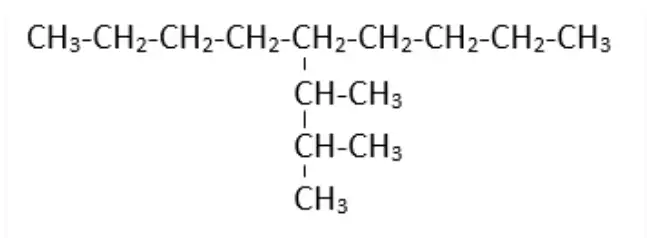
The image shows the chemical structure of a hydrocarbon molecule with a long chain and a branched group attached. Step-by-step explanation: 1. The main chain is a straight line of carbon atoms each bonded to hydrogen atoms, represented by CH3 (methyl) and CH2 (methylene) groups. 2. The main chain contains nine carbon atoms linearly connected (from CH3 to CH2 repeated). 3. Attached to the fifth carbon in the main chain is a branch. 4. This branch has a carbon attached to two methyl (CH3) groups and one more carbon-chain ending in CH3. 5. This molecule is a branched alkane, an organic compound made of carbon and hydrogen atoms. In simple terms, this image shows a big carbon chain with a smaller chain branching off the side, making the molecule more complex.
Different Approaches in IUPAC Naming
Methods for Assigning Names to Organic Compounds
IUPAC nomenclature employs several methods depending on the nature of the compound:
Compositional Nomenclature: Names compounds based on their elemental composition using prefixes to indicate the number of atoms, such as "phosphorus trichloride" for PCl3.
Substitutive Nomenclature: Involves replacing hydrogen atoms in a parent hydride with substituent groups, naming the compound accordingly, e.g., "trichlorophosphine" for PCl3.
Additive Nomenclature: Primarily used for coordination compounds, where ligands are named as prefixes, such as "penta-ammine-chloro-cobalt(III) chloride" for [CoCl(NH3)5]Cl2.
Example: The compound PCl3 can be named as "phosphorus trichloride" (compositional), "trichlorophosphine" (substitutive), or "tri-chlorido-phosphorus" (additive), depending on the nomenclature method used.
Phosphorus trichloride molecule
Naming Key Aliphatic Hydrocarbons
Systematic Names for Alkanes, Alkenes, and Alkynes
Aliphatic hydrocarbons are classified based on the types of bonds between carbon atoms, and their IUPAC names reflect these differences:
Alkanes: Saturated hydrocarbons with single bonds, general formula \( C_nH_{2n+2} \), named with the suffix -ane. Example: Methane for CH4, Butane for C4H10.
Alkenes: Unsaturated hydrocarbons with at least one double bond, general formula \( C_nH_{2n} \), named with the suffix -ene. Example: Ethene for C2H4, Propene for C3H6.
Alkynes: Unsaturated hydrocarbons with at least one triple bond, general formula \( C_nH_{2n-2} \), named with the suffix -yne. Example: Ethyne for C2H2.
Example: The compound C3H6 is named "propene" indicating a three-carbon chain with a double bond.
Representative structures of alkanes, alkenes, and alkynes
Detailed Example of IUPAC Naming
Stepwise Naming of a Branched Hydrocarbon
Consider a hydrocarbon with a straight chain of nine carbon atoms. The fifth carbon atom in this chain has a substituent group attached, which itself is a three-carbon chain. Additionally, the first and second carbons of this substituent have methyl groups attached.
First, the longest chain of nine carbons is identified as the parent chain and numbered accordingly. The substituent attached at carbon 5 is a propyl group with two methyl branches at positions 1 and 2, named as 1,2-dimethylpropyl.
Combining these, the full IUPAC name of the compound is:
5-(1,2-dimethylpropyl)nonane
Stepwise solution:
Identify the longest carbon chain: 9 carbons → "nonane".
Locate the substituent on carbon 5.
Name the substituent: a 3-carbon chain (propyl) with methyl groups on carbons 1 and 2 → "1,2-dimethylpropyl".
Combine substituent and parent chain with locant → "5-(1,2-dimethylpropyl)nonane".
Summary Table for IUPAC Nomenclature Essentials
Aspect | Description | Example |
|---|---|---|
Parent Chain | Longest continuous carbon chain | Nonane (9 carbons) |
Locants | Numbering to give substituents lowest possible numbers | Carbon 5 for substituent position |
Prefixes | Names of substituents arranged alphabetically | 1,2-dimethylpropyl |
Suffixes | Indicate functional groups or hydrocarbon type | -ane for alkanes, -ene for alkenes |
Numbering Substituents | Numbering starts from carbon attached to parent chain | Methyl groups at positions 1 and 2 on substituent |
Glossary of Key Terms in Organic Nomenclature
Term | Definition |
|---|---|
Alkane | Saturated hydrocarbon with single bonds, general formula \( C_nH_{2n+2} \) |
Alkene | Unsaturated hydrocarbon containing at least one double bond, formula \( C_nH_{2n} \) |
Alkyne | Unsaturated hydrocarbon with at least one triple bond, formula \( C_nH_{2n-2} \) |
Locant | Number assigned to a carbon atom to indicate substituent position |
Parent Chain | Longest continuous chain of carbon atoms in a molecule |
Prefix | Part of the name indicating substituents or side chains |
Suffix | Ending of the name indicating the main functional group |
Substituent | Atom or group replacing hydrogen on the parent chain |
Trivial Name | Common or traditional name not following systematic rules |
IUPAC | International Union of Pure and Applied Chemistry, sets naming standards |
Frequently Asked Questions on IUPAC Nomenclature
Why is a standardized naming system like IUPAC necessary?
It provides a universal language for chemists worldwide, ensuring each compound has a unique and unambiguous name that clearly describes its structure.
What are the main components of an IUPAC name?
An IUPAC name consists of a root indicating the carbon chain length, prefixes for substituents, and suffixes for functional groups.
How does IUPAC nomenclature handle complex substituents?
Complex substituents are named as substituted alkyl groups with numbering starting at the carbon attached to the parent chain, enclosed in parentheses.
Are trivial names still used in chemistry?
Yes, trivial names are often used for simplicity and tradition, especially for well-known compounds, but IUPAC names are preferred for clarity and precision.
What elements are typically found in organic compounds?
Organic compounds primarily contain carbon and hydrogen, often with oxygen, nitrogen, halogens, sulfur, and phosphorus as common additional elements.