Comprehensive Overview of Nitric Acid: Properties, Preparation, and Applications
Fundamental Characteristics and Molecular Architecture of Nitric Acid
Understanding the Molecular Composition and Structure
Nitric acid is an inorganic compound with the chemical formula HNO3. It is a potent mineral acid known for its corrosive nature and colorless appearance in pure form. Over time, exposure to air causes it to develop a yellowish tint due to decomposition into nitrogen oxides and water. The molecule consists of one nitrogen atom centrally bonded to three oxygen atoms and one hydrogen atom. One oxygen forms a double bond with nitrogen, another oxygen is single bonded to nitrogen and also bonded to hydrogen, while the third oxygen carries a negative charge and is singly bonded to nitrogen. The nitrogen atom carries a positive charge, balancing the overall molecule to be neutral. Resonance structures allow delocalization of charges within the molecule, contributing to its stability.
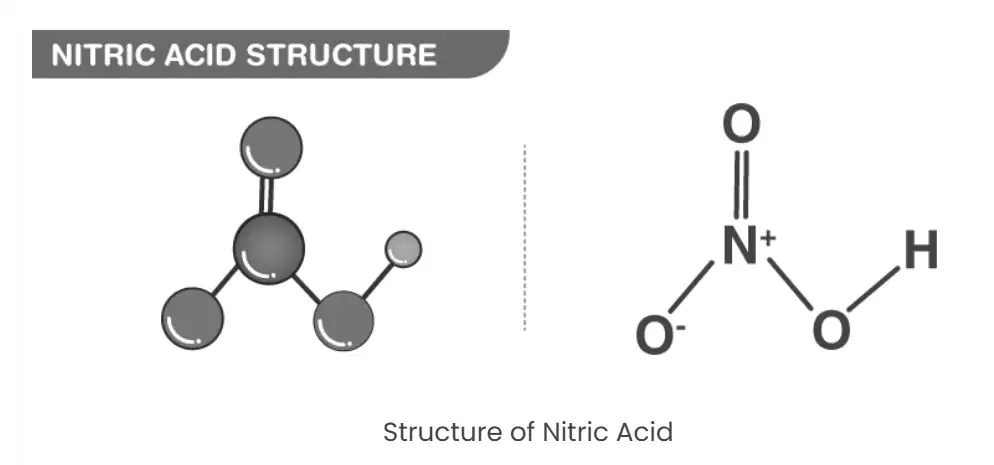
Structural representation of Nitric Acid (HNO3) molecule
Example: Calculating the Total Number of Covalent Bonds in Nitric Acid
Determine the total number of covalent bonds present in a single molecule of nitric acid.
Solution:
The nitrogen atom forms four covalent bonds: one double bond with an oxygen atom and two single bonds with the other two oxygen atoms. One of these oxygen atoms is also bonded to a hydrogen atom.
Counting the bonds:
1 double bond (counts as 2 bonds) between N and O
2 single bonds between N and O
1 single bond between O and H
Total bonds = 2 (double bond) + 2 (single bonds N-O) + 1 (O-H) = 5 covalent bonds.
Laboratory Synthesis and Collection Techniques for Nitric Acid
Methodology for Preparing Nitric Acid in the Lab
The laboratory preparation of nitric acid relies on the principle that a more volatile acid can be displaced from its salt by a less volatile acid. In this process, concentrated sulfuric acid, which is less volatile, reacts with a nitrate salt to release nitric acid vapors.
For example, potassium nitrate (KNO3) reacts with concentrated sulfuric acid (H2SO4) when heated carefully to about 200°C, producing potassium bisulfate (KHSO4) and nitric acid (HNO3).
The chemical reaction is:
\[ \mathrm{KNO_3 + H_2SO_4 \rightarrow KHSO_4 + HNO_3} \]
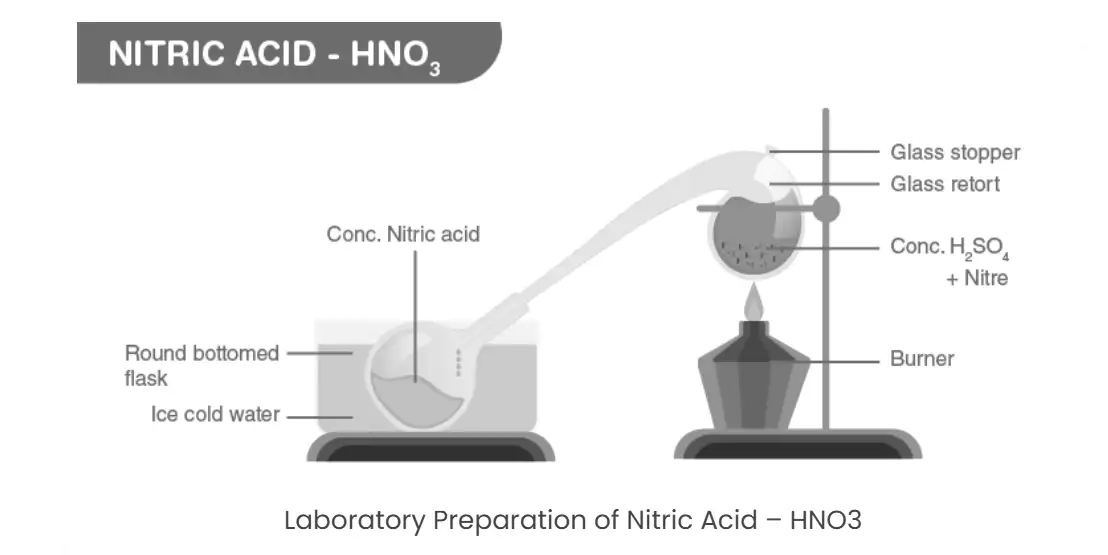
Laboratory apparatus for synthesizing Nitric Acid
Example: Calculating the Theoretical Yield of Nitric Acid
Calculate the theoretical amount of nitric acid produced when 60 g of potassium nitrate reacts with excess concentrated sulfuric acid.
Solution:
Molar mass of KNO3 = 39.1 + 14 + (16 × 3) = 101.1 g/mol
Moles of KNO3 = \( \frac{60}{101.1} = 0.593 \text{ mol} \)
From the balanced equation, 1 mole of KNO3 produces 1 mole of HNO3.
Molar mass of HNO3 = 1 + 14 + (16 × 3) = 63 g/mol
Theoretical mass of HNO3 = \( 0.593 \times 63 = 37.36 \text{ g} \)
Therefore, 37.36 g of nitric acid can be theoretically obtained.
Procedure for Collecting Nitric Acid Vapors
During the reaction, nitric acid vapors are released and must be condensed to collect the liquid acid. This is achieved by cooling the vapors in a condenser, where they liquefy and are collected in a receiver. Proper temperature control is essential to prevent decomposition and loss of product.
Physical and Chemical Behavior of Nitric Acid
Key Physical Characteristics
Nitric acid is a colorless liquid in its pure form, with a pungent and acrid odor. It is highly corrosive and toxic, capable of causing severe burns upon contact with skin. The acid has a pH of approximately 3.0, indicating strong acidity. Over time, exposure to air causes it to develop a yellowish color due to the formation of nitrogen dioxide.
Reactivity and Chemical Properties
Nitric acid is a strong acid that turns blue litmus paper red. It decomposes slowly when exposed to air, producing brown nitrogen dioxide gas, which imparts a yellow-brown color to aged samples. The decomposition reaction is:
\[ 4 \mathrm{HNO_3} \rightarrow 4 \mathrm{NO_2} + \mathrm{O_2} + 2 \mathrm{H_2O} \]
It reacts with metals that are more reactive than hydrogen, liberating hydrogen gas and forming metal nitrates. For example:
\[ \mathrm{Mg} + 2 \mathrm{HNO_3} \rightarrow \mathrm{Mg(NO_3)_2} + \mathrm{H_2} \]
\[ \mathrm{Mn} + 2 \mathrm{HNO_3} \rightarrow \mathrm{Mn(NO_3)_2} + \mathrm{H_2} \]
Example: Predicting the Products of Reaction Between Zinc and Nitric Acid
What are the products when zinc metal reacts with dilute nitric acid?
Solution:
Zinc is more reactive than hydrogen, so it displaces hydrogen from nitric acid, forming zinc nitrate and hydrogen gas.
Chemical equation:
\[ \mathrm{Zn} + 2 \mathrm{HNO_3} \rightarrow \mathrm{Zn(NO_3)_2} + \mathrm{H_2} \]
This reaction releases hydrogen gas and produces zinc nitrate in solution.
Industrial and Practical Applications of Nitric Acid
Utilization in Various Sectors
Nitric acid is a vital chemical in multiple industries due to its strong oxidizing properties and ability to form nitrates. Its primary uses include:
Production of ammonium nitrate, a key component in fertilizers and explosives.
Manufacture of explosives such as trinitrotoluene (TNT).
Use as an oxidizer in liquid-fueled rocket propellants.
Application in medical treatments, such as wart removal in its pure form.
Employment as a doping agent in electrochemical processes.
Example: Identifying the Role of Nitric Acid in Fertilizer Production
Explain how nitric acid contributes to the manufacture of fertilizers.
Answer:
Nitric acid reacts with ammonia to produce ammonium nitrate, a nitrogen-rich fertilizer.
Ammonium nitrate provides essential nitrogen nutrients to plants, promoting growth.
The acid's ability to form nitrates makes it indispensable in fertilizer chemistry.
Quick Reference: Essential Facts About Nitric Acid
Aspect | Details |
|---|---|
Chemical Formula | HNO3 |
Physical State | Colorless liquid (turns yellow on aging) |
Odor | Pungent, acrid |
pH | Approximately 3.0 |
Preparation Method | Displacement from potassium nitrate by concentrated sulfuric acid |
Key Reactions | Reacts with metals to form nitrates and hydrogen gas; decomposes to nitrogen dioxide |
Uses | Fertilizers, explosives, rocket propellants, electrochemistry, medical applications |
Hazards | Highly corrosive and toxic; causes severe burns |
Glossary of Key Terms Related to Nitric Acid
Term | Definition |
|---|---|
Corrosive | Substance that can destroy or irreversibly damage materials or living tissue. |
Oxidizing Agent | A chemical that accepts electrons and causes another substance to be oxidized. |
Volatile Acid | An acid that easily vaporizes at relatively low temperatures. |
Resonance | Delocalization of electrons within molecules that can be represented by multiple structures. |
Nitrate | An ion or salt containing the NO3− group. |
Decomposition | The breakdown of a compound into simpler substances. |
Ammonium Nitrate | A nitrogenous fertilizer produced by reacting ammonia with nitric acid. |
pH | A scale used to specify the acidity or basicity of an aqueous solution. |
Passivation | The process by which a material becomes less affected by environmental factors. |
Hydronium Ion | The ion H3O+ formed when an acid donates a proton to water. |
Frequently Asked Questions About Nitric Acid
How can nitric acid be identified in the laboratory?
Nitric acid appears as a colorless to pale yellow liquid with a sharp, acrid smell. Concentrated samples release nitrogen dioxide gases, which are brownish in color.
What is the taste of nitric acid?
Being a strong acid, nitric acid has a bitter and sour taste, but tasting it is dangerous and not recommended due to its corrosive nature.
Does nitric acid react with water?
Yes, nitric acid ionizes in water to produce hydronium ions (H3O+) and nitrate ions (NO3−), making the solution acidic.
Which metals are dissolved by nitric acid?
Many reactive metals such as magnesium and manganese react with nitric acid to form nitrates and hydrogen gas. However, noble metals like gold and platinum resist oxidation by nitric acid.
What substance can neutralize nitric acid spills safely?
Sodium bicarbonate is commonly used to neutralize nitric acid safely, converting it into harmless salts and carbon dioxide.