Understanding Molar Conductivity in Electrolyte Solutions
Fundamentals of Molar Conductivity
Concept and Definition of Molar Conductivity
Molar conductivity quantifies the ability of all ions produced by dissolving one mole of an electrolyte to conduct electricity in a solution. It depends on the ionic concentration and is not a fixed value. Essentially, it measures the conductance of a solution volume containing exactly one mole of dissolved electrolyte placed between electrodes one centimetre apart with a unit cross-sectional area.
This property is crucial for evaluating how effectively an electrolyte facilitates electrical conduction in a solution, reflecting the combined contribution of its ions.
The mathematical expression for molar conductivity is:
\[ \Lambda_m = \frac{K}{c} \]
where \( K \) is the specific conductivity (conductance per unit length and cross-sectional area) and \( c \) is the molar concentration in moles per litre.
The SI unit of molar conductivity is Siemens meter squared per mole (\( \text{S} \cdot \text{m}^2 \cdot \text{mol}^{-1} \)).
Example Problem
Calculate the molar conductivity of a sodium chloride solution with a concentration of 0.25 M and a specific conductivity of 0.020 S/cm at 298 K.
Solution:
First, convert specific conductivity to S/m:
\[ 0.020 \text{ S/cm} = 0.020 \times 100 = 2.0 \text{ S/m} \]
Using the formula:
\[ \Lambda_m = \frac{K}{c} = \frac{2.0 \text{ S/m}}{0.25 \text{ mol/L}} = \frac{2.0}{0.25} = 8.0 \text{ S m}^2 \text{ mol}^{-1} \]
Therefore, the molar conductivity is \( 8.0 \text{ S m}^2 \text{ mol}^{-1} \).
Influence of Concentration on Molar Conductivity
How Dilution Affects Molar Conductivity in Electrolytes
Molar conductivity varies with the concentration of the electrolyte solution. As the solution becomes more diluted, molar conductivity generally increases for both strong and weak electrolytes. This occurs because dilution promotes greater dissociation of electrolyte molecules into ions, increasing the number of charge carriers available to conduct electricity.
For strong electrolytes, the increase in molar conductivity with dilution is gradual and can be described by Kohlrausch’s law:
\[ \Lambda_m = \Lambda_m^0 - A \sqrt{c} \]
Here, \( \Lambda_m^0 \) is the limiting molar conductivity at infinite dilution, \( A \) is a constant dependent on the electrolyte and temperature, and \( c \) is the concentration.
In contrast, weak electrolytes show a sharp rise in molar conductivity at low concentrations due to increased ionization, while at higher concentrations, their molar conductivity remains low because of limited dissociation.
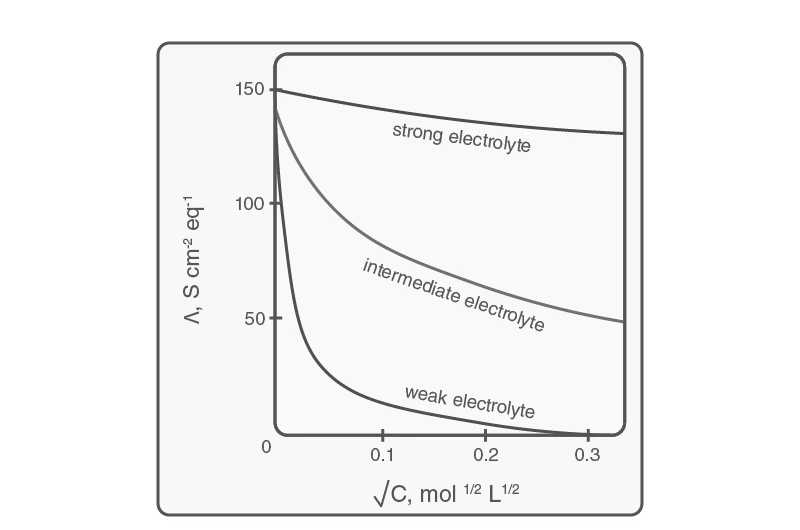
Variation of molar conductivity with concentration for different electrolytes
Example Problem
Given a strong electrolyte with a limiting molar conductivity \( \Lambda_m^0 = 150 \text{ S m}^2 \text{ mol}^{-1} \) and a constant \( A = 10 \text{ S m}^2 \text{ mol}^{-1} \), calculate the molar conductivity at a concentration of 0.04 mol/L.
Solution:
Apply Kohlrausch’s law:
\[ \Lambda_m = 150 - 10 \times \sqrt{0.04} = 150 - 10 \times 0.2 = 150 - 2 = 148 \text{ S m}^2 \text{ mol}^{-1} \]
Thus, the molar conductivity at 0.04 mol/L is \( 148 \text{ S m}^2 \text{ mol}^{-1} \).
Specific Conductivity and Its Role in Electrolyte Solutions
Understanding Specific Conductivity and Its Dependence on Various Factors
Specific conductivity, also known as conductivity, measures how well a given volume of electrolyte solution can conduct electric current. It is the reciprocal of resistance and is expressed in Siemens per meter (S/m).
The conductance \( G \) of a solution is related to its resistance \( R \) by:
\[ G = \frac{1}{R} \]
Resistance depends on the resistivity \( \rho \), length \( l \), and cross-sectional area \( A \) of the solution:
\[ R = \rho \frac{l}{A} \]
Therefore, conductance can be expressed as:
\[ G = \frac{1}{\rho} \times \frac{A}{l} = k \frac{A}{l} \]
where \( k = \frac{1}{\rho} \) is the specific conductivity.
Specific conductivity depends on:
The nature and concentration of the electrolyte
The size and mobility of ions
The solvent’s properties such as viscosity
Temperature of the solution
Since different electrolytes have varying ion concentrations, specific conductivity alone is insufficient for comparing their conductance. This limitation is addressed by using molar conductivity.
Example Problem
A 0.1 M solution of an electrolyte has a resistance of 50 Ω when measured between electrodes 1 cm apart with a cross-sectional area of 1 cm². Calculate the specific conductivity.
Solution:
Given:
Resistance, \( R = 50 \, \Omega \)
Distance between electrodes, \( l = 1 \text{ cm} = 0.01 \text{ m} \)
Cross-sectional area, \( A = 1 \text{ cm}^2 = 1 \times 10^{-4} \text{ m}^2 \)
Specific conductivity \( k \) is:
\[ k = \frac{1}{R} \times \frac{l}{A} = \frac{1}{50} \times \frac{0.01}{1 \times 10^{-4}} = 0.02 \times 100 = 2.0 \text{ S/m} \]
Thus, the specific conductivity is \( 2.0 \text{ S/m} \).
Mechanism of Electrical Conduction in Electrolytes
How Electrolytes Facilitate Electric Current Flow
Electrolytes conduct electricity because they dissociate into free-moving charged ions in solution. This ionic movement is analogous to the flow of free electrons in metallic conductors.
According to Arrhenius’ theory, when an electrolyte dissolves in water, it separates into positively charged cations and negatively charged anions. These ions were initially bound together by electrostatic forces but become free upon dissolution:
\[ AB \rightleftharpoons A^+ + B^- \]
This dissociation is reversible, with ions recombining as well. The migration of these ions under an electric field towards oppositely charged electrodes enables current flow.
For example, in a copper sulfate solution, copper ions move towards the cathode to gain electrons and deposit as copper metal, while sulfate ions move towards the anode and undergo oxidation, releasing electrons back to the circuit.
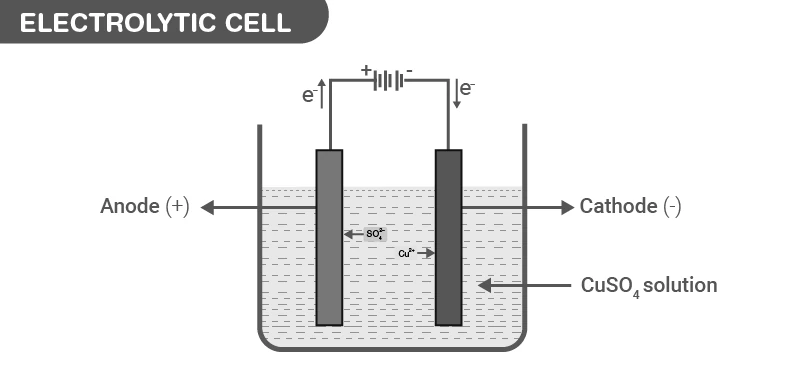
Electrolytic cell illustrating ion movement and electron flow
Example Problem
Explain the role of ions in conducting electricity in an aqueous sodium chloride solution.
Answer:
When NaCl dissolves, it dissociates into Na+ and Cl− ions.
Na+ ions migrate towards the cathode (negative electrode) to gain electrons.
Cl− ions move towards the anode (positive electrode) to lose electrons.
This movement of ions constitutes the electric current in the solution.
Practical Calculations Involving Molar Conductivity
Sample Problems and Stepwise Solutions
Problem 1
Find the molar conductivity of a potassium chloride solution with a concentration of 0.35 M and a specific conductivity of 0.025 S/cm at 298 K.
Solution:
Convert specific conductivity to S/m:
\[ 0.025 \text{ S/cm} = 0.025 \times 100 = 2.5 \text{ S/m} \]
Calculate molar conductivity:
\[ \Lambda_m = \frac{K}{c} = \frac{2.5}{0.35} \approx 7.14 \text{ S m}^2 \text{ mol}^{-1} \]
The molar conductivity is approximately \( 7.14 \text{ S m}^2 \text{ mol}^{-1} \).
Problem 2
A 0.15 M KCl solution has a conductivity of 0.027 S/cm at 298 K. Determine its molar conductivity.
Solution:
Convert conductivity:
\[ 0.027 \text{ S/cm} = 2.7 \text{ S/m} \]
Calculate molar conductivity:
\[ \Lambda_m = \frac{2.7}{0.15} = 18.0 \text{ S m}^2 \text{ mol}^{-1} \]
Thus, molar conductivity is \( 18.0 \text{ S m}^2 \text{ mol}^{-1} \).
Problem 3
Given the molar conductance at infinite dilution of \( \text{Na}^+ \) is \( 50 \times 10^{-4} \text{ S m}^2 \text{ mol}^{-1} \) and \( \text{Cl}^- \) is \( 75 \times 10^{-4} \text{ S m}^2 \text{ mol}^{-1} \), calculate the total molar conductance of NaCl.
Solution:
Sum the individual ionic molar conductances:
\[ \Lambda_m^0 = 50 \times 10^{-4} + 75 \times 10^{-4} = 125 \times 10^{-4} = 1.25 \times 10^{-2} \text{ S m}^2 \text{ mol}^{-1} \]
The total molar conductance of NaCl at infinite dilution is \( 1.25 \times 10^{-2} \text{ S m}^2 \text{ mol}^{-1} \).
Summary Table for Quick Review
Property | Definition | Unit | Dependence |
|---|---|---|---|
Molar Conductivity (\( \Lambda_m \)) | Conductance of all ions from one mole of electrolyte | \( \text{S} \cdot \text{m}^2 \cdot \text{mol}^{-1} \) | Concentration, ionic dissociation |
Specific Conductivity (K) | Conductance per unit length and cross-sectional area | \( \text{S/m} \) | Ion concentration, temperature, solvent |
Conductance (G) | Reciprocal of resistance | \( \text{S} \) | Resistance of solution |
Resistance (R) | Opposition to current flow | \( \Omega \) | Length, area, resistivity |
Kohlrausch’s Law | Variation of molar conductivity with concentration for strong electrolytes | — | Concentration, electrolyte type |
Glossary of Key Terms
Term | Meaning |
|---|---|
Molar Conductivity | Conductance of ions from one mole of electrolyte in solution |
Specific Conductivity | Conductance per unit length and cross-sectional area of solution |
Conductance | Measure of how easily electricity passes through a solution |
Resistance | Opposition offered by a solution to electric current |
Kohlrausch’s Law | Relation describing molar conductivity variation with concentration |
Electrolyte | Substance that dissociates into ions in solution to conduct electricity |
Cation | Positively charged ion |
Anion | Negatively charged ion |
Arrhenius Theory | Explanation of electrolyte dissociation into ions in solution |
Limiting Molar Conductivity | Molar conductivity at infinite dilution where ion interactions are negligible |
Frequently Asked Questions (FAQs)
What is the relationship between specific conductivity and molar conductivity?
Molar conductivity is the specific conductivity divided by the molar concentration of the electrolyte, expressed as \( \Lambda_m = \frac{K}{c} \).
How does molar conductivity of strong electrolytes change with dilution?
For strong electrolytes, molar conductivity increases gradually with dilution due to reduced ion interactions, following Kohlrausch’s law.
Why does molar conductivity of weak electrolytes increase sharply at low concentrations?
Weak electrolytes show a sharp increase in molar conductivity upon dilution because dilution enhances their degree of ionization, increasing free ions.
Why are electrolytes able to conduct electricity?
Electrolytes conduct electricity because they dissociate into free-moving ions that carry charge through the solution.
How does dilution affect specific conductivity and molar conductivity differently?
With dilution, specific conductivity decreases as ion concentration per unit volume drops, but molar conductivity increases because more ions are free to move due to increased dissociation.