Comprehensive Guide to Liquid Chromatography Techniques
Fundamentals of Chromatographic Separation
Core Principles and Components of Chromatography
Chromatography is a vital analytical method employed to separate, identify, and purify components within mixtures for both qualitative and quantitative purposes. The technique relies on the distinct migration rates of substances as they traverse a stationary phase under the influence of a mobile phase.
The stationary phase typically consists of a porous solid such as silica or alumina, while the mobile phase can be a liquid or gas that moves through or over the stationary phase. The interaction differences between the components and these phases enable effective separation.
Example: Consider a mixture containing three compounds X, Y, and Z. When passed through a stationary phase of silica with a mobile phase solvent, each compound migrates at a unique speed due to varying affinities, resulting in their separation.
Understanding the Role of Stationary and Mobile Phases
The stationary phase acts as the fixed medium through which the mobile phase flows. It can be a solid or a liquid layer adsorbed onto a solid support. The mobile phase, either liquid or gas, carries the sample mixture through the stationary phase.
Separation occurs because different molecules in the mixture interact differently with the stationary phase, causing them to move at different rates and thus separate over time.
Example: In a chromatography setup using alumina as the stationary phase and a liquid solvent as the mobile phase, polar molecules may adhere more strongly to alumina and move slower, while non-polar molecules elute faster.
Exploring Liquid Chromatography and Its Variants
Overview of Liquid Chromatography
Liquid Chromatography (LC) is an analytical technique where the mobile phase is a liquid. The process is conducted either in a column or on a flat surface, where the sample dissolved in the mobile phase passes through the stationary phase.
Separation is achieved due to differences in adsorption, partitioning, size, or ionic interactions between the solutes and the stationary phase. This method is particularly effective for separating colored mixtures, but even colorless mixtures can be detected using visualization techniques such as ultraviolet light exposure.
Example: A mixture of dyes is passed through a column with a stationary phase of silica gel and a liquid mobile phase. Due to varying affinities, each dye separates distinctly, allowing identification and quantification.
Classification of Liquid Chromatography Types
Liquid Chromatography can be categorized into four main types based on the nature of the stationary and mobile phases:
Reversed-Phase Chromatography
Normal Phase Chromatography
Ion Exchange Chromatography
Size Exclusion Chromatography
Example: When analyzing a pharmaceutical sample, reversed-phase chromatography might be chosen for its ability to separate hydrophobic compounds effectively.
Detailed Insights into Liquid Chromatography Variants
Reversed-Phase Chromatography Explained
This technique employs a non-polar stationary phase combined with a polar mobile phase. Hydrophilic molecules dissolve in the polar mobile phase and elute quickly, whereas hydrophobic molecules tend to adsorb onto the non-polar stationary phase, delaying their elution.
Commonly, alkyl chains are covalently bonded to the stationary phase particles. Organic solvents mixed with aqueous buffers are used to elute compounds. Ion pairing can also be utilized to separate charged analytes.
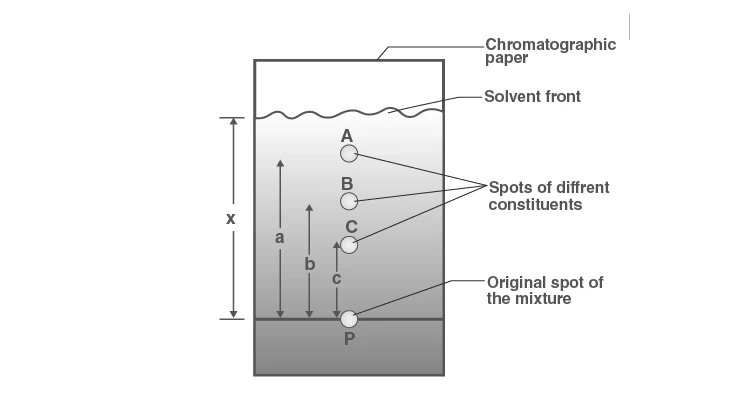
Diagram illustrating the reversed-phase chromatography process
Example: A mixture containing polar and non-polar compounds is passed through a reversed-phase column. The polar compounds elute first, while the non-polar compounds are retained longer, enabling their separation.
Principles of Normal Phase Chromatography
Normal Phase Chromatography uses a polar stationary phase and a non-polar mobile phase. Silica and organic materials with cyano or amino groups are typical stationary phases. The mobile phase often consists of non-polar solvents like hexane mixed with polar solvents such as chloroform or ethyl acetate.
This method is ideal for separating chiral molecules, cis-trans isomers, geometric isomers, and compounds sensitive to water. Less polar substances elute before more polar ones.
Example: Separation of cis and trans isomers of a compound is achieved using normal phase chromatography with a silica stationary phase and hexane as the mobile phase.
Ion Exchange Chromatography Fundamentals
Ion Exchange Chromatography separates ions and polar molecules based on their affinity to an ionic stationary phase, using an aqueous buffer as the mobile phase. It is divided into cation exchange (retaining positive ions) and anion exchange (retaining negative ions).
This technique is widely used to separate organic and inorganic ions and is known for its high tolerance to complex sample matrices and predictable elution patterns. However, it is limited to compounds with ionizable groups.
Example: Separation of amino acids with different charges is performed using cation exchange chromatography, where positively charged amino acids bind to the stationary phase and are eluted selectively.
Understanding Size Exclusion Chromatography
Also called Gel Filtration Chromatography, this method separates molecules based on their size and sometimes molecular weight. The stationary phase contains pores of specific sizes, allowing smaller molecules to enter and be retained longer, while larger molecules elute first.
This technique is commonly applied in separating industrial polymers and proteins.
Example: A protein mixture is passed through a gel filtration column. Larger proteins elute first, followed by smaller proteins, enabling size-based separation.
Key Concepts and Practical Applications
Retention Factor (Rf) and Its Significance
The Retention factor, denoted as \( R_f \), is a crucial parameter in chromatography. It is defined as the ratio of the distance traveled by the analyte to the distance traveled by the solvent front:
\[ R_f = \frac{\text{Distance travelled by analyte}}{\text{Distance travelled by solvent front}} \]
This value is characteristic for each compound under specific conditions and aids in their identification.
Example: In a chromatogram, if compound P travels 3.5 cm and the solvent front moves 7 cm, then
\[ R_f = \frac{3.5}{7} = 0.5 \]
Benefits of Using Liquid Chromatography
Liquid Chromatography offers an economical and efficient method for separating mixtures. The manual control over mobile phase flow, detection of separated bands, and collection of components makes it accessible and versatile.
Additionally, the glassware required is affordable and widely available, making it suitable for various laboratory settings.
Example: A small laboratory uses liquid chromatography to separate plant pigments due to its low cost and ease of operation.
Practical Uses of Liquid Chromatography
This technique finds applications across multiple fields including:
Ink sample analysis
Environmental monitoring and cleanliness assessment
Food quality control
Pharmaceutical and chemical industry testing
Forensic investigations and clinical diagnostics.
Quick Reference Summary
Chromatography Type | Stationary Phase | Mobile Phase | Separation Basis | Typical Applications |
|---|---|---|---|---|
Reversed-Phase | Non-polar (alkyl chains) | Polar solvents (water, buffers) | Hydrophobic interactions | Pharmaceuticals, organic compounds |
Normal Phase | Polar (silica, cyano groups) | Non-polar solvents (hexane) | Polarity differences | Isomer separation, chiral compounds |
Ion Exchange | Ionic (cation/anion exchangers) | Aqueous buffers | Charge affinity | Ion separation, proteins, amino acids |
Size Exclusion | Porous gel matrix | Liquid solvent | Molecular size | Polymers, proteins |
Glossary of Key Terms
Term | Definition |
|---|---|
Chromatography | Technique for separating mixture components based on differential migration. |
Stationary Phase | The fixed phase through which the mobile phase passes during separation. |
Mobile Phase | The moving phase (liquid or gas) that carries the sample through the stationary phase. |
Retention Factor (Rf) | Ratio of distance traveled by analyte to solvent front in chromatography. |
Reversed-Phase Chromatography | Chromatography with non-polar stationary and polar mobile phases. |
Normal Phase Chromatography | Chromatography with polar stationary and non-polar mobile phases. |
Ion Exchange Chromatography | Separation based on ionic interactions between analytes and charged stationary phase. |
Size Exclusion Chromatography | Separation based on molecular size using porous stationary phase. |
Elution | Process of washing out analytes from the stationary phase by the mobile phase. |
Adsorption | Adherence of molecules onto the surface of the stationary phase. |
Frequently Asked Questions
What is the fundamental principle behind chromatography?
Chromatography separates mixture components based on their different migration rates through a stationary phase under the influence of a mobile phase.
How does liquid chromatography differ from other chromatographic methods?
In liquid chromatography, the mobile phase is a liquid, allowing separation based on adsorption, partitioning, size, or ionic interactions, unlike gas chromatography where the mobile phase is a gas.
What determines the choice between reversed-phase and normal phase chromatography?
The polarity of the stationary and mobile phases guides the choice: reversed-phase uses a non-polar stationary phase with a polar mobile phase, while normal phase uses the opposite, depending on the sample's properties.
How is the retention factor (Rf) useful in chromatography?
The Rf value helps identify compounds by comparing the distance traveled by the analyte relative to the solvent front under specific conditions.
What are some common applications of liquid chromatography?
It is widely used in pharmaceutical analysis, environmental testing, food quality control, forensic science, and clinical diagnostics.