Understanding Gas Liquefaction and Critical Phenomena
Exploring the Relationship Between Gas Volume, Temperature, and Pressure
Fundamentals of Gas Behavior and Deviations from Ideal Gas Laws
The process of transforming gases into liquids, known as liquefaction, is crucial in various scientific and industrial applications. Thomas Andrews pioneered the study of how gases behave under different conditions by examining carbon dioxide. His research revealed that at high temperatures, gases tend to follow the ideal gas law closely. However, when pressure increases significantly, gases resist liquefaction despite the ideal gas predictions. As the temperature drops, the gas's behavior diverges from the ideal model, indicating the onset of phase changes.
Illustrative Problem
Consider a gas that behaves ideally at 350 K and 1 atm pressure. If the temperature is lowered to 280 K while increasing the pressure to 50 atm, explain qualitatively how the gas behavior deviates from the ideal gas law and why liquefaction might occur.
Solution:
- At 350 K and 1 atm, the gas molecules are far apart, and interactions are negligible, so ideal gas law applies.
- Lowering temperature to 280 K reduces molecular kinetic energy, increasing intermolecular attractions.
- Increasing pressure to 50 atm forces molecules closer, enhancing these attractions.
- These combined effects cause deviations from ideal gas behavior, leading to condensation or liquefaction.
Critical Constants and Their Role in Gas Liquefaction
Understanding Critical Temperature, Pressure, and Volume
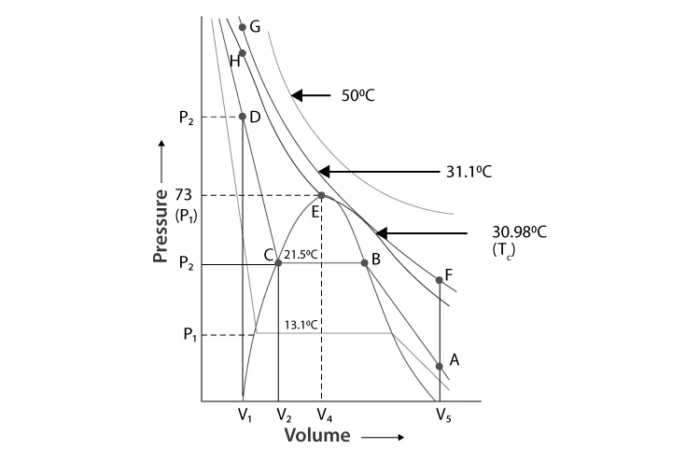
Carbon dioxide remains gaseous up to a pressure of 73 atm and a temperature of 30.98°C. These values are known as the critical pressure and critical temperature, respectively. At this critical point, the gas cannot be liquefied by pressure alone. The volume occupied by one mole of gas at these conditions is termed the critical volume. Beyond this pressure, the gas transitions into a liquid, and further pressure increase compresses the liquid phase. The behavior of carbon dioxide near these critical constants exemplifies the general properties of gases approaching liquefaction.
Numerical Example
Calculate the critical volume of 1 mole of a gas if at the critical temperature \( T_c = 31.0^\circ \text{C} \) and critical pressure \( P_c = 72 \text{ atm} \), the volume is measured as 0.095 \text{ L}.
Solution:
The critical volume \( V_c \) is given directly as the volume at critical temperature and pressure:
\[ V_c = 0.095 \text{ L} \]
This volume represents the molar volume at the critical point where gas and liquid phases become indistinguishable.
Phase Transitions and Isotherm Behavior Below Critical Temperature
Analyzing Gas Compression and Coexistence of Phases
When the temperature falls below the critical temperature, the gas exhibits distinct phase changes upon compression. For example, at 21.5°C, carbon dioxide remains gaseous until a certain pressure (point B) is reached. At this juncture, the gas begins to liquefy, resulting in a mixture of liquid and gas phases coexisting. Further compression does not increase pressure until all gas condenses into liquid (point C). The isotherm graph shows a horizontal segment representing this phase equilibrium. Points A and D correspond to pure gas and pure liquid states, respectively, while the dome-shaped region between them indicates the coexistence of liquid and vapor phases. This behavior is characteristic of all gases undergoing liquefaction.
Applied Problem
At 20°C, a sample of carbon dioxide is compressed from volume \( V_2 = 0.12 \text{ L} \) to \( V_3 = 0.08 \text{ L} \). The pressure increases from \( P_2 = 40 \text{ atm} \) to \( P_3 = 60 \text{ atm} \). Explain the phase changes occurring during this compression.
Solution:
- Initially, CO₂ is in gaseous form at \( V_2 \) and \( P_2 \).
- As volume decreases to \( V_3 \), pressure rises to \( P_3 \), approaching liquefaction conditions.
- Between these points, gas starts condensing into liquid, creating a two-phase mixture.
- The pressure increase indicates compression of gas and partial liquefaction.
Quick Reference: Key Concepts in Gas Liquefaction
| Term | Definition | Significance |
|---|---|---|
| Critical Temperature (\(T_c\)) | Maximum temperature at which a gas can be liquefied by pressure alone | Determines liquefaction feasibility |
| Critical Pressure (\(P_c\)) | Minimum pressure required to liquefy a gas at \(T_c\) | Defines liquefaction threshold |
| Critical Volume (\(V_c\)) | Molar volume of gas at critical temperature and pressure | Indicates phase boundary |
| Isotherm | Curve representing constant temperature on a P-V diagram | Shows phase transitions |
| Phase Equilibrium | State where liquid and gas coexist at constant pressure and temperature | Important for understanding liquefaction |
| Liquefaction | Conversion of gas into liquid by cooling or compression | Essential in industrial gas storage |
| Ideal Gas Law | Equation \( PV = nRT \) describing ideal gas behavior | Baseline for gas behavior |
| Deviation from Ideal Gas | Real gas behavior differing from ideal predictions due to interactions | Indicates phase changes |
| Two-Phase Region | Area on P-V diagram where liquid and gas coexist | Represents phase transition zone |
| Compression | Reduction of gas volume by applying pressure | Method to induce liquefaction |
Glossary of Essential Terms
| Term | Meaning |
|---|---|
| Critical Point | The unique combination of temperature and pressure where gas and liquid phases become indistinguishable |
| Isotherm | A curve on a graph representing states of constant temperature |
| Phase Transition | Change of a substance from one state of matter to another |
| Liquefaction | The process of converting gas into liquid |
| Ideal Gas | A hypothetical gas that perfectly follows the ideal gas law |
| Real Gas | A gas that exhibits deviations from ideal behavior due to molecular interactions |
| Critical Temperature | The highest temperature at which a gas can be liquefied by pressure |
| Critical Pressure | The minimum pressure needed to liquefy a gas at its critical temperature |
| Critical Volume | The volume occupied by one mole of gas at the critical temperature and pressure |
| Two-Phase Region | The area on a phase diagram where liquid and gas coexist in equilibrium |
Frequently Asked Questions
Can a substance exist simultaneously in two states?
Yes, during phase transitions such as boiling or condensation, a substance can exist as both liquid and gas in equilibrium.
How is matter classified based on states?
Matter is generally classified into solid, liquid, and gas states, each with distinct properties of shape and volume.
Why is understanding the three states of matter important?
It helps explain natural phenomena and is essential for applications in science and industry, including material design and chemical processes.
What constitutes matter at the microscopic level?
Matter is composed of atoms and molecules that determine its physical and chemical properties.
Is light considered matter?
No, light is energy in the form of electromagnetic waves and does not have mass or occupy space like matter.