Understanding Limiting Reagents in Chemical Reactions
Core Concept of Limiting Reagents
Defining the Reactant That Controls Reaction Completion
In any chemical reaction, the substance that is fully consumed first, thereby halting further progress, is known as the limiting reagent. This reactant restricts the amount of product formed because once it is exhausted, the reaction cannot proceed, regardless of the quantities of other reactants present.
The concept of limiting reagents is grounded in stoichiometry, which dictates the precise mole ratios required for reactants to combine completely. For example, consider the synthesis of ammonia:
\[ 3\text{H}_2 + \text{N}_2 \rightarrow 2\text{NH}_3 \]
Here, 3 moles of hydrogen gas react with 1 mole of nitrogen gas to produce 2 moles of ammonia. If only 2 moles of hydrogen are available with 1 mole of nitrogen, hydrogen becomes the limiting reagent because it is insufficient to react with all the nitrogen present.
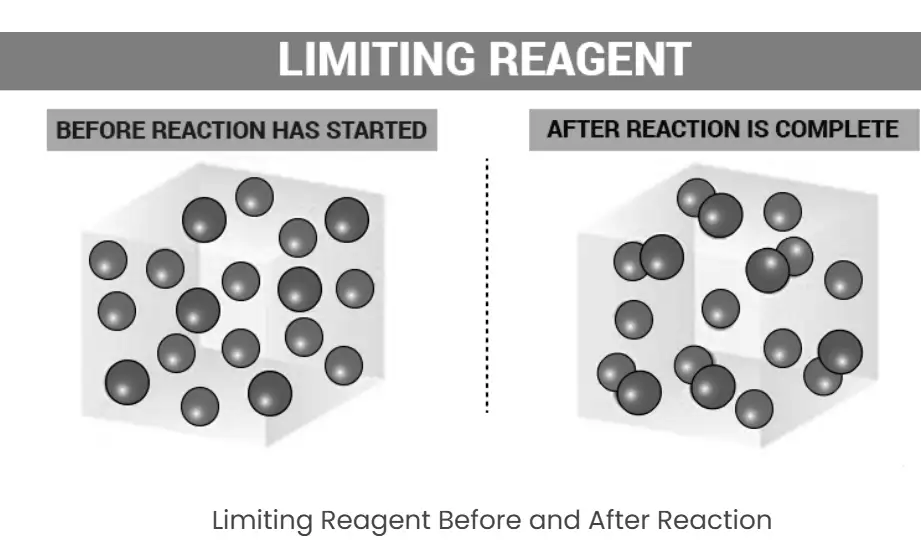
Diagram illustrating the concept of limiting reagent
This example highlights how the limiting reagent determines the extent of the reaction, while the other reactants remain in excess.
Example Problem
Suppose 4 moles of hydrogen gas react with 1 mole of nitrogen gas to form ammonia. Identify the limiting reagent.
Solution:
The balanced equation is:
\[ 3\text{H}_2 + \text{N}_2 \rightarrow 2\text{NH}_3 \]
According to the stoichiometric ratio, 3 moles of \(\text{H}_2\) react with 1 mole of \(\text{N}_2\). Here, 4 moles of \(\text{H}_2\) are available, which is more than the required 3 moles for 1 mole of \(\text{N}_2\).
Therefore, nitrogen gas is the limiting reagent as it will be completely consumed first.
Practical Examples of Limiting Reagents
Identifying the Limiting Reactant in Common Reactions
To understand limiting reagents better, consider the reaction between hydrogen and oxygen to form water:
\[ 2\text{H}_2 + \text{O}_2 \rightarrow 2\text{H}_2\text{O} \]
If 1 mole each of hydrogen and oxygen are mixed, hydrogen will be consumed twice as fast as oxygen, making hydrogen the limiting reagent.
Application Example
Calculate the volume of hydrogen gas produced when 120 g of hydrochloric acid reacts with 65 g of zinc under standard conditions.
Solution:
The reaction is:
\[ 2\text{HCl} (aq) + \text{Zn} (s) \rightarrow \text{ZnCl}_2 (aq) + \text{H}_2 (g) \]
Molar masses: \(\text{HCl} = 36.5 \text{ g/mol}\), \(\text{Zn} = 65 \text{ g/mol}\)
Calculate moles:
\[ \text{Moles of HCl} = \frac{120}{36.5} \approx 3.29 \text{ mol} \]
\[ \text{Moles of Zn} = \frac{65}{65} = 1 \text{ mol} \]
From the balanced equation, 2 moles of HCl react with 1 mole of Zn. For 1 mole of Zn, 2 moles of HCl are required. Since 3.29 moles of HCl are available, Zn is the limiting reagent.
Hydrogen gas produced equals moles of Zn (limiting reagent): 1 mole.
At standard temperature and pressure (STP), 1 mole of gas occupies 22.4 L, so volume of \(\text{H}_2\) is:
\[ 1 \times 22.4 = 22.4 \text{ L} \]
Methods to Determine the Limiting Reagent
Strategies for Identifying the Reactant That Limits Product Formation
Determining the limiting reagent is essential for calculating the maximum amount of product formed in a reaction. Two common approaches are used:
Mole Ratio Method: Compare the mole ratio of reactants used with the stoichiometric ratio from the balanced equation. The reactant that is present in a smaller amount than required is the limiting reagent.
Product Formation Method: Calculate the amount of product each reactant can produce. The reactant yielding the least product is the limiting reagent.
For example, if two reactants A and B react according to the equation:
\[ aA + bB \rightarrow \text{Products} \]
Calculate moles of A and B, then determine the required moles of B to react with A using the ratio \(\frac{b}{a}\). If actual moles of B are less than required, B is limiting; otherwise, A is limiting.
Determination Example
Given 5 moles of reactant A and 3 moles of reactant B reacting as per:
\[ 2A + 3B \rightarrow \text{Products} \]
Find the limiting reagent.
Solution:
Moles of B required for 5 moles of A:
\[ \frac{3}{2} \times 5 = 7.5 \text{ moles} \]
Available moles of B are 3, which is less than 7.5, so B is the limiting reagent.
Quick Reference Summary
Term | Definition | Key Point |
|---|---|---|
Limiting Reagent | The reactant fully consumed first, stopping the reaction. | Determines maximum product formed. |
Excess Reagent | Reactant remaining after reaction completion. | Not fully used up. |
Stoichiometry | Calculation of reactants and products in chemical reactions. | Based on mole ratios. |
Mole Ratio | Ratio of moles of reactants/products from balanced equation. | Essential for limiting reagent identification. |
Balanced Equation | Chemical equation with equal atoms on both sides. | Foundation for stoichiometric calculations. |
Product Yield | Amount of product formed from reactants. | Limited by limiting reagent. |
Standard Temperature and Pressure (STP) | Conditions of 0°C and 1 atm pressure. | Used for gas volume calculations. |
Molar Volume | Volume occupied by one mole of gas at STP. | 22.4 L for ideal gases. |
Reactant | Substance consumed in a chemical reaction. | Participates directly in reaction. |
Reagent | Substance used to cause a chemical reaction. | May or may not be consumed. |
Glossary of Key Terms
Term | Meaning |
|---|---|
Limiting Reagent | The reactant that is completely used up first in a reaction. |
Excess Reagent | The reactant that remains after the limiting reagent is consumed. |
Stoichiometry | The calculation of relative quantities of reactants and products. |
Mole Ratio | The ratio of moles of substances in a balanced chemical equation. |
Balanced Equation | A chemical equation with equal numbers of atoms on both sides. |
Product Yield | The amount of product formed in a chemical reaction. |
Standard Temperature and Pressure (STP) | Defined as 0°C and 1 atm pressure for gas calculations. |
Molar Volume | The volume occupied by one mole of gas at STP, 22.4 L. |
Reactant | A substance that undergoes change during a chemical reaction. |
Reagent | A chemical used to cause a reaction, may or may not be consumed. |
Frequently Asked Questions
What defines a limiting reagent in a chemical reaction?
The limiting reagent is the reactant that is completely consumed first, limiting the amount of product formed.
How does a reactant differ from a reagent?
A reactant directly participates and changes in a reaction, while a reagent is any substance used to cause a reaction.
Why is identifying the limiting reagent important?
It helps predict the maximum amount of product that can be formed and prevents wastage of other reactants.
Are limiting reagents present in every chemical reaction?
Limiting reagents occur when reactants are not in exact stoichiometric proportions, which is common in most reactions.
What advantage does knowing the limiting reagent provide?
It allows chemists to calculate theoretical yields and optimize reactant usage efficiently.