Understanding Ionization and Arrhenius Theory of Acids and Bases
Fundamentals of Ionization in Chemical Compounds
Concept and Mechanism of Ionization
Ionization is the process where neutral molecules split into charged particles called ions when dissolved in a solvent. This transformation results in the formation of positive and negative ions, collectively known as electrolytes. The extent to which this splitting occurs is quantified by the degree of ionization, denoted by \( \alpha \), which is the fraction of molecules that dissociate compared to the total molecules present.
The degree of ionization is mathematically expressed as:
\[ \alpha = \frac{\text{Number of molecules dissociated}}{\text{Total number of molecules}} \]
This parameter helps in understanding how completely a compound ionizes in a given solution.
Example Problem
A 0.1 molar solution of a compound contains 0.02 moles of ionized molecules. Calculate the degree of ionization.
Solution:
Given total moles = 0.1 mol, ionized moles = 0.02 mol.
Degree of ionization,
\[ \alpha = \frac{0.02}{0.1} = 0.2 \]
Thus, 20% of the molecules are ionized in the solution.
Arrhenius’ Explanation of Acid and Base Ionization
Defining Acids and Bases According to Arrhenius
Arrhenius theory classifies acids as substances that increase the concentration of hydrogen ions \( H^+ \) in aqueous solutions, while bases are those that increase hydroxide ions \( OH^- \). This theory is pivotal in explaining how acids and bases behave in water, especially their ionization patterns.
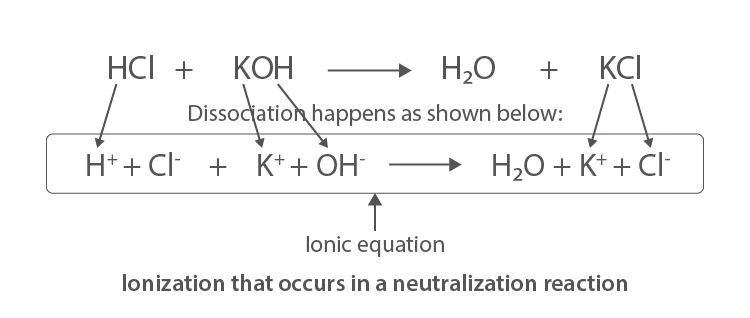
The strength of acids and bases is linked to their degree of ionization. Strong acids like hydrochloric acid (HCl) and perchloric acid (HClO4) dissociate almost completely, releasing a high concentration of \( H^+ \) ions. Similarly, strong bases such as sodium hydroxide (NaOH) and lithium hydroxide (LiOH) fully dissociate to produce \( OH^- \) ions. Weak acids and bases ionize only partially, resulting in lower ion concentrations.
For example, the dissociation of a weak acid \( HA \) in water is represented as:
\[ HA (aq) + H_2O (l) \rightleftharpoons H_3O^+ (aq) + A^- (aq) \]
Example Problem
In a 0.05 M solution of a weak acid \( HA \), 0.005 M of \( H_3O^+ \) ions are produced. Calculate the degree of ionization.
Solution:
Degree of ionization,
\[ \alpha = \frac{\text{Concentration of ionized acid}}{\text{Initial concentration}} = \frac{0.005}{0.05} = 0.1 \]
Therefore, 10% of the acid molecules ionize in the solution.
Equilibrium and Ionization Constants of Acids and Bases
Understanding Ionization Equilibria and Constants
Ionization of acids and bases in water is a reversible process, establishing an equilibrium between the undissociated molecules and the ions formed. For an acid \( HA \), the equilibrium can be written as:
\[ HA (aq) + H_2O (l) \rightleftharpoons H_3O^+ (aq) + A^- (aq) \]
The equilibrium constant \( K \) for this reaction is:
\[ K = \frac{[H_3O^+][A^-]}{[HA][H_2O]} \]
Since the concentration of water remains nearly constant, it is incorporated into the constant to define the acid ionization constant \( K_a \):
\[ K_a = \frac{[H_3O^+][A^-]}{[HA]} \]
A higher \( K_a \) value indicates a stronger acid due to greater ionization.
Similarly, for a base \( BOH \), the ionization equilibrium is:
\[ BOH (aq) + H_2O (l) \rightleftharpoons B^+ (aq) + OH^- (aq) \]
The base ionization constant \( K_b \) is given by:
\[ K_b = \frac{[B^+][OH^-]}{[BOH]} \]
Stronger bases have larger \( K_b \) values, reflecting higher ionization.
Example Problem
A 0.1 M solution of a base \( BOH \) produces \( 0.01 \) M of \( OH^- \) ions at equilibrium. Calculate the base ionization constant \( K_b \) assuming initial concentration of \( BOH \) remains approximately 0.1 M.
Solution:
Concentration of ionized base = \( 0.01 \) M, so:
\[ K_b = \frac{[B^+][OH^-]}{[BOH]} = \frac{(0.01)(0.01)}{0.1} = 1 \times 10^{-3} \]
This value indicates the extent of ionization of the base in solution.
Practical Examples of Acid and Base Ionization
Ionization Reactions of Common Acids and Bases
Acetic acid and ammonium hydroxide are typical examples illustrating ionization in aqueous solutions. Acetic acid partially ionizes as:
\[ CH_3COOH + H_2O \rightleftharpoons H_3O^+ + CH_3COO^- \]
Ammonium hydroxide ionizes as:
\[ NH_4OH + H_2O \rightleftharpoons NH_4^+ + OH^- \]
These equilibria demonstrate the reversible nature of ionization and the formation of hydronium and hydroxide ions respectively.
Example Problem
In a 0.2 M acetic acid solution, the concentration of acetate ions \( CH_3COO^- \) is found to be 0.015 M. Calculate the degree of ionization.
Solution:
\[ \alpha = \frac{0.015}{0.2} = 0.075 \]
Hence, 7.5% of acetic acid molecules ionize in the solution.
Quick Reference: Key Ionization Concepts
| Term | Definition | Formula/Example |
|---|---|---|
| Degree of Ionization (\( \alpha \)) | Fraction of molecules ionized in solution | \( \alpha = \frac{\text{Ionized molecules}}{\text{Total molecules}} \) |
| Arrhenius Acid | Substance increasing \( H^+ \) ions in water | e.g., \( HCl \rightarrow H^+ + Cl^- \) |
| Arrhenius Base | Substance increasing \( OH^- \) ions in water | e.g., \( NaOH \rightarrow Na^+ + OH^- \) |
| Acid Ionization Constant (\( K_a \)) | Equilibrium constant for acid ionization | \( K_a = \frac{[H_3O^+][A^-]}{[HA]} \) |
| Base Ionization Constant (\( K_b \)) | Equilibrium constant for base ionization | \( K_b = \frac{[B^+][OH^-]}{[BOH]} \) |
| Strong Acid/Base | Completely ionizes in solution | High \( \alpha \), high \( K_a \) or \( K_b \) |
| Weak Acid/Base | Partially ionizes in solution | Low \( \alpha \), low \( K_a \) or \( K_b \) |
| Hydronium Ion | Protonated water molecule | \( H_3O^+ \) |
| Electrolyte | Substance producing ions in solution | Acids, bases, salts |
| Ionization Equilibrium | Dynamic balance between ions and molecules | Reversible ionization reactions |
Glossary of Important Terms
| Term | Meaning |
|---|---|
| Ionization | Process of forming ions from neutral molecules |
| Degree of Ionization | Ratio of ionized molecules to total molecules |
| Arrhenius Acid | Substance that increases \( H^+ \) ions in water |
| Arrhenius Base | Substance that increases \( OH^- \) ions in water |
| Electrolyte | Compound that produces ions in solution |
| Equilibrium Constant | Ratio expressing balance of reactants and products |
| Hydronium Ion | Water molecule bonded to a proton, \( H_3O^+ \) |
| Conjugate Acid/Base | Species formed after proton transfer |
| Strong Acid/Base | Substance that ionizes completely |
| Weak Acid/Base | Substance that ionizes partially |
Frequently Asked Questions
What occurs during the ionization of acids and bases?
Acids ionize in water to release hydrogen ions \( H^+ \), while bases ionize to produce hydroxide ions \( OH^- \), increasing the solution's conductivity.
How can we determine if a compound ionizes completely?
If the degree of ionization \( \alpha \) equals 1, it indicates full ionization of the compound in solution.
Is hydrochloric acid a strong or weak acid?
Hydrochloric acid is a strong acid as it dissociates almost entirely in aqueous solutions, reflected by a high degree of ionization.
How is percent ionization calculated for weak acids or bases?
Percent ionization is calculated by dividing the concentration of ionized species by the initial concentration and multiplying by 100.
What defines base ionization in aqueous solutions?
Base ionization refers to the process where a base produces hydroxide ions \( OH^- \) and its conjugate acid in water, characterized by the ionization constant \( K_b \).