Fundamentals and Key Concepts of Organic Chemistry
Understanding Bond Breakage in Organic Reactions
Mechanisms of Covalent Bond Disruption
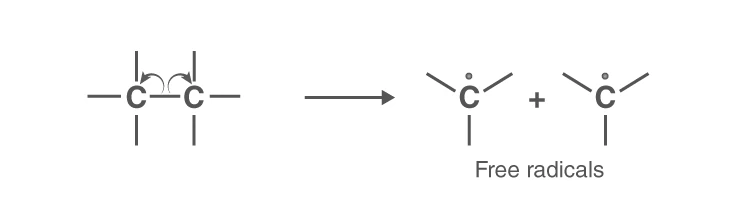
Organic reactions fundamentally involve the rupture and formation of chemical bonds. The cleavage of covalent bonds can occur in two distinct manners: homolytic and heterolytic. Homolytic cleavage results in each atom retaining one electron from the bond, producing free radicals. Conversely, heterolytic cleavage leads to an uneven distribution of electrons, generating charged species such as ions.
Recognizing the type of bond cleavage is crucial for predicting reaction pathways and intermediates in organic chemistry.
Illustration of Homolytic Bond Cleavage
In homolytic cleavage, the bond breaks symmetrically, and each atom acquires one electron, forming free radicals. This process is often depicted using fish-hook arrows to indicate the movement of a single electron.

Example Problem
Consider a molecule of chlorine (Cl2) undergoing homolytic cleavage under UV light. Calculate the number of free radicals formed and describe their electronic configuration.
Solution:
When Cl2 breaks homolytically, each chlorine atom receives one electron from the shared pair, resulting in two chlorine free radicals.
Each chlorine radical has an unpaired electron in its outer shell, making it highly reactive.
Thus, the reaction produces 2 Cl· radicals, each with 7 valence electrons and one unpaired electron.
Concepts of Heterolytic Bond Cleavage
Heterolytic cleavage involves the unequal division of electrons in a bond, where one atom retains both bonding electrons, resulting in the formation of a cation and an anion. This process is typically represented with full-headed arrows indicating the movement of an electron pair.

Example Problem
In the heterolytic cleavage of hydrogen chloride (HCl), identify the ions formed and their charges.
Solution:
During heterolytic cleavage, the bonding electrons move towards the more electronegative chlorine atom.
This results in the formation of H+ (proton) and Cl− (chloride ion).
Hence, the products are H+ (cation) and Cl− (anion).
Key Reactive Species and Intermediates in Organic Chemistry
Defining Reaction Intermediates
Intermediates are transient species formed during multi-step organic reactions. For a reaction sequence A → B → C, the species B is an intermediate. These intermediates often determine the reaction mechanism and can sometimes be isolated or detected experimentally.
Characteristics of Carbenes
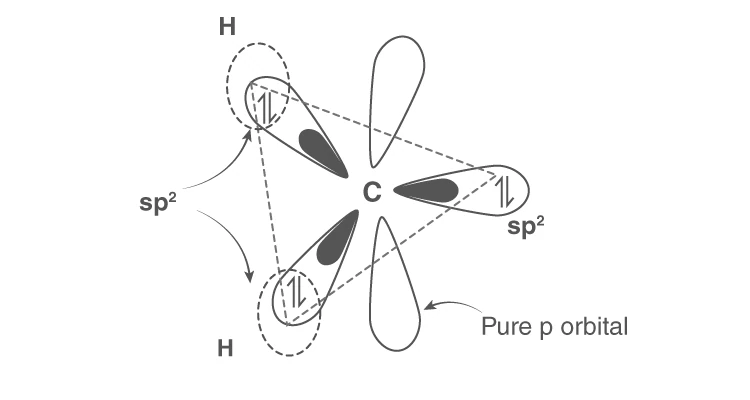
Carbenes are neutral, highly reactive species containing a divalent carbon atom with six valence electrons, making them electron-deficient. They exist in two spin states: singlet and triplet.
Singlet carbenes have paired electrons in the same orbital with opposite spins, resulting in a spin state of 1. They are typically sp2 hybridized with a bent geometry.
Triplet carbenes have two unpaired electrons in separate orbitals with parallel spins, giving a spin state of 3. They are sp hybridized and exhibit a linear shape.
Example Problem
Compare the stability of singlet and triplet carbenes and explain the reason for the difference.
Solution:
- Triplet carbenes are more stable due to lower electron-electron repulsion, as their unpaired electrons occupy different orbitals.
- Singlet carbenes have paired electrons in the same orbital, increasing repulsion and energy.
- Therefore, triplet carbenes possess lower energy and greater stability than singlet carbenes.
Free Radicals in Organic Chemistry
Free radicals are species with an unpaired electron, typically formed by homolytic cleavage of carbon bonds. They are generally planar and sp3 hybridized, with the unpaired electron residing in a p-orbital. Stability of free radicals depends on their structure and resonance possibilities.
Example Problem
Explain why tertiary free radicals are more stable than primary free radicals.
Solution:
- Tertiary free radicals are stabilized by hyperconjugation from adjacent alkyl groups donating electron density.
- Primary free radicals have fewer alkyl groups to provide such stabilization.
- Thus, the stability order is tertiary > secondary > primary free radicals.
Carbanions and Carbocations Explained
Carbanions are negatively charged carbon species formed by heterolytic cleavage where the carbon retains both bonding electrons. They are sp3 hybridized and have a pyramidal shape due to the lone pair.
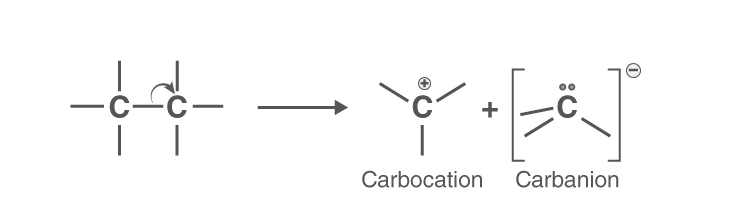
Carbocations are positively charged carbon species with an empty p-orbital, sp2 hybridized, and planar in shape. They form typically by heterolytic cleavage where the carbon loses bonding electrons.
Example Problem
Describe the hybridization and geometry of a carbocation and explain why it is planar.
Solution:
- Carbocations are sp2 hybridized with three sigma bonds and an empty p-orbital.
- The empty p-orbital is perpendicular to the plane of the sigma bonds, resulting in a trigonal planar geometry.
- This planar structure allows for maximum overlap and stabilization of the empty orbital.
Energy Profiles and Reagent Roles in Organic Transformations
Transition States Versus Intermediates
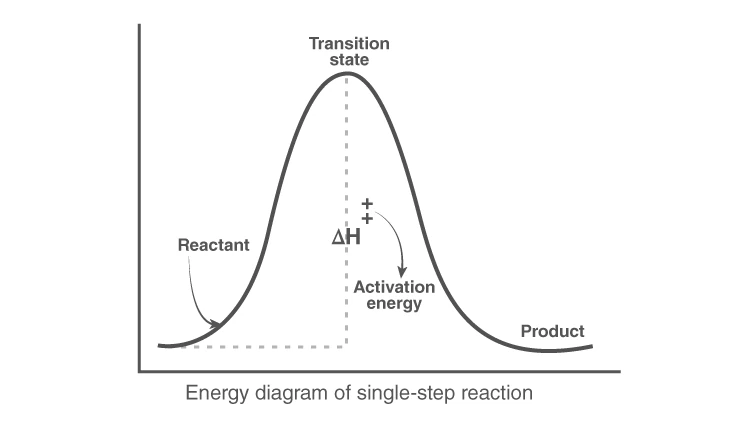
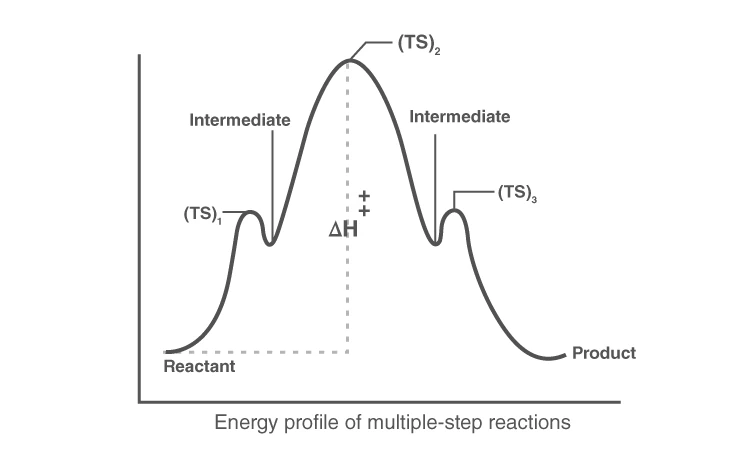
In organic reactions, transition states represent the highest energy points along the reaction coordinate and are not isolable. Intermediates, however, are species formed at energy minima between steps and can sometimes be isolated.
The energy profile of a reaction illustrates these concepts, showing peaks for transition states and valleys for intermediates.
Example Problem
For a reaction sequence A → B → C → D, identify which species are intermediates and which represent transition states.
Solution:
- B and C are intermediates as they are energy minima and can be isolated.
- Transition states correspond to the energy maxima between these intermediates.
- Transition states are transient and cannot be isolated.
Classification and Function of Reagents
Reagents are substances added to organic molecules to induce specific chemical changes. They are broadly categorized based on their electron affinity:
- Electrophiles: Electron-deficient species that accept electrons, often positively charged or neutral Lewis acids.
- Nucleophiles: Electron-rich species that donate electrons, often negatively charged or neutral molecules with lone pairs.
General reaction format:
\[ \text{Substrate} + \text{Reagent} \rightarrow \text{Product} \]
Example Problem
Classify the following reagents as electrophiles or nucleophiles: H+, OH−, AlCl3, NH3.
Solution:
- H+: Electrophile (positively charged)
- OH−: Nucleophile (negatively charged)
- AlCl3: Electrophile (neutral Lewis acid)
- NH3: Nucleophile (neutral molecule with lone pair)
Overview of Organic Reaction Types
Organic reactions are classified into several categories based on their mechanisms and outcomes:
- Substitution Reactions: Replacement of one group by another, e.g., nucleophilic (SN1, SN2) and electrophilic substitutions.
- Addition Reactions: Addition of atoms or groups to unsaturated molecules, subdivided into electrophilic and nucleophilic additions.
- Elimination Reactions: Removal of atoms or groups, often reversing addition reactions, classified as E1, E2, and E1CB.
- Oxidation-Reduction Reactions: Electron transfer processes altering oxidation states.
- Pericyclic Reactions: Concerted reactions involving cyclic transition states.
- Molecular Rearrangements: Structural reorganization within molecules.
Electronic Effects and Stability in Organic Molecules
Inductive Effect and Electron Distribution
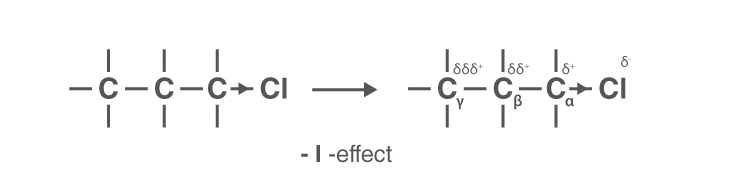
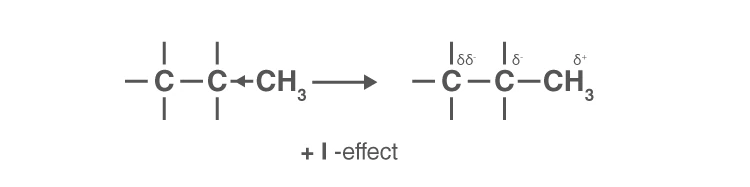
The inductive effect involves the transmission of electron density through sigma bonds due to electronegativity differences. Electron-withdrawing groups (-I effect) pull electron density away, making adjacent carbons slightly positive, while electron-donating groups (+I effect) push electron density towards carbons.
Example Problem
Predict the effect of a chlorine substituent on the electron density of the adjacent carbon atoms in a chloropropane molecule.
Solution:
- Chlorine is more electronegative and exerts a -I effect.
- It withdraws electron density from the α-carbon, making it slightly positive.
- This effect diminishes rapidly along the carbon chain and is negligible beyond the β-carbon.
Electromeric Effect and Temporary Electron Shifts
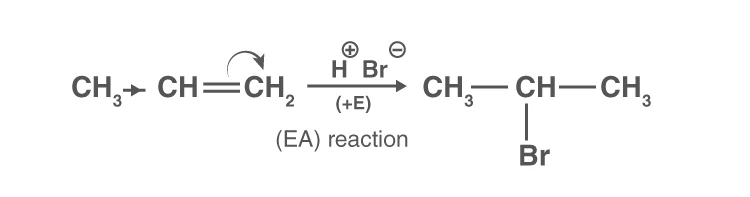
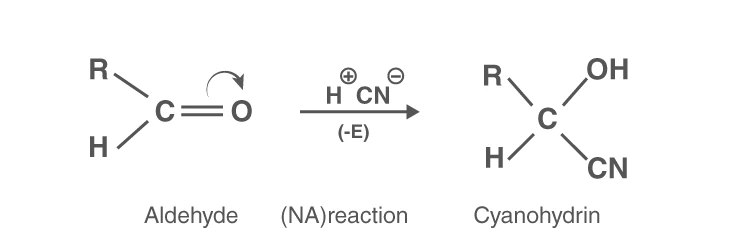
The electromeric effect is a transient shift of π-electrons in response to an attacking reagent. It has two types:
- Positive Electromeric Effect (+E): π-electrons are donated to the reagent, common in electrophilic additions.
- Negative Electromeric Effect (−E): π-electrons shift towards a more electronegative atom, typical in nucleophilic additions.
Example Problem
Explain the role of the positive electromeric effect in the reaction of ethene with H+.
Solution:
- Ethene’s π-electrons are donated to the proton (H+), forming a carbocation intermediate.
- This is an example of the +E effect facilitating electrophilic addition.
- The carbocation then reacts further to complete the addition.
Mesomeric Effect and Resonance Stabilization
The mesomeric effect arises from the permanent delocalization of π-electrons in conjugated systems, enhancing molecular stability. It is classified as:
- Positive Mesomeric Effect (+M): Electron donation into the conjugated system by groups with lone pairs.
- Negative Mesomeric Effect (−M): Electron withdrawal from the conjugated system by electron-withdrawing groups.
Resonance involves multiple canonical forms contributing to the actual hybrid structure, which cannot be represented by a single Lewis structure.
Example Problem
Why is the carbonate ion (CO32−) more stable than predicted by a single Lewis structure?
Solution:
- It has multiple resonance structures with delocalized π-electrons.
- The resonance hybrid distributes charge evenly, lowering energy.
- This delocalization accounts for its enhanced stability.
Impact of Steric Hindrance on Molecular Stability
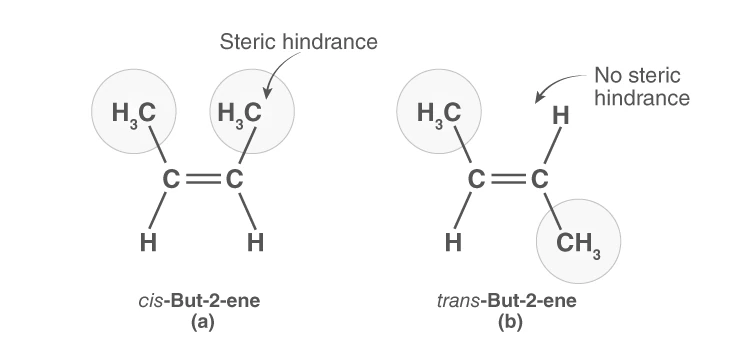
Steric hindrance occurs when bulky groups in a molecule cause spatial crowding, leading to electronic repulsions that affect reactivity and stability. For example, trans-2-butene is more stable than cis-2-butene due to reduced steric strain.
Example Problem
Explain why trans-2-butene is more stable than cis-2-butene using steric hindrance concepts.
Solution:
- In cis-2-butene, bulky methyl groups are on the same side, causing repulsion.
- In trans-2-butene, methyl groups are opposite, minimizing steric strain.
- Reduced steric hindrance in trans isomer leads to greater stability.
Factors Affecting Stability of Organic Intermediates
Carbocation Stability and Inductive Effects
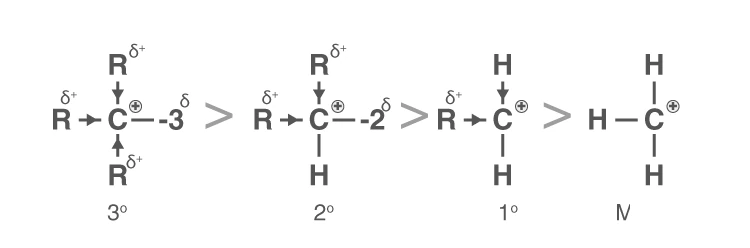
Carbocation stability increases with the number of alkyl substituents due to the +I effect, where alkyl groups donate electron density through sigma bonds, stabilizing the positively charged carbon.
Example Problem
Arrange the following carbocations in order of increasing stability: methyl, primary, secondary, tertiary.
Solution:
The stability order is:
\[ \text{methyl} < \text{primary} < \text{secondary} < \text{tertiary} \]
This is due to the increasing +I effect from alkyl groups stabilizing the positive charge.
Hyperconjugation and Carbocation Stability
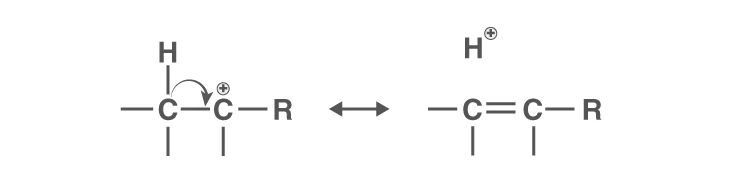
Hyperconjugation involves the delocalization of electrons from adjacent C-H sigma bonds into the empty p-orbital of a carbocation, enhancing its stability. The greater the number of α-hydrogens, the more hyperconjugated structures are possible.
Example Problem
Explain how hyperconjugation stabilizes a tertiary carbocation more than a primary carbocation.
Solution:
- Tertiary carbocations have more adjacent C-H bonds available for hyperconjugation.
- Electron density from these bonds delocalizes into the empty p-orbital.
- This delocalization reduces positive charge density, increasing stability.
Carbanion Stability and Electron Donation
Carbanions are destabilized by alkyl groups due to their electron-donating +I effect, which increases electron density on an already negatively charged carbon, causing repulsion.
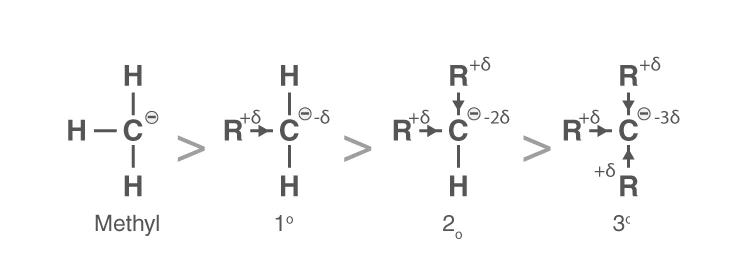
Example Problem
Rank the following carbanions in order of stability: methyl, primary, secondary, tertiary.
Solution:
The stability order is:
\[ \text{tertiary} < \text{secondary} < \text{primary} < \text{methyl} \]
Alkyl groups destabilize carbanions by increasing electron density and repulsion.
Free Radical Stability Trends
Free radicals follow a stability trend similar to carbocations, with tertiary radicals being more stable due to hyperconjugation and possible resonance stabilization.
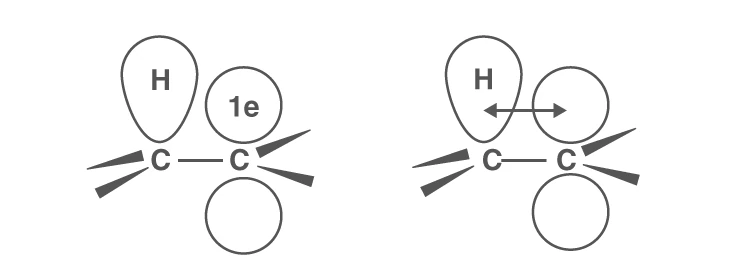
Example Problem
Why does resonance increase the stability of certain free radicals?
Solution:
- Resonance allows the unpaired electron to be delocalized over multiple atoms.
- This delocalization lowers the energy and increases stability.
- Therefore, free radicals with resonance structures are more stable than those without.
Quick Reference Summary
| Concept | Definition | Key Characteristics |
|---|---|---|
| Homolytic Cleavage | Equal splitting of bond electrons | Forms free radicals; fish-hook arrows used |
| Heterolytic Cleavage | Unequal splitting of bond electrons | Forms ions; full-headed arrows used |
| Carbenes | Neutral divalent carbon species | Singlet (paired electrons), triplet (unpaired electrons) |
| Free Radicals | Species with unpaired electron | Planar, sp3 hybridized, reactive |
| Carbocations | Positively charged carbon species | sp2 hybridized, planar, stabilized by +I and hyperconjugation |
| Carbanions | Negatively charged carbon species | sp3 hybridized, pyramidal, destabilized by alkyl groups |
| Transition State | Highest energy point in reaction | Not isolable, transient |
| Inductive Effect | Electron shift through sigma bonds | +I (electron donating), -I (electron withdrawing) |
| Electromeric Effect | Temporary π-electron shift | +E (donation), -E (withdrawal) |
| Mesomeric Effect | Permanent π-electron delocalization | +M (electron donation), -M (electron withdrawal) |
Glossary of Essential Terms
| Term | Meaning |
|---|---|
| Carbene | A reactive species with a divalent carbon atom having six valence electrons. |
| Free Radical | A molecule or atom with an unpaired electron, highly reactive. |
| Carbocation | A positively charged carbon species with an empty p-orbital. |
| Carbanion | A negatively charged carbon species with a lone pair of electrons. |
| Homolytic Cleavage | Bond breaking where each atom retains one electron. |
| Heterolytic Cleavage | Bond breaking where one atom retains both bonding electrons. |
| Inductive Effect | Electron density shift through sigma bonds due to electronegativity differences. |
| Electromeric Effect | Temporary shift of π-electrons in response to an attacking reagent. |
| Mesomeric Effect | Permanent delocalization of π-electrons in conjugated systems. |
| Hyperconjugation | Delocalization of electrons from adjacent C-H bonds into an empty p-orbital. |
Frequently Asked Questions
What is the difference between homolytic and heterolytic bond cleavage?
Homolytic cleavage splits the bond electrons equally, forming free radicals, while heterolytic cleavage results in one atom taking both electrons, producing ions.
Why are triplet carbenes more stable than singlet carbenes?
Triplet carbenes have unpaired electrons in separate orbitals, reducing electron repulsion and lowering energy compared to singlet carbenes with paired electrons in the same orbital.
How does the inductive effect influence carbocation stability?
Electron-donating alkyl groups stabilize carbocations by donating electron density through sigma bonds (+I effect), increasing carbocation stability.
What role does hyperconjugation play in organic intermediates?
Hyperconjugation delocalizes electrons from adjacent C-H bonds into empty orbitals, stabilizing carbocations and free radicals.
Can transition states be isolated like intermediates?
No, transition states are high-energy, transient configurations that cannot be isolated, unlike intermediates which may be isolable.