Understanding Intermolecular Forces and Their Types
Fundamentals of Intermolecular Attractions
What Are Intermolecular Forces?
Intermolecular forces (IMFs) are the forces of attraction or repulsion that occur between molecules within a substance. These forces govern how molecules interact with each other and play a crucial role in determining the physical and chemical behavior of materials.
Unlike the strong bonds holding atoms together within a molecule, intermolecular forces are generally weaker but essential for phenomena such as the formation of liquids and solids. They influence properties like boiling points, melting points, and solubility.
For example, the particles in solids and liquids are held together by these forces, which is why these states of matter have definite shapes or volumes compared to gases.
Classification of Intermolecular Forces
Dipole-Dipole Attractions Between Polar Molecules
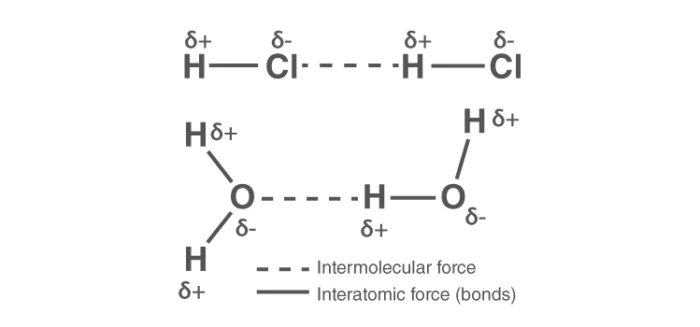
Dipole-dipole forces arise when molecules with permanent dipoles attract each other. These dipoles form because atoms in a molecule have different electronegativities, causing uneven electron distribution and partial charges.
The positive end of one polar molecule is drawn to the negative end of another, creating an attractive force that affects the substance's physical properties.
Ion-Related Interactions in Molecular Systems
Ion-Dipole Forces Between Ions and Polar Molecules
Ion-dipole interactions occur when charged ions attract polar molecules. This force is significant in solutions where ionic compounds dissolve in polar solvents like water.
The strength of this interaction depends on factors such as the ion's charge and size, as well as the dipole moment and size of the polar molecule.
Ion-Induced Dipole Forces: Polarization by Ions
Ion-induced dipole forces happen when an ion causes a nearby non-polar molecule to become temporarily polarized, creating an induced dipole. This induced dipole then interacts attractively with the ion.
Interactions Involving Induced Dipoles and Temporary Forces
Dipole-Induced Dipole Attractions
These forces occur when a polar molecule induces a dipole in a neighboring non-polar molecule by distorting its electron cloud. The resulting induced dipole then interacts with the original polar molecule, creating an attraction.
London Dispersion Forces: The Weakest Intermolecular Attraction
Dispersion forces, also known as London forces, are the weakest type of intermolecular forces. They arise from the momentary fluctuations in electron density within molecules, creating temporary dipoles that attract neighboring molecules.
These forces act over very short distances and are present in all molecules, whether polar or non-polar.
Summary of Key Intermolecular Forces
| Type of Force | Description | Example | Relative Strength |
|---|---|---|---|
| Dipole-Dipole | Attraction between permanent dipoles of polar molecules | HCl molecules | Moderate |
| Ion-Dipole | Between ions and polar molecules | NaCl in water | Strong |
| Ion-Induced Dipole | Ion polarizes a non-polar molecule | Na+ and O2 | Moderate |
| Dipole-Induced Dipole | Polar molecule induces dipole in non-polar molecule | H2O and O2 | Weak |
| London Dispersion | Temporary dipoles due to electron movement | Argon atoms | Weakest |
Glossary of Important Terms
| Term | Definition |
|---|---|
| Intermolecular Forces | Attractive or repulsive forces between molecules affecting physical properties. |
| Dipole | A molecule with separated positive and negative charges due to uneven electron distribution. |
| Polar Molecule | A molecule with a permanent dipole moment caused by electronegativity differences. |
| Ion-Dipole Interaction | Attraction between an ion and a polar molecule. |
| Induced Dipole | A temporary dipole formed when a molecule's electron cloud is distorted. |
| London Dispersion Forces | Weak forces due to temporary dipoles in all molecules. |
| Electronegativity | The tendency of an atom to attract electrons in a chemical bond. |
| Boiling Point | The temperature at which a liquid changes to vapor, influenced by intermolecular forces. |
| Polarization | The distortion of electron cloud in a molecule or atom. |
| Van der Waals Forces | Collective term for dipole-dipole, dipole-induced dipole, and dispersion forces. |
Frequently Asked Questions
How do intermolecular forces influence boiling points?
Stronger intermolecular forces require more energy to break, resulting in higher boiling points. For example, ionic interactions lead to higher boiling points than dispersion forces.
What are van der Waals forces?
Van der Waals forces are weak attractions between neutral molecules caused by induced or permanent dipoles, including dispersion and dipole-dipole forces.
What distinguishes intermolecular from intramolecular forces?
Intramolecular forces hold atoms together within a molecule, while intermolecular forces act between separate molecules.
How many main types of intermolecular forces exist?
There are five primary types: dipole-dipole, ion-dipole, ion-induced dipole, dipole-induced dipole, and London dispersion forces.
Which intermolecular force is the weakest and which is the strongest?
Dispersion forces are the weakest, while ion-dipole interactions are among the strongest intermolecular forces.