Comprehensive Guide to Hydrogen Fuel and Fuel Cells
Fundamentals of Hydrogen as a Clean Energy Source
Understanding Hydrogen Fuel and Its Characteristics
Hydrogen fuel is gaining attention as a clean energy alternative because it produces no harmful emissions when combusted with oxygen, releasing only water vapor. This element, known for its unique properties, shares similarities with both alkali metals and halogens, making it versatile in chemical reactions. The combustion of hydrogen generates a significant amount of heat, which is why it is considered a promising fuel for future energy needs.
Hydrogen fuel cells, in particular, are remarkable for their high energy output. They can deliver up to three times the efficiency of traditional petrol engines while producing far fewer pollutants. This makes hydrogen fuel cells an attractive option for reducing environmental impact while meeting energy demands.
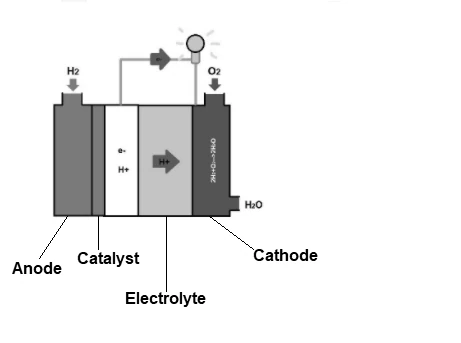
In a typical hydrogen fuel cell, hydrogen serves as the primary fuel, but oxygen is also essential for the reaction. The fuel cell operates by combining hydrogen and oxygen electrochemically to generate electricity, with water as the only by-product. The cell contains an electrolyte that transports charged particles between electrodes and a catalyst that speeds up the chemical reactions.
Example Problem: Energy Comparison of Hydrogen Fuel
A hydrogen fuel cell produces 3 times more energy than a petrol engine. If a petrol engine produces 50 kW of power, calculate the power output of the hydrogen fuel cell.
Solution:
The power output of the hydrogen fuel cell is:
\[ 3 \times 50 \text{ kW} = 150 \text{ kW} \]
Thus, the hydrogen fuel cell produces 150 kW of power, demonstrating its superior efficiency.
Mechanism and Applications of Hydrogen Fuel Cells
How Hydrogen Fuel Cells Operate and Their Environmental Impact
Hydrogen fuel cells are electrochemical devices that convert hydrogen and oxygen into electricity, heat, and water without combustion. Hydrogen atoms enter the fuel cell at the anode, where they lose electrons and become positively charged ions. These electrons travel through an external circuit, providing electric current, while the ions move through the electrolyte to the cathode, where they combine with oxygen and electrons to form water.
Unlike traditional combustion engines, fuel cells produce electricity with minimal pollution. The main by-product is water, making them environmentally friendly. However, impurities such as nitrogen in hydrogen gas can lead to nitrogen oxide emissions, which can be mitigated by controlling temperature and moisture within the cell.
Fuel cells are not limited to vehicles; they are also used in stationary power generation for residential and commercial buildings, often utilizing hydrogen or natural gas as fuel. The waste heat generated can be harnessed for heating purposes, improving overall energy efficiency.
Example Problem: Electrochemical Reaction in a Fuel Cell
In a hydrogen fuel cell, hydrogen atoms lose electrons at the anode. If 2 moles of hydrogen react, calculate the total charge (in coulombs) produced, given that 1 mole of electrons carries a charge of approximately 96485 C.
Solution:
Each hydrogen molecule (H2) releases 2 moles of electrons. For 2 moles of H2:
\[ \text{Total moles of electrons} = 2 \times 2 = 4 \text{ moles} \]
Total charge produced:
\[ 4 \times 96485 \text{ C} = 385940 \text{ C} \]
Therefore, 385,940 coulombs of charge are generated during the reaction.
Production Methods and Future Prospects of Hydrogen Energy
Industrial Techniques for Generating Hydrogen Fuel
Hydrogen is not readily available in its pure form in nature and must be produced using energy-intensive methods. Two common industrial processes are steam methane reforming and electrolysis.
Steam methane reforming extracts hydrogen from methane but releases carbon dioxide and carbon monoxide, contributing to greenhouse gas emissions and climate change. Conversely, electrolysis splits water into hydrogen and oxygen using electricity, which can be sourced from renewable energies such as solar, wind, or hydro power, making it a cleaner alternative.
Example Problem: Hydrogen Production via Electrolysis
If 36 grams of water are electrolyzed, calculate the amount of hydrogen gas produced. (Molar mass of water = 18 g/mol, and water splits into 2 moles of hydrogen atoms per mole of water.)
Solution:
Number of moles of water:
\[ \frac{36 \text{ g}}{18 \text{ g/mol}} = 2 \text{ moles} \]
Each mole of water produces 2 moles of hydrogen atoms, which combine to form hydrogen gas (H2):
\[ 2 \text{ moles water} \times 2 = 4 \text{ moles of H atoms} \]
Since 2 hydrogen atoms form 1 molecule of H2, moles of hydrogen gas produced:
\[ \frac{4}{2} = 2 \text{ moles of H}_2 \]
Molar mass of H2 = 2 g/mol, so mass of hydrogen gas:
\[ 2 \times 2 \text{ g} = 4 \text{ g} \]
Thus, 4 grams of hydrogen gas are produced from 36 grams of water.
Concept of the Hydrogen Economy and Its Applications
The "hydrogen economy" envisions hydrogen as a key energy carrier replacing fossil fuels in heating, transportation, and electricity generation. This approach aims to reduce carbon emissions by transmitting energy in the form of hydrogen rather than electricity. Currently, hydrogen is blended with compressed natural gas (CNG) to enhance fuel efficiency and is expected to see broader adoption in the near future.
Hydrogen fuel powers various modes of transport including cars, airplanes, and boats, as well as stationary and portable fuel cell systems. However, challenges such as storage difficulties—due to the need for cryogenic or high-pressure tanks—limit widespread use in vehicles.
Example Problem: Storage Volume of Compressed Hydrogen
A hydrogen gas cylinder stores hydrogen at 200 atmospheres pressure. If the volume of hydrogen at standard atmospheric pressure (1 atm) is 1000 liters, calculate the volume of hydrogen gas in the cylinder.
Solution:
Using Boyle’s Law \( P_1 V_1 = P_2 V_2 \):
\[ 1 \text{ atm} \times 1000 \text{ L} = 200 \text{ atm} \times V_2 \]
\[ V_2 = \frac{1 \times 1000}{200} = 5 \text{ L} \]
The compressed hydrogen occupies 5 liters in the cylinder.
Benefits and Challenges of Using Hydrogen Fuel
Advantages of Hydrogen as a Sustainable Energy Source
Hydrogen fuel offers several environmental and performance benefits:
- Combustion produces only water vapor, eliminating carbon dioxide emissions.
- It significantly reduces tailpipe pollutants compared to fossil fuels.
- Hydrogen fuel cells provide higher efficiency than internal combustion engines.
- They enable cleaner and quieter operation in vehicles and power plants.
Example Problem: Emission Comparison
If a petrol car emits 2.3 kg of CO2 per liter of fuel burned, calculate the CO2 emissions saved by using hydrogen fuel for 50 liters of petrol equivalent.
Solution:
CO2 emissions from petrol:
\[ 2.3 \text{ kg/liter} \times 50 \text{ liters} = 115 \text{ kg} \]
Hydrogen fuel emits zero CO2, so emissions saved are 115 kg.
Limitations and Obstacles in Hydrogen Fuel Adoption
Despite its advantages, hydrogen fuel faces several challenges:
- Storage requires high-pressure or extremely low temperatures, complicating transport and handling.
- Production methods like steam methane reforming emit greenhouse gases unless coupled with carbon capture.
- Fuel cells and hydrogen infrastructure are currently expensive, limiting widespread use.
- Hydrogen’s low energy density by volume demands advanced storage solutions for practical applications.
Exam Tip: Remember that hydrogen fuel cells operate via electrochemical reactions, not combustion, which is why they produce water instead of carbon dioxide.
Quick Reference: Key Points on Hydrogen Fuel
| Aspect | Details |
|---|---|
| Fuel Type | Hydrogen gas (H2) |
| Energy Carrier | Not a primary source; produced from water or hydrocarbons |
| Combustion Products | Water vapor only |
| Production Methods | Steam methane reforming, electrolysis |
| Fuel Cell Output | Electricity, heat, water |
| Efficiency | Up to 80% electrical conversion efficiency |
| Storage Challenges | Requires high pressure or cryogenic temperatures |
| Environmental Impact | Low emissions; potential greenhouse gases from production |
| Applications | Vehicles, stationary power, portable devices |
| Major Limitation | Cost and infrastructure development |
Glossary of Important Terms
| Term | Definition |
|---|---|
| Hydrogen Fuel Cell | An electrochemical device that converts hydrogen and oxygen into electricity and water. |
| Electrolysis | Process of splitting water into hydrogen and oxygen using electricity. |
| Steam Methane Reforming | Industrial method to produce hydrogen from methane, releasing CO2. |
| Electrolyte | Medium in a fuel cell that transports ions between electrodes. |
| Catalyst | Substance that speeds up chemical reactions without being consumed. |
| Redox Reaction | Chemical reaction involving reduction and oxidation processes. |
| Hydrogen Economy | Concept of using hydrogen as a major energy carrier to reduce carbon emissions. |
| Compressed Hydrogen | Hydrogen gas stored under high pressure for use as fuel. |
| Greenhouse Gases | Gases that trap heat in the atmosphere, contributing to climate change. |
| Inverter | Device that converts DC electricity from fuel cells to AC electricity. |
Frequently Asked Questions
How efficient are hydrogen fuel cells compared to traditional engines?
Hydrogen fuel cells can convert up to 80% of the hydrogen's energy into electrical energy, which is significantly higher than the efficiency of internal combustion engines.
What factors influence the power output of a hydrogen fuel cell?
The power depends on the fuel cell type, size, operating temperature, and gas pressure. Typically, a single cell produces about 1 volt, so multiple cells are combined for practical power levels.
What are the main environmental benefits of hydrogen fuel cells?
They produce water as the only emission, reduce greenhouse gases, and lower air pollutants compared to fossil fuel combustion.
What type of chemical reaction occurs in a hydrogen fuel cell?
It is an electrochemical redox reaction where hydrogen is oxidized and oxygen is reduced, releasing energy as electricity and heat.
What are the challenges limiting widespread use of hydrogen fuel cells?
High costs, storage difficulties, and the need for extensive infrastructure are major barriers to large-scale adoption.