Comprehensive Overview of Hydrocarbon Chemistry
Fundamentals and Classification of Hydrocarbons
Understanding Hydrocarbon Composition and Categories
Hydrocarbons are organic molecules exclusively composed of carbon and hydrogen atoms. They often exist as colourless gases with faint odours and can range from simple to complex molecular structures. These compounds are broadly categorized into four main groups: alkanes, alkenes, alkynes, and aromatic hydrocarbons. Studying hydrocarbons is essential as it sheds light on the behavior of various functional groups and their synthesis. Additionally, hydrocarbons like propane and butane are commercially significant as components of Liquefied Petroleum Gas (LPG), while benzene serves as a precursor in pharmaceutical manufacturing.
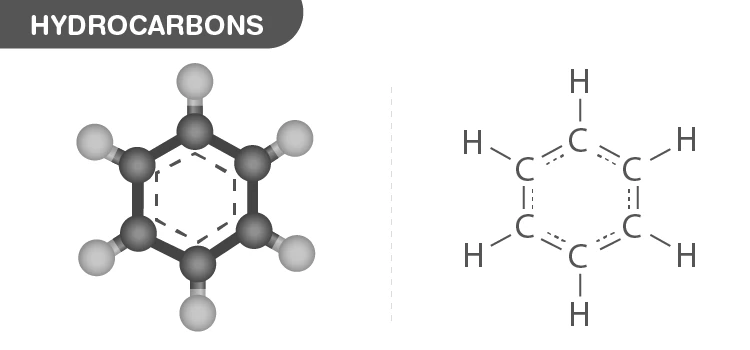
Illustration of Hydrocarbon Molecular Structure
Example Problem
Identify the molecular formula of a hydrocarbon containing 5 carbon atoms and 12 hydrogen atoms. Classify the hydrocarbon based on its saturation.
Solution:
The molecular formula is \( \mathrm{C_5H_{12}} \). This fits the general formula for alkanes, \( \mathrm{C_nH_{2n+2}} \), where \( n=5 \) gives \( 2(5)+2=12 \) hydrogens.
Therefore, the compound is a saturated hydrocarbon, specifically an alkane.
Structural Classification and Types of Hydrocarbons
Hydrocarbons are classified primarily by their bonding and structural features rather than their origin. The main types include:
Saturated Hydrocarbons (Alkanes): Contain only single bonds between carbon atoms, with the general formula \( \mathrm{C_nH_{2n+2}} \). Carbon atoms are sp³ hybridized.
Unsaturated Hydrocarbons: Include alkenes with one or more double bonds (\( \mathrm{C_nH_{2n}} \)) and alkynes with one or more triple bonds (\( \mathrm{C_nH_{2n-2}} \)).
Cycloalkanes: Saturated hydrocarbons forming ring structures with single bonds.
Aromatic Hydrocarbons (Arenes): Contain one or more benzene-like rings with delocalized π-electrons.
Aliphatic Hydrocarbons: Straight or branched chains without rings.
Alicyclic Hydrocarbons: Ring structures that are not aromatic, with carbons possibly sp, sp², or sp³ hybridized.
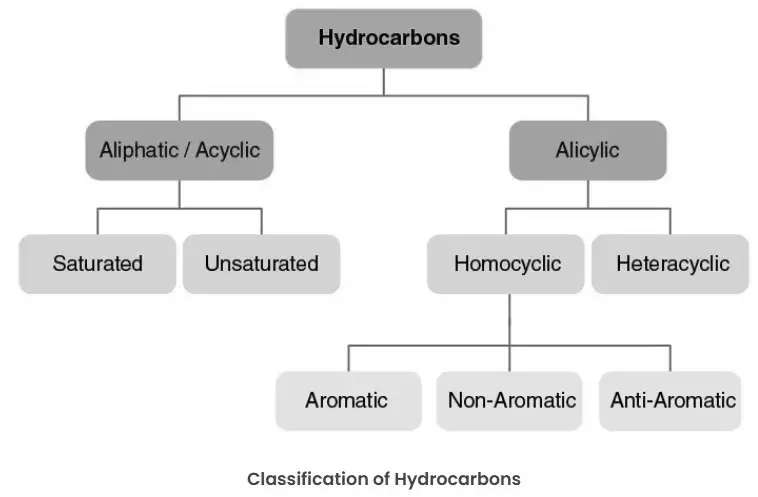
Diagram Depicting Hydrocarbon Classifications
Example Problem
Classify the hydrocarbon with the formula \( \mathrm{C_4H_6} \) and describe its bonding type.
Solution:
The formula \( \mathrm{C_4H_6} \) fits the general formula for alkynes, \( \mathrm{C_nH_{2n-2}} \), where \( n=4 \) gives \( 2(4)-2=6 \) hydrogens.
This indicates the presence of at least one triple bond, classifying it as an unsaturated hydrocarbon (alkyne).
Physical and Chemical Characteristics of Hydrocarbons
Key Physical Traits and Molecular Behavior
The physical properties of hydrocarbons vary with their molecular structure. Alkanes with fewer than 10 carbon atoms are typically gases at room temperature, while larger molecules tend to be liquids or solids. Their boiling and melting points are generally low due to weak Van der Waals forces. Factors influencing boiling points include molecular mass and branching; higher molecular mass increases boiling points, whereas increased branching reduces them by decreasing surface area and intermolecular forces. Hydrocarbons are mostly insoluble in water but dissolve well in non-polar solvents like benzene and carbon tetrachloride.
Example Problem
Compare the boiling points of n-butane and isobutane and explain the difference.
Solution:
Both have the molecular formula \( \mathrm{C_4H_{10}} \), but n-butane is a straight chain, while isobutane is branched.
Due to less branching, n-butane has a higher boiling point (approximately \(-0.5^\circ \mathrm{C}\)) compared to isobutane (approximately \(-11.7^\circ \mathrm{C}\)) because straight chains have greater surface area, leading to stronger Van der Waals forces.
Chemical Properties and Reactions of Hydrocarbons
Hydrocarbons exhibit diverse chemical behaviors depending on their saturation and structure. The process of cracking breaks large hydrocarbon molecules into smaller, more useful ones by applying heat and pressure, often with catalysts. This is vital in producing fuels like gasoline and diesel. Saturated hydrocarbons are generally less reactive, while unsaturated hydrocarbons readily undergo addition reactions. Aromatic hydrocarbons typically participate in electrophilic substitution reactions.
Example Problem
Explain the cracking of a heavy hydrocarbon molecule \( \mathrm{C_{16}H_{34}} \) and write a possible reaction.
Solution:
Cracking breaks down large alkanes into smaller alkanes and alkenes. For example:
\[ \mathrm{C_{16}H_{34} \xrightarrow{heat, catalyst} C_8H_{18} + C_8H_{16}} \]
This reaction produces octane (alkane) and octene (alkene), which are more useful as fuels.
Methods of Synthesizing Hydrocarbons and Their Applications
Techniques for Producing Alkanes, Alkenes, and Alkynes
Alkanes can be synthesized by hydrogenating alkenes or alkynes using catalysts such as nickel or platinum. For instance, ethene can be converted to ethane by passing hydrogen gas over a nickel catalyst. Alkyl halides can also be reduced to alkanes using reagents like lithium aluminium hydride (LiAlH₄) or sodium borohydride (NaBH₄), though their effectiveness varies with the halide type. Alkenes are commonly prepared through elimination reactions, including E1 and E2 mechanisms, which remove atoms or groups to form double bonds. Alkynes can be synthesized from alkyl halides or alcohols via elimination or substitution reactions.
Example Problem
Describe the hydrogenation of propene to propane and write the balanced chemical equation.
Solution:
Propene (\( \mathrm{C_3H_6} \)) reacts with hydrogen gas in the presence of a nickel catalyst to form propane (\( \mathrm{C_3H_8} \)):
\[ \mathrm{CH_3-CH=CH_2 + H_2 \xrightarrow{Ni} CH_3-CH_2-CH_3} \]
This reaction saturates the double bond, converting the alkene to an alkane.
Industrial and Practical Uses of Hydrocarbons
Hydrocarbons serve as essential fuels, such as LPG and CNG, powering vehicles and heating systems. They are foundational in producing polymers like polyethylene and polystyrene, which are widely used plastics. Additionally, hydrocarbons act as precursors in manufacturing pharmaceuticals, dyes, lubricants, and greases, highlighting their versatility in various industries.
Example Problem
List three major applications of hydrocarbons in everyday life and industry.
Solution:
Used as fuels: LPG and CNG for cooking and transportation.
Raw materials for polymer production: polyethylene and polystyrene plastics.
Precursors in pharmaceutical and dye synthesis.
Quick Reference: Hydrocarbon Essentials
Hydrocarbon Type | General Formula | Bonding | Example |
|---|---|---|---|
Alkanes (Saturated) | \( \mathrm{C_nH_{2n+2}} \) | Single bonds (sp³) | Methane (\( \mathrm{CH_4} \)) |
Alkenes (Unsaturated) | \( \mathrm{C_nH_{2n}} \) | At least one double bond (sp²) | Ethene (\( \mathrm{C_2H_4} \)) |
Alkynes (Unsaturated) | \( \mathrm{C_nH_{2n-2}} \) | At least one triple bond (sp) | Ethyne (\( \mathrm{C_2H_2} \)) |
Cycloalkanes | \( \mathrm{C_nH_{2n}} \) | Ring with single bonds | Cyclohexane (\( \mathrm{C_6H_{12}} \)) |
Aromatic Hydrocarbons | Varies (benzene: \( \mathrm{C_6H_6} \)) | Delocalized π-electrons in rings | Benzene (\( \mathrm{C_6H_6} \)) |
Glossary of Key Terms in Hydrocarbon Chemistry
Term | Definition |
|---|---|
Alkane | A saturated hydrocarbon with only single bonds between carbon atoms. |
Alkene | An unsaturated hydrocarbon containing at least one carbon-carbon double bond. |
Alkyne | An unsaturated hydrocarbon with one or more carbon-carbon triple bonds. |
Aromatic Hydrocarbon | Hydrocarbons containing one or more benzene-like rings with delocalized electrons. |
Catenation | The ability of carbon atoms to bond with each other forming chains or rings. |
Cracking | A process that breaks large hydrocarbon molecules into smaller, more useful ones. |
Hydrogenation | The addition of hydrogen to unsaturated hydrocarbons to form saturated ones. |
Elimination Reaction | A reaction where atoms or groups are removed from a molecule to form double or triple bonds. |
Van der Waals Forces | Weak intermolecular forces affecting boiling and melting points of hydrocarbons. |
Hybridization | The mixing of atomic orbitals to form new hybrid orbitals in molecules. |
Frequently Asked Questions on Hydrocarbons
What are the main categories of hydrocarbons?
Hydrocarbons are mainly classified into alkanes (saturated), alkenes and alkynes (unsaturated), cycloalkanes (ringed saturated), and aromatic hydrocarbons (containing benzene rings).
What elements constitute hydrocarbons?
Hydrocarbons consist solely of carbon and hydrogen atoms bonded together.
Why do alkanes exhibit low chemical reactivity?
Alkanes have strong single bonds and lack functional groups, making them relatively inert under normal conditions.
How does branching affect the boiling point of hydrocarbons?
Increased branching reduces surface area, weakening Van der Waals forces and lowering the boiling point compared to straight-chain isomers.
What is the product formed when ethene undergoes ozonolysis?
Ozonolysis of ethene produces two molecules of formaldehyde (methanal), \( \mathrm{HCHO} \).