Essential Properties and Trends of Noble Gases
Overview of Noble Gas Elements
Composition and Stability of Noble Gases
The elements in Group 18 of the periodic table, commonly called noble gases, include helium (He), neon (Ne), argon (Ar), krypton (Kr), xenon (Xe), and radon (Rn). These gases are characterized by their full outer electron shells, which confer exceptional stability. Except for helium, which has two electrons in its outermost shell, all other noble gases possess eight valence electrons, resulting in a highly stable octet configuration. This electronic arrangement makes them largely unreactive under normal conditions, earning them the label of inert gases.
Due to their chemical inertness, noble gases rarely form compounds, and their physical and chemical properties follow distinct trends down the group.
Group 18 elements - Noble Gases
Example Problem
List all the noble gases and explain why helium is an exception in terms of its valence electrons.
Solution:
The noble gases are helium (He), neon (Ne), argon (Ar), krypton (Kr), xenon (Xe), and radon (Rn).
All these elements have a full outer shell, typically with eight electrons (octet), except helium, which has only two electrons (duplet) in its first shell.
This duplet configuration in helium is stable because the first shell can hold a maximum of two electrons, unlike other shells that require eight electrons for stability.
Electronic Structure and Its Impact on Properties
Valence Electron Configuration of Noble Gases
Noble gases exhibit a general valence electron configuration of \( ns^2 np^6 \), which corresponds to a complete outer shell, except helium, which has the configuration \( 1s^2 \). This full valence shell is the primary reason for their chemical inertness and stability. The filled orbitals make these atoms energetically stable and less likely to gain or lose electrons.
Example Problem
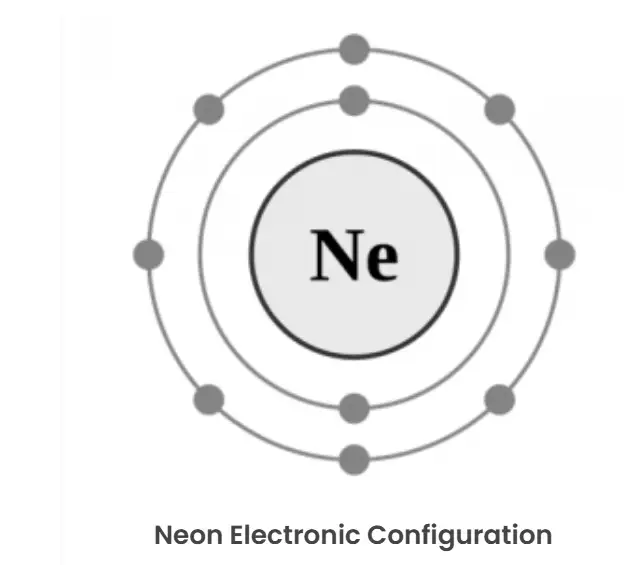
Write the electronic configuration of neon and explain why it is chemically unreactive.
Solution:
Neon has an atomic number of 10. Its electronic configuration is \( 1s^2 2s^2 2p^6 \).
The outermost shell (second shell) has 8 electrons, fulfilling the octet rule.
This full valence shell makes neon highly stable and unreactive because it does not tend to gain or lose electrons.
Neon Electronic Configuration
Physical and Chemical Trends in Noble Gases
Variation of Atomic Radius Down the Group
Atomic size in noble gases is relatively small compared to other elements in the same period. As we move down Group 18, the atomic radius increases due to the addition of electron shells. This increase in shell number outweighs the effect of increasing nuclear charge, resulting in a larger atomic size for heavier noble gases.
Example Problem
Compare the atomic radii of helium and xenon and explain the trend observed in Group 18.
Solution:
Helium has the smallest atomic radius because it has only one electron shell.
Xenon has a larger atomic radius due to the presence of more electron shells (five shells).
The atomic radius increases down the group because each successive element has an additional electron shell, increasing the distance between the nucleus and the outermost electrons.
Ionization Energy Patterns Among Noble Gases
Noble gases possess very high ionization energies because removing an electron from a stable, full valence shell requires significant energy. However, ionization energy decreases as we move down the group because the outer electrons are farther from the nucleus and experience less electrostatic attraction, making them easier to remove.
Example Problem
Explain why helium has a higher ionization energy than radon.
Solution:
Helium's electrons are closer to the nucleus and experience a stronger nuclear attraction.
Radon's outer electrons are farther from the nucleus due to more electron shells, reducing the effective nuclear attraction.
Therefore, helium requires more energy to remove an electron, resulting in a higher ionization energy.
Electron Gain Enthalpy Characteristics
Due to their stable electron configurations, noble gases have large positive electron gain enthalpy values, indicating that they do not tend to gain electrons easily. Adding an electron would disrupt their stable octet or duplet, which is energetically unfavorable.
Example Problem
Why do noble gases have positive electron gain enthalpy values?
Solution:
Their valence shells are already full, so gaining an electron would require placing it in a higher energy level.
This process is endothermic, meaning energy must be supplied, resulting in positive electron gain enthalpy.
Hence, noble gases are reluctant to accept additional electrons.
Quick Reference: Summary of Noble Gas Properties
Property | Trend in Group 18 | Explanation |
|---|---|---|
Valence Electron Configuration | \( ns^2 np^6 \) (except He: \( 1s^2 \)) | Full outer shell leads to chemical inertness |
Atomic Radius | Increases down the group | Additional electron shells increase size |
Ionization Energy | Decreases down the group | Outer electrons are farther from nucleus, easier to remove |
Electron Gain Enthalpy | Large positive values | Stable configuration resists gaining electrons |
Chemical Reactivity | Very low | Full valence shell makes them inert |
Glossary of Key Terms
Term | Definition |
|---|---|
Octet Rule | Atoms tend to have eight electrons in their valence shell for stability. |
Duplet Configuration | Stable arrangement of two electrons in the first shell, as in helium. |
Valence Electrons | Electrons present in the outermost shell of an atom. |
Ionization Energy | Energy required to remove an electron from a gaseous atom or ion. |
Electron Gain Enthalpy | Energy change when an electron is added to a neutral atom. |
Atomic Radius | Distance from the nucleus to the outermost electron shell. |
Inert Gas | Another name for noble gases due to their low reactivity. |
Electron Shell | Energy level where electrons orbit the nucleus. |
Stable Configuration | Electron arrangement that makes an atom less reactive. |
Group 18 | The last column in the periodic table containing noble gases. |
Frequently Asked Questions
Why are noble gases chemically inert?
Because they have full valence electron shells, making them energetically stable and unlikely to react.
What makes helium different from other noble gases?
Helium has only two electrons in its outer shell (duplet), which is stable for its first shell, unlike the octet configuration of others.
How does atomic radius change in noble gases down the group?
Atomic radius increases down the group due to the addition of electron shells, despite increasing nuclear charge.
Why do noble gases have high ionization energies?
Because removing an electron from a full valence shell requires a large amount of energy.
Can noble gases form compounds?
They rarely form compounds due to their stable electron configurations, but some heavier noble gases can form compounds under special conditions.