Comprehensive Overview of Halogen Elements
Fundamental Traits and Electronic Structure of Halogens
Introduction to Halogen Elements
The halogen group, positioned as group 17 in the periodic table, comprises highly reactive non-metallic elements including fluorine, chlorine, bromine, iodine, and astatine. These elements share strikingly similar chemical and physical characteristics, a uniformity rarely observed in other groups. The term "halogen" originates from Greek, meaning "salt producer," reflecting their tendency to form salts when combined with metals.
Each halogen atom contains seven electrons in its outermost shell, following the general electronic configuration \( ns^2 np^5 \). This configuration leaves them one electron short of achieving the stable noble gas electron arrangement, which drives their high reactivity. Among them, astatine is unique as it is radioactive.
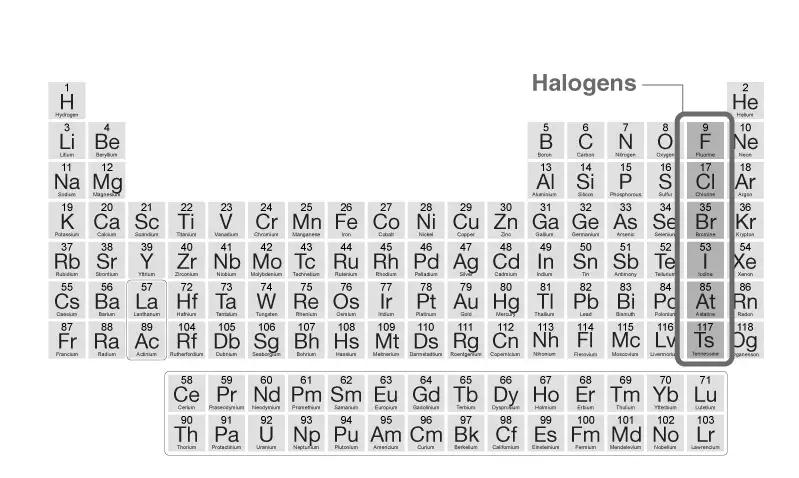
Visual representation of the halogen family
Example Problem
Question: Explain why halogens are highly reactive and identify the electronic configuration that contributes to this property.
Solution:
Halogens have seven valence electrons, making them one electron short of a full octet.
This incomplete octet creates a strong tendency to gain one electron to achieve stability.
The general electronic configuration is \( ns^2 np^5 \), which is highly reactive due to the desire to complete the octet.
This electron deficiency explains their vigorous chemical activity, especially in forming halide compounds.
Oxidation States and Their Influence on Halogen Chemistry
Varied Oxidation States in Halogen Elements
Halogens predominantly exhibit an oxidation state of -1, reflecting their tendency to gain an electron. However, chlorine, bromine, and iodine can also display positive oxidation states of +1, +3, +5, and +7. These higher states occur when halogens bond with highly electronegative atoms such as fluorine and oxygen.
For instance, chlorine and bromine form oxides and oxoacids where they exhibit +4 and +6 oxidation states. Fluorine, due to the absence of d orbitals and its extreme electronegativity, remains restricted to the -1 state and cannot expand its octet.
Example Problem
Question: Why does fluorine only exhibit an oxidation state of -1, while chlorine can show multiple positive oxidation states?
Solution:
Fluorine lacks available d orbitals in its valence shell, preventing it from expanding its octet.
Its high electronegativity strongly favors gaining one electron, resulting in only the -1 oxidation state.
Chlorine has accessible d orbitals, allowing it to form compounds with higher oxidation states (+1, +3, +5, +7) when bonded with electronegative atoms like oxygen and fluorine.
Reactivity and Chemical Behavior of Halogen Elements
Interaction with Metals, Non-metals, and Water
Halogens are known for their vigorous reactivity, readily combining with metals and non-metals to form halide compounds. Their oxidizing power diminishes down the group, with fluorine being the most potent oxidizer. This trend is evident in their ability to oxidize halide ions of elements with higher atomic numbers, as shown in the reaction:
\[ \mathrm{F}_2 + 2X^- \rightarrow 2\mathrm{F}^- + X_2 \quad (X = \mathrm{Cl}, \mathrm{Br}, \mathrm{I}) \]
Halogens also react differently with water. Fluorine oxidizes water to oxygen gas, whereas chlorine and bromine form hydrohalic and hypohalous acids. Iodine's reaction with water is non-spontaneous but can be oxidized in acidic conditions:
\[ 4 I^- (aq) + 4 H^+ (aq) + O_2 (g) \rightarrow 2 I_2 (s) + 2 H_2O (l) \]
Example Problem
Question: Predict the product when bromine reacts with water and explain the oxidizing trend of halogens.
Solution:
Bromine reacts with water to form hydrobromic acid (HBr) and hypobromous acid (HBrO).
Halogens act as oxidizing agents, with their strength decreasing from fluorine to iodine.
Fluorine, being the strongest oxidizer, can displace other halide ions from their compounds.
Key Physical and Chemical Properties of Halogen Elements
Electronic Configuration and Atomic Characteristics
Halogens possess seven electrons in their outermost shell, following the configuration \( ns^2 np^5 \), which makes them eager to gain one electron to complete their octet. This electronic structure is fundamental to their chemical behavior.
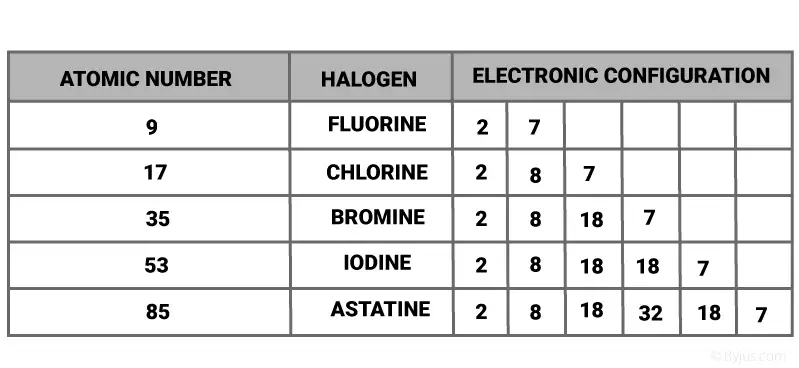
Electronic configuration pattern of halogen elements
Atomic and Ionic Radii Trends
Within group 17, halogens have the smallest atomic radii in their respective periods due to a high effective nuclear charge. However, moving down the group from fluorine to iodine, both atomic and ionic radii increase because of the addition of electron shells.
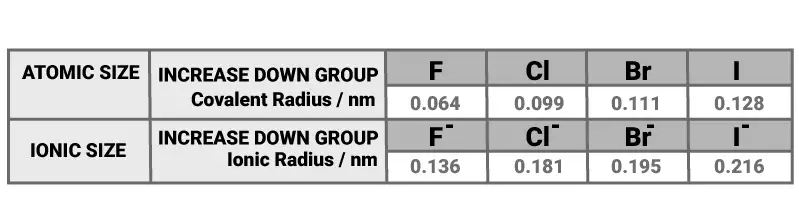
Variation of atomic and ionic radii in halogen elements
Ionization and Electron Gain Enthalpy
Halogens exhibit high ionization enthalpy values, reflecting their reluctance to lose electrons. This ionization energy decreases down the group due to increasing atomic size. Conversely, their electron gain enthalpy is highly negative, indicating a strong tendency to gain electrons, although this negativity lessens from fluorine to iodine. Notably, chlorine has a more negative electron gain enthalpy than fluorine.
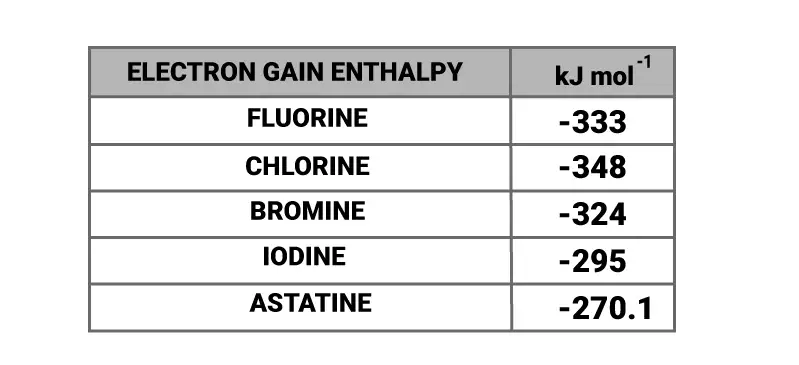
Electron gain enthalpy trends among halogens
Electronegativity Patterns
Halogens are highly electronegative, with electronegativity decreasing down the group due to reduced effective nuclear charge. Fluorine stands out as the most electronegative element in the periodic table.
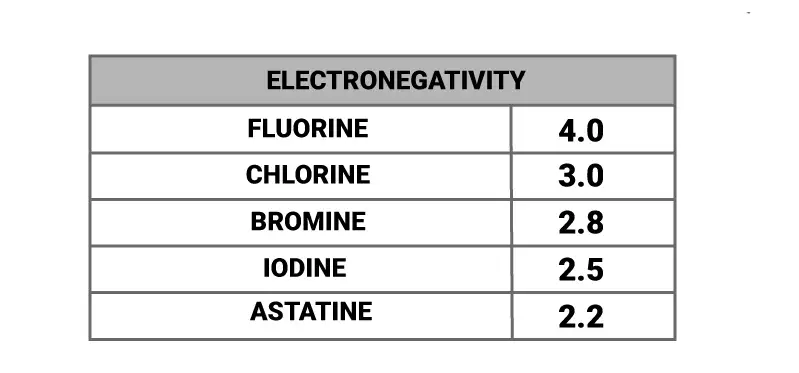
Electronegativity values of halogen elements
Example Problem
Question: Explain why chlorine has a more negative electron gain enthalpy than fluorine despite fluorine being more electronegative.
Solution:
Fluorine's small size causes significant electron-electron repulsion in its compact 2p orbitals.
This repulsion reduces the energy released when fluorine gains an electron, making its electron gain enthalpy less negative.
Chlorine, being larger, experiences less repulsion, allowing it to release more energy upon gaining an electron, resulting in a more negative electron gain enthalpy.
Summary Table for Quick Revision
Property | Trend in Group 17 | Explanation |
|---|---|---|
Electronic Configuration | ns2np5 for all | Seven valence electrons, one short of noble gas configuration |
Atomic & Ionic Radii | Increase down the group | Additional electron shells increase size |
Ionization Enthalpy | Decreases down the group | Atomic size increase lowers ionization energy |
Electron Gain Enthalpy | Becomes less negative down the group (except Cl) | Electron repulsion and atomic size effects |
Electronegativity | Decreases down the group | Effective nuclear charge decreases with size |
Oxidation States | -1 common; +1, +3, +5, +7 in Cl, Br, I | Higher states due to bonding with F and O |
Reactivity | Decreases down the group | Atomic size and bond strength influence |
Glossary of Key Terms
Term | Definition |
|---|---|
Halogens | Group 17 elements known for high reactivity and salt formation |
Oxidation State | Charge an atom would have if electrons were transferred completely |
Electronegativity | Ability of an atom to attract electrons in a chemical bond |
Ionization Enthalpy | Energy required to remove an electron from an atom |
Electron Gain Enthalpy | Energy change when an atom gains an electron |
Octet Rule | Atoms tend to have eight electrons in their valence shell for stability |
Halide | Compound formed when halogens react with metals |
Oxides | Compounds containing oxygen bonded to another element |
Oxoacids | Acids containing oxygen, hydrogen, and another element |
Effective Nuclear Charge | Net positive charge experienced by valence electrons |
Frequently Asked Questions (FAQs)
Why is the I–Cl bond more reactive than the I–I bond?
The I–Cl bond is polar and weaker compared to the nonpolar and stronger I–I bond, making I–Cl more chemically reactive.
What causes chlorine's bleaching effect to be permanent?
Chlorine permanently bleaches by oxidizing colored substances into colorless compounds through nascent oxygen.
How do the oxidizing powers of fluorine and chlorine compare?
Fluorine has the highest electrode potential and is the strongest oxidizing agent, while chlorine is less potent, and iodine is the weakest.
Why does fluorine form only one oxoacid, HOF, unlike chlorine?
Due to fluorine's small size, high electronegativity, and lack of d orbitals, it can only form the oxoacid HOF.
Can you name two toxic gases derived from chlorine?
Mustard gas and phosgene are two poisonous gases prepared using chlorine.