Essential Characteristics of Group 16 Elements
Overview of the Chalcogen Family
The elements classified under group 16 of the periodic table are commonly referred to as chalcogens or ore-forming elements. This group includes oxygen, sulfur, selenium, tellurium, and polonium. Their name stems from their frequent occurrence in ores, primarily as oxides and sulfides, from which many metals are extracted. These elements exhibit diverse physical and chemical properties, ranging from non-metallic to metalloid characteristics.
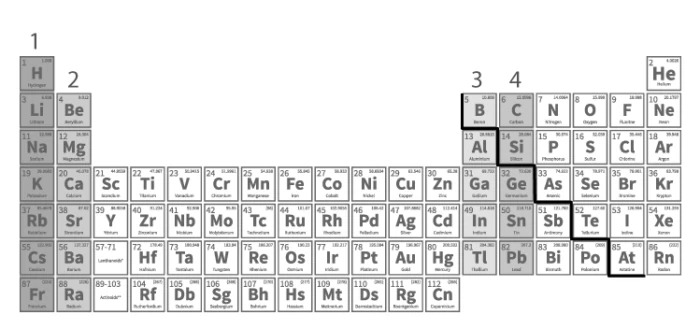
Group 16 elements - The Chalcogens
Distribution and Abundance in Nature
Oxygen is the most prevalent element in this group and is widely distributed in the Earth's crust, atmosphere, and hydrosphere. It ranks as the fourth most abundant element in the universe after hydrogen, helium, and neon. Oxygen constitutes approximately 89% of water by mass, nearly 46% of the Earth's crust, and about 20% of the air we breathe. The other members of the group are less abundant but play significant roles in various geological and biological processes.
Example Problem
Calculate the percentage by mass of oxygen in water, given that water is composed of two hydrogen atoms and one oxygen atom. Atomic masses: H = 1 u, O = 16 u.
Solution:
The molar mass of water \( \text{H}_2\text{O} \) is:
\[ 2 \times 1 + 16 = 18 \text{ u} \]
The mass percentage of oxygen in water is:
\[ \frac{16}{18} \times 100 = 88.89\% \]
Therefore, oxygen makes up approximately 88.89% of the mass of water.
Distinctive Features of Oxygen and Sulfur
Properties and Roles of Oxygen
Oxygen, symbolized as O, is a colorless and odorless gas essential for respiration in living organisms. It primarily exists as a diatomic molecule (\( \text{O}_2 \)) but can also be found in a triatomic form known as ozone (\( \text{O}_3 \)), which plays a crucial role in protecting the Earth from ultraviolet radiation. Oxygen readily reacts with many elements, often releasing heat in combustion reactions, which are vital in energy production and various industrial processes.
Example Problem
When 5 grams of carbon combust completely in oxygen, calculate the mass of carbon dioxide produced. Atomic masses: C = 12 u, O = 16 u.
Solution:
The balanced chemical equation for combustion of carbon is:
\[ \text{C} + \text{O}_2 \rightarrow \text{CO}_2 \]
Molar mass of carbon = 12 g/mol
Molar mass of carbon dioxide = 12 + 2 \times 16 = 44 \text{ g/mol}
Mass of \( \text{CO}_2 \) produced from 5 g of carbon:
\[ \frac{44}{12} \times 5 = 18.33 \text{ g} \]
Thus, 18.33 grams of carbon dioxide is formed.
Characteristics and Occurrence of Sulfur
Sulfur, represented by the symbol S, is a non-metal that ranks ninth in cosmic abundance. It exists both in free elemental form and combined states, such as sulfates in seawater. Sulfur deposits are often found underground in dome-shaped structures, formed through bacterial reduction of sulfate minerals like gypsum. It is widely used in industry, especially in the manufacture of sulfuric acid and vulcanization of rubber.
Example Problem
Calculate the percentage of sulfur in a compound containing 32 g of sulfur and 64 g of oxygen.
Solution:
Total mass of compound = 32 + 64 = 96 g
Percentage of sulfur:
\[ \frac{32}{96} \times 100 = 33.33\% \]
Therefore, sulfur constitutes 33.33% of the compound by mass.
Exploring Selenium, Tellurium, and Polonium
Nature and Stability of Selenium
Selenium is a relatively rare element found both in elemental form and combined with heavy metals such as lead, silver, and mercury. Its most stable allotrope under normal conditions is the gray metallic form. Selenium has important applications in electronics and glass manufacturing due to its semiconducting properties.
Example Problem
A mineral sample contains 0.5 g of selenium combined with 4.5 g of lead. Calculate the mass percentage of selenium in the sample.
Solution:
Total mass = 0.5 + 4.5 = 5 g
Mass percentage of selenium:
\[ \frac{0.5}{5} \times 100 = 10\% \]
Thus, selenium makes up 10% of the mineral by mass.
Properties and Occurrence of Tellurium
Tellurium, atomic number 52, exhibits characteristics intermediate between metals and non-metals, classifying it as a metalloid. It is one of the rarest stable elements in the Earth's crust and is often found in elemental form or combined with metals like copper, lead, silver, and gold. Tellurium is used in alloys and semiconductor technology.
Example Problem
Calculate the atomic mass of tellurium if a sample contains 52 protons, 76 neutrons, and 52 electrons.
Solution:
Atomic mass is approximately the sum of protons and neutrons:
\[ 52 + 76 = 128 \text{ u} \]
Electrons have negligible mass, so the atomic mass is 128 u.
Radioactive Nature of Polonium
Polonium is the rarest member of group 16 and is radioactive. It is primarily used in scientific research involving alpha radiation. Due to its radioactivity, polonium requires careful handling and is not commonly found in everyday applications.
Example Problem
Polonium-210 emits alpha particles with a mass number of 4 and atomic number 2. Write the nuclear reaction equation for the alpha decay of polonium-210.
Solution:
Alpha decay reduces the mass number by 4 and atomic number by 2:
\[ {}^{210}_{84}\text{Po} \rightarrow {}^{206}_{82}\text{Pb} + {}^{4}_{2}\text{He} \]
Polonium-210 decays into lead-206 by emitting an alpha particle.
Quick Reference Summary
Element | Symbol | State | Occurrence | Key Property |
|---|---|---|---|---|
Oxygen | O | Gas | Abundant in air, water, crust | Supports respiration and combustion |
Sulfur | S | Solid (non-metal) | Free and combined in minerals | Used in industry, forms sulfates |
Selenium | Se | Solid (metallic form) | Combined with heavy metals | Semiconductor properties |
Tellurium | Te | Solid (metalloid) | Free and in metal compounds | Used in alloys and electronics |
Polonium | Po | Solid (radioactive) | Rare, radioactive | Alpha radiation source |
Glossary of Key Terms
Term | Definition |
|---|---|
Chalcogens | Elements of group 16 known for forming ores. |
Diatomic Molecule | A molecule composed of two atoms, e.g., \( \text{O}_2 \). |
Ozone | Triatomic form of oxygen (\( \text{O}_3 \)) with protective atmospheric role. |
Combustion | Exothermic reaction of a substance with oxygen producing heat. |
Allotrope | Different structural forms of the same element. |
Metalloid | Element with properties intermediate between metals and non-metals. |
Radioactivity | Spontaneous emission of particles or radiation from unstable nuclei. |
Alpha Particle | Helium nucleus emitted during radioactive decay. |
Sulfate | Polyatomic ion containing sulfur and oxygen, \( \text{SO}_4^{2-} \). |
Cosmic Abundance | Relative abundance of elements in the universe. |
Frequently Asked Questions
Why are group 16 elements called chalcogens?
They are termed chalcogens because they commonly occur in ores as sulfides and oxides, playing a key role in ore formation.
What is the significance of oxygen in the environment?
Oxygen supports respiration in living organisms and is essential for combustion and many chemical processes.
How does sulfur occur naturally?
Sulfur is found both in free elemental form and combined as sulfates in seawater and minerals.
What makes polonium unique among group 16 elements?
Polonium is radioactive and is the rarest element in the group, used mainly in scientific applications involving alpha radiation.
What are the common uses of tellurium?
Tellurium is used in alloys, semiconductors, and as an additive in metal processing due to its metalloid properties.