Fundamental Principles Governing Gas Behavior
Understanding the Relationship Between Pressure and Volume
Inverse Correlation of Gas Pressure and Volume at Constant Temperature
When the temperature remains unchanged, the volume of a gas inversely varies with the pressure applied to it. This means that increasing the pressure compresses the gas, reducing its volume, while decreasing pressure allows the gas to expand. This principle is essential in understanding how gases respond to changes in their environment.
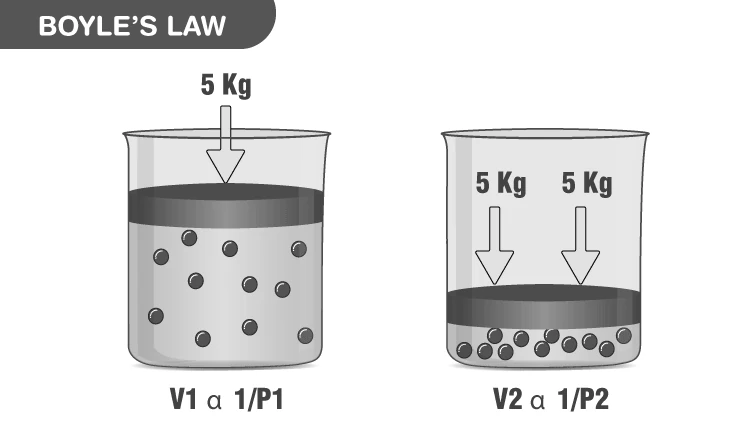
Graphical representation of pressure-volume inverse relationship
The mathematical expression for this relationship is:
\[ P \times V = k \]
where \(P\) is the pressure, \(V\) is the volume, and \(k\) is a constant for a fixed amount of gas at constant temperature. This can also be rearranged to compare two states of the same gas:
\[ P_1 V_1 = P_2 V_2 \]
Example: A gas occupies 22.0 mL at a pressure of 4.00 atm. If the pressure is reduced to 2.50 atm without changing the temperature or amount of gas, what will be the new volume?
Solution:
Using the relation \(P_1 V_1 = P_2 V_2\),
\[ V_2 = \frac{P_1 V_1}{P_2} = \frac{4.00 \times 22.0}{2.50} = 35.2 \text{ mL} \]
Therefore, the gas expands to 35.2 mL when the pressure decreases to 2.50 atm.
Volume Changes with Temperature at Constant Pressure
Direct Proportionality Between Gas Volume and Absolute Temperature
At a steady pressure, the volume of a gas increases as its temperature rises, provided the temperature is measured on the absolute scale (Kelvin). This direct relationship explains why gases expand when heated and contract when cooled under constant pressure conditions.
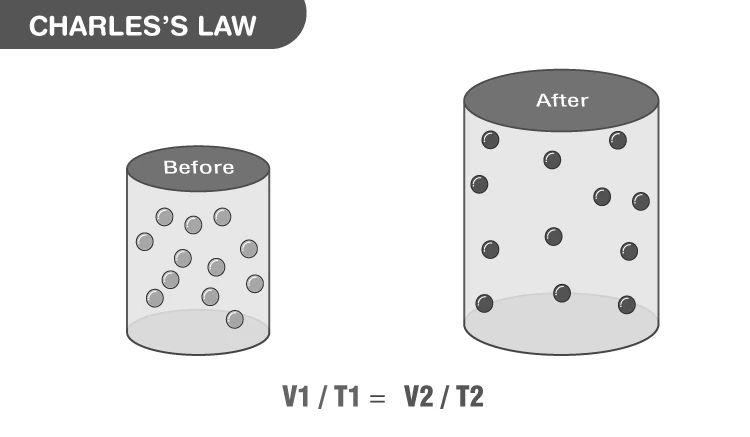
Volume variation with temperature at constant pressure
The law is mathematically stated as:
\[ \frac{V_1}{T_1} = \frac{V_2}{T_2} \]
where \(V\) is volume and \(T\) is temperature in Kelvin.
Example: A helium balloon has a volume of 15.0 L at 25.0 °C. If the temperature rises to 50.0 °C at constant pressure, what is the new volume of the balloon?
Solution:
Convert temperatures to Kelvin:
\(T_1 = 25.0 + 273.15 = 298.15 \text{ K}\)
\(T_2 = 50.0 + 273.15 = 323.15 \text{ K}\)
Using the formula:
\[ V_2 = V_1 \times \frac{T_2}{T_1} = 15.0 \times \frac{323.15}{298.15} = 16.25 \text{ L} \]
The balloon expands to 16.25 L when heated to 50.0 °C.
Pressure Variation with Temperature at Constant Volume
Direct Relationship Between Gas Pressure and Absolute Temperature
When the volume of a gas is held fixed, its pressure rises proportionally with an increase in temperature. This occurs because heating the gas increases the kinetic energy of its molecules, causing more frequent and forceful collisions against the container walls.
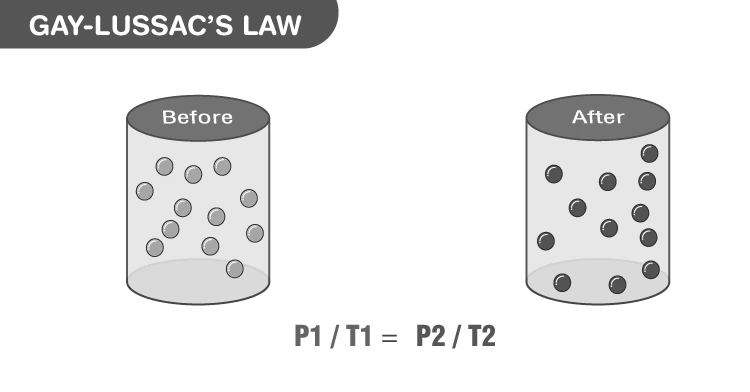
Pressure changes with temperature at fixed volume
The mathematical form of this law is:
\[ \frac{P_1}{T_1} = \frac{P_2}{T_2} \]
where \(P\) is pressure and \(T\) is temperature in Kelvin.
Example: A gas in a sealed container has a pressure of 1.50 atm at 20.0 °C. If the temperature is increased to 60.0 °C, what will be the new pressure?
Solution:
Convert temperatures to Kelvin:
\(T_1 = 20.0 + 273.15 = 293.15 \text{ K}\)
\(T_2 = 60.0 + 273.15 = 333.15 \text{ K}\)
Using the formula:
\[ P_2 = P_1 \times \frac{T_2}{T_1} = 1.50 \times \frac{333.15}{293.15} = 1.70 \text{ atm} \]
The pressure increases to 1.70 atm after heating.
Effect of Gas Quantity on Volume at Constant Temperature and Pressure
Proportionality Between Gas Volume and Number of Moles
For gases under fixed temperature and pressure, the volume occupied is directly proportional to the amount of gas present, measured in moles. This means doubling the number of gas molecules doubles the volume, assuming other conditions remain constant.
This principle is fundamental in understanding gas mixtures and reactions involving gases.
The relationship is expressed as:
\[ \frac{V_1}{n_1} = \frac{V_2}{n_2} \]
where \(V\) is volume and \(n\) is the number of moles.
Example: A container holds 4.00 L of oxygen gas at a certain temperature and pressure, containing 0.80 moles. If the amount of oxygen is increased to 1.50 moles, what will be the new volume?
Solution:
Using the formula:
\[ V_2 = V_1 \times \frac{n_2}{n_1} = 4.00 \times \frac{1.50}{0.80} = 7.50 \text{ L} \]
The volume expands to 7.50 L with the increased amount of gas.
Integrating Gas Laws: The Combined Gas Equation
Unified Relation Among Pressure, Volume, and Temperature
The combined gas law merges the principles of Boyle’s, Charles’s, and Gay-Lussac’s laws to relate pressure, volume, and temperature for a fixed amount of gas. It is particularly useful when more than one variable changes simultaneously.
The formula is:
\[ \frac{P_1 V_1}{T_1} = \frac{P_2 V_2}{T_2} \]
This equation allows calculation of any one variable when the others change, assuming the gas quantity remains constant.
Example: A gas occupies 3.00 L at 1.00 atm and 300 K. If the pressure increases to 2.00 atm and the temperature rises to 400 K, what is the new volume?
Solution:
Using the combined gas law:
\[ V_2 = \frac{P_1 V_1 T_2}{P_2 T_1} = \frac{1.00 \times 3.00 \times 400}{2.00 \times 300} = 2.00 \text{ L} \]
The volume decreases to 2.00 L under the new conditions.
The Ideal Gas Law: Comprehensive Gas Behavior Equation
Relating Pressure, Volume, Temperature, and Amount of Gas
The ideal gas law combines all previous gas laws and Avogadro’s principle into a single equation that connects pressure, volume, temperature, and the number of moles of gas. It is widely used to predict the behavior of gases under various conditions.
The equation is:
\[ PV = nRT \]
where:
\(P\) = pressure
\(V\) = volume
\(n\) = number of moles
\(R\) = universal gas constant (\(8.314 \text{ J/mol·K}\))
\(T\) = temperature in Kelvin
Example: Calculate the pressure inside a 2.00 L container holding 0.50 moles of nitrogen gas at 27 °C.
Solution:
Convert temperature to Kelvin:
\(T = 27 + 273.15 = 300.15 \text{ K}\)
Using the ideal gas law:
\[ P = \frac{nRT}{V} = \frac{0.50 \times 8.314 \times 300.15}{2.00} = 622.5 \text{ Pa} \]
The pressure inside the container is approximately 622.5 Pa.
Summary of Gas Law Formulas
Gas Law | Mathematical Expression | Conditions |
|---|---|---|
Boyle’s Law | \(P V = \text{constant}\) | Constant temperature, fixed amount of gas |
Charles’s Law | \(\frac{V}{T} = \text{constant}\) | Constant pressure, fixed amount of gas |
Gay-Lussac’s Law | \(\frac{P}{T} = \text{constant}\) | Constant volume, fixed amount of gas |
Avogadro’s Law | \(\frac{V}{n} = \text{constant}\) | Constant temperature and pressure |
Combined Gas Law | \(\frac{P V}{T} = \text{constant}\) | Fixed amount of gas |
Ideal Gas Law | \(P V = n R T\) | General case for ideal gases |
Key Terminology in Gas Laws
Term | Definition |
|---|---|
Pressure (P) | Force exerted by gas molecules per unit area on container walls |
Volume (V) | Space occupied by the gas |
Temperature (T) | Measure of average kinetic energy of gas particles, in Kelvin |
Mole (n) | Amount of substance containing \(6.022 \times 10^{23}\) particles |
Universal Gas Constant (R) | Constant relating energy scale to temperature, \(8.314 \text{ J/mol·K}\) |
Ideal Gas | Hypothetical gas with no intermolecular forces and point particles |
Elastic Collision | Collision where kinetic energy is conserved |
Absolute Temperature | Temperature measured from absolute zero, in Kelvin |
Boltzmann Constant (k) | Relates average kinetic energy to temperature at molecular level |
Combined Gas Law | Equation combining Boyle’s, Charles’s, and Gay-Lussac’s laws |
Frequently Asked Questions on Gas Behavior
What defines an ideal gas?
An ideal gas is a theoretical gas composed of many randomly moving point particles that do not interact except through elastic collisions.
Why is temperature measured in Kelvin for gas laws?
Kelvin scale starts at absolute zero, where molecular motion ceases, making it essential for accurate proportional relationships in gas laws.
How does the ideal gas law differ from combined gas law?
The ideal gas law includes the amount of gas (moles) and universal gas constant, while the combined gas law assumes a fixed amount of gas.
Can real gases always be treated as ideal gases?
Real gases approximate ideal behavior at low pressure and high temperature but deviate under high pressure or low temperature.
What practical applications use gas laws?
Gas laws are applied in fields like meteorology, respiratory physiology, engineering, and chemical reactions involving gases.