Understanding the Galvanic Cell: Principles and Applications
Fundamentals of Galvanic Cells and Their Operation
Core Concept and Energy Conversion in Galvanic Cells
A galvanic cell, also known as a voltaic cell, is a device that transforms the chemical energy released from spontaneous oxidation-reduction (redox) reactions into usable electrical energy. This conversion occurs as electrons are transferred between chemical species, generating an electric current that can perform external work.
To harness this energy effectively, the overall redox reaction is divided into two separate half-reactions: one involving oxidation and the other reduction. These half-reactions are physically separated into two compartments connected by an external circuit and a salt bridge, allowing controlled electron flow and ion exchange.
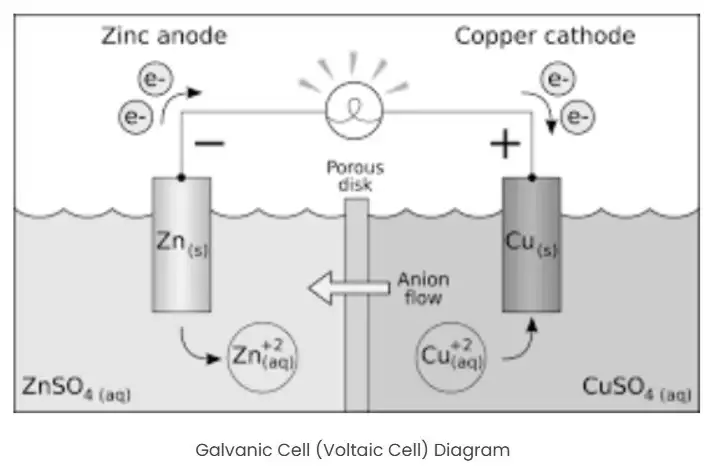
Schematic representation of a galvanic (voltaic) cell
Example Problem: Calculating Energy Output from a Galvanic Cell
Consider a galvanic cell where the oxidation half-reaction releases 0.75 moles of electrons and the cell operates at a potential difference of 1.1 volts. Calculate the electrical work done by the cell in joules.
Solution:
The electrical work \( W \) done by the cell is given by:
\[ W = n \times F \times E \]
where:
\( n = 0.75 \) moles of electrons
\( F = 96485 \text{ C/mol} \) (Faraday's constant)
\( E = 1.1 \text{ V} \) (cell potential)
Calculating:
\[ W = 0.75 \times 96485 \times 1.1 = 79786.1 \text{ J} \]
Therefore, the galvanic cell performs approximately 79,786 joules of electrical work.
Key Components and Their Roles in a Galvanic Cell
A galvanic cell consists of several essential parts, each serving a specific function to enable the conversion of chemical energy into electrical energy:
Anode: The electrode where oxidation occurs, releasing electrons into the external circuit.
Cathode: The electrode where reduction takes place, accepting electrons from the circuit.
Salt Bridge: A pathway containing an electrolyte solution that maintains electrical neutrality by allowing ion flow between the two half-cells.
Half-Cells: Separate compartments housing the electrodes and their respective electrolytes, isolating oxidation and reduction reactions.
External Circuit: Conductive wiring that permits electron flow from anode to cathode.
Load: An electrical device or resistor that utilizes the electron flow to perform work.
Example Problem: Identifying Cell Components
In a galvanic cell, if zinc is oxidized and copper ions are reduced, identify the anode, cathode, and the role of the salt bridge.
Solution:
Anode: Zinc electrode (site of oxidation)
Cathode: Copper electrode (site of reduction)
Salt Bridge: Maintains charge balance by allowing ion flow, preventing charge buildup that would stop the reaction.
Mechanism of Electron Flow and Potential Development
When a metal electrode contacts its electrolyte, metal atoms tend to lose electrons and enter the solution as ions, leaving behind electrons on the electrode surface. This process causes the electrode to become negatively charged. Conversely, metal ions in the electrolyte may gain electrons and deposit onto the electrode, making it positively charged.
The balance between these opposing tendencies establishes an equilibrium, resulting in a potential difference at the electrode-electrolyte interface, known as the electrode potential.
In a galvanic cell, the electrode where oxidation occurs (anode) carries a negative potential relative to its solution, while the electrode where reduction occurs (cathode) has a positive potential. The difference between these potentials is the cell potential, which drives electron flow through the external circuit when connected.
When the circuit is open, this potential difference is called the electromotive force (emf) of the cell.
Example Problem: Determining Cell Potential
A galvanic cell has an anode with an electrode potential of -0.76 V and a cathode with +0.34 V. Calculate the overall cell potential.
Solution:
The cell potential \( E_{\text{cell}} \) is:
\[ E_{\text{cell}} = E_{\text{cathode}} - E_{\text{anode}} = 0.34 - (-0.76) = 1.10 \text{ V} \]
This positive value indicates a spontaneous reaction and the ability to do electrical work.
Practical Illustration: The Daniell Cell
Overview and Reaction Details of the Daniell Cell
The Daniell cell is a classic example of a galvanic cell that efficiently converts chemical energy into electrical energy. It consists of a zinc electrode immersed in a zinc sulfate solution and a copper electrode immersed in a copper sulfate solution, connected by a salt bridge.
In this cell, zinc undergoes oxidation at the anode, releasing electrons, while copper ions gain electrons at the cathode, undergoing reduction.
The half-reactions are:
At the cathode (reduction):
\[ \text{Cu}^{2+} + 2e^- \rightarrow \text{Cu} \]
At the anode (oxidation):
\[ \text{Zn} \rightarrow \text{Zn}^{2+} + 2e^- \]
Example Problem: Calculating Cell Voltage of a Daniell Cell
Given the standard electrode potentials: \( E^\circ_{\text{Zn}^{2+}/\text{Zn}} = -0.76 \text{ V} \) and \( E^\circ_{\text{Cu}^{2+}/\text{Cu}} = +0.34 \text{ V} \), find the standard cell potential.
Solution:
Using the formula:
\[ E^\circ_{\text{cell}} = E^\circ_{\text{cathode}} - E^\circ_{\text{anode}} = 0.34 - (-0.76) = 1.10 \text{ V} \]
This positive voltage confirms the spontaneous nature of the Daniell cell reaction.
Summary and Key Terms for Quick Review
Term | Definition |
|---|---|
Galvanic Cell | A device that converts chemical energy from spontaneous redox reactions into electrical energy. |
Anode | Electrode where oxidation occurs, releasing electrons. |
Cathode | Electrode where reduction takes place, accepting electrons. |
Salt Bridge | Electrolyte-filled connector that maintains charge balance by allowing ion flow. |
Electrode Potential | Potential difference developed at the electrode-electrolyte interface. |
Cell Potential | Voltage difference between the two electrodes of a galvanic cell. |
Electromotive Force (emf) | Cell potential when no current is drawn from the cell. |
Oxidation | Loss of electrons by a species during a redox reaction. |
Reduction | Gain of electrons by a species during a redox reaction. |
Daniell Cell | A galvanic cell using zinc and copper electrodes to generate electrical energy. |
Glossary of Essential Terms
Term | Meaning |
|---|---|
Galvanic Cell | Electrochemical cell producing electricity from spontaneous redox reactions. |
Anode | Electrode where oxidation occurs and electrons are released. |
Cathode | Electrode where reduction occurs and electrons are accepted. |
Salt Bridge | Device allowing ion flow to maintain electrical neutrality. |
Electrode Potential | Voltage developed at the interface of electrode and electrolyte. |
Cell Potential | Overall voltage difference between anode and cathode. |
Oxidation | Process of losing electrons in a chemical reaction. |
Reduction | Process of gaining electrons in a chemical reaction. |
Electromotive Force (emf) | Maximum potential difference of a cell without current flow. |
Daniell Cell | Specific galvanic cell with zinc and copper electrodes. |
Frequently Asked Questions
What is the primary purpose of a galvanic cell?
A galvanic cell generates electrical energy by harnessing the energy released from spontaneous redox reactions, enabling the flow of electrons through an external circuit.
How is a basic voltaic cell constructed?
It consists of two different metal electrodes, such as copper and zinc, each immersed in their respective electrolyte solutions, connected externally by a wire and internally by a salt bridge to complete the circuit.
Why does the cathode have a positive charge in a galvanic cell?
The cathode gains electrons during reduction, making it positively charged relative to the anode, which loses electrons during oxidation and becomes negatively charged.
Is the Daniell cell an example of a galvanic cell?
Yes, the Daniell cell is a classic galvanic cell where zinc is oxidized and copper ions are reduced, producing electrical energy.
What role does the salt bridge play in a galvanic cell?
The salt bridge maintains electrical neutrality by allowing ions to flow between the two half-cells, preventing charge buildup that would otherwise stop the electron flow.