Understanding the First Law of Thermodynamics
Fundamentals of Thermodynamic State Variables
Defining State Variables and Their Types
Thermodynamic state variables are measurable properties that describe the equilibrium condition of a system. These variables provide a snapshot of the system's macroscopic state, but they only apply when the system is in equilibrium. State variables are categorized into two groups: intensive and extensive. Intensive variables, such as temperature and pressure, remain constant regardless of the system's size. In contrast, extensive variables like volume, mass, and internal energy depend on the system's scale.
Example: Consider a gas confined in a container. The pressure inside the container is an intensive variable because it does not change if the container size changes, while the volume occupied by the gas is an extensive variable as it depends on the container's size.
Core Principles of the First Law of Thermodynamics
Energy Conservation in Thermodynamic Systems
The first law of thermodynamics is a statement of energy conservation within thermodynamic processes. It asserts that energy cannot be created or destroyed but can be transformed from one form to another or transferred between systems. When heat energy is supplied to a system, part of it changes the system's internal energy, while the remainder performs work on the surroundings.
Mathematically, this relationship is expressed as:
\[ \Delta Q = \Delta U + W \]
where:
\( \Delta Q \) is the heat added to or removed from the system,
\( \Delta U \) is the change in the system's internal energy,
\( W \) is the work done by the system on its surroundings.
Rearranging the equation gives:
\[ \Delta U = \Delta Q - W \]
This form highlights that the change in internal energy depends on the net heat added minus the work done by the system. Importantly, the quantity \( \Delta Q - W \) is path-independent, meaning it depends only on the initial and final states of the system.
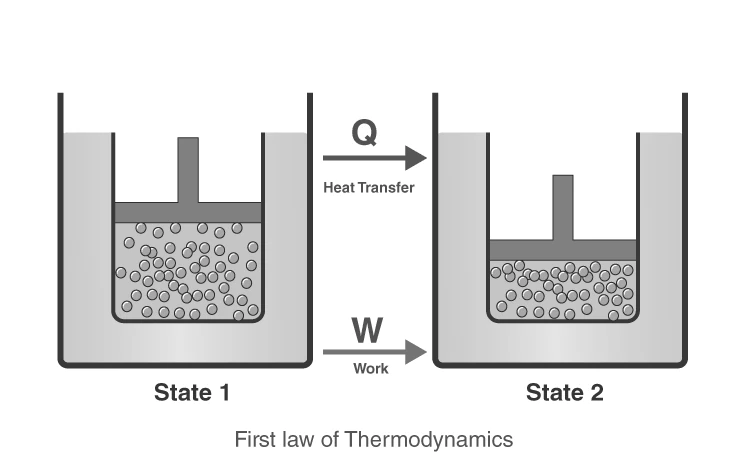
Visual representation of the first law of thermodynamics
Understanding Sign Conventions in Energy Transfer
Interpreting Heat and Work Signs
Correctly applying sign conventions is crucial for solving thermodynamics problems. The standard conventions are:
Heat added to the system is positive (\( Q > 0 \)); heat lost by the system is negative (\( Q < 0 \)).
Work done by the system on the surroundings is positive (\( W > 0 \)); work done on the system is negative (\( W < 0 \)).
These conventions ensure consistency when calculating changes in internal energy and analyzing energy flow.
Sign conventions for heat and work in thermodynamics
Practical Applications: Solved Problems on the First Law
Example 1: Calculating Internal Energy Change with Heat Addition and Work Done
A system receives 3500 J of heat, and it performs 2800 J of work on its surroundings. Determine the change in the system's internal energy.
Solution:
Using the sign conventions:
Heat added to the system: \( Q = +3500 \text{ J} \)
Work done by the system: \( W = +2800 \text{ J} \)
Applying the first law formula:
\[ \Delta U = Q - W = 3500 - 2800 = 700 \text{ J} \]
The internal energy of the system increases by 700 J.
Example 2: Internal Energy Change with Heat Loss and Work Done on the System
Consider a system that loses 1800 J of heat while 2200 J of work is done on it. Calculate the change in internal energy.
Solution:
Assigning signs based on conventions:
Heat lost by the system: \( Q = -1800 \text{ J} \)
Work done on the system: \( W = -2200 \text{ J} \)
Using the formula:
\[ \Delta U = Q - W = -1800 - (-2200) = -1800 + 2200 = 400 \text{ J} \]
The internal energy increases by 400 J.
Quick Reference: Summary of Key Concepts
Concept | Description |
|---|---|
First Law of Thermodynamics | Energy conservation principle: \( \Delta U = Q - W \) |
State Variables | Properties defining system equilibrium; intensive (e.g., pressure) and extensive (e.g., volume) |
Heat (\( Q \)) | Energy transferred due to temperature difference; positive when added to system |
Work (\( W \)) | Energy transfer by force; positive when done by system on surroundings |
Internal Energy (\( U \)) | Total energy contained within the system |
Sign Conventions | Heat added and work done by system are positive; heat lost and work done on system are negative |
Glossary of Important Terms
Term | Definition |
|---|---|
Thermodynamic System | A defined quantity of matter or region in space under study |
State Variable | Property that defines the state of a system at equilibrium |
Intensive Variable | Property independent of system size (e.g., temperature, pressure) |
Extensive Variable | Property dependent on system size (e.g., volume, mass) |
Internal Energy (\( U \)) | Total microscopic energy within a system |
Heat (\( Q \)) | Energy transfer due to temperature difference |
Work (\( W \)) | Energy transfer resulting from force acting through distance |
Equilibrium | State where macroscopic properties remain constant over time |
Conservation of Energy | Principle stating energy cannot be created or destroyed |
Path Independence | Property where change depends only on initial and final states |
Frequently Asked Questions
What is the essence of the first law of thermodynamics?
It states that energy cannot be created or destroyed, only transformed or transferred, ensuring total energy conservation in a system.
Who formulated the first law of thermodynamics?
The law was developed through contributions by scientists such as Julius Robert Mayer, James Joule, and Rudolf Clausius in the 19th century.
Is it possible to violate the first law of thermodynamics?
No, the first law is a fundamental principle of physics and has never been observed to be violated in any experiment.
Why is the first law important for environmental studies?
It helps in understanding energy flow and efficiency in natural and engineered systems, crucial for managing resources and sustainability.
What are the limitations of the first law of thermodynamics?
While it accounts for energy conservation, it does not predict the direction of processes or account for entropy changes, which are addressed by the second law.