Understanding the Finkelstein Reaction in Organic Chemistry
Fundamentals of Halogen Exchange via Nucleophilic Substitution
Mechanism and Core Principles of the Finkelstein Reaction
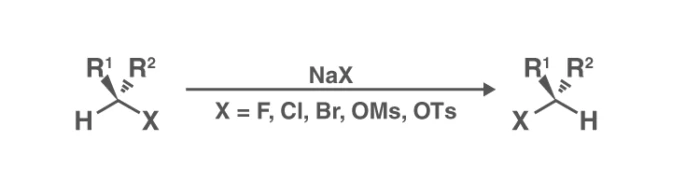
The Finkelstein reaction is a classic example of a bimolecular nucleophilic substitution (SN2) where one halogen atom in an alkyl halide is replaced by another halogen. This transformation is facilitated by the use of a metal halide salt, typically sodium iodide, in a polar aprotic solvent such as acetone. The reaction proceeds through a single-step mechanism involving backside attack, which results in inversion of stereochemistry at the carbon center.
This reaction is driven by the differential solubility of the metal halide salts formed; for instance, sodium bromide or sodium chloride precipitates out of acetone, shifting the equilibrium towards the product side. The Finkelstein reaction is particularly effective with primary alkyl halides and those adjacent to carbonyl groups or allylic/benzylic positions.
Example Problem
Convert 1-chloropropane to 1-iodopropane using the Finkelstein reaction. Write the balanced chemical equation and explain the reaction conditions.
Solution:
The reaction involves treating 1-chloropropane with sodium iodide in acetone:
\[ \mathrm{CH_3CH_2CH_2Cl} \ _{(acetone)} + \mathrm{NaI} \ _{(acetone)} \rightarrow \mathrm{CH_3CH_2CH_2I} \ _{(acetone)} + \mathrm{NaCl} \ _{(s)} \]
The sodium chloride formed is insoluble in acetone and precipitates out, driving the reaction forward. The reaction proceeds via an SN2 mechanism, causing inversion of configuration if the carbon is chiral.
Factors Influencing the Efficiency of Halogen Exchange
The success of the Finkelstein reaction depends on several key factors:
- Nucleophilicity: The iodide ion is a strong nucleophile in polar aprotic solvents, enhancing substitution rates.
- Nature of the Leaving Group: Chloride and bromide ions are good leaving groups, but iodide is a better nucleophile, favoring the exchange.
- Carbon-Halogen Bond Strength: Weaker carbon-halogen bonds facilitate easier substitution.
- Reactivity of Alkyl Halide: Primary halides react faster than secondary or tertiary due to steric hindrance.
Example Problem
Explain why 2-bromobutane reacts slower than 1-bromobutane in the Finkelstein reaction.
Solution:
- 2-Bromobutane is a secondary alkyl halide, which has more steric hindrance around the reactive center.
- This steric crowding reduces the nucleophile's ability to attack the carbon atom.
- 1-Bromobutane, being primary, offers less steric hindrance, allowing faster SN2 substitution.
Modern Applications and Extensions of the Finkelstein Reaction
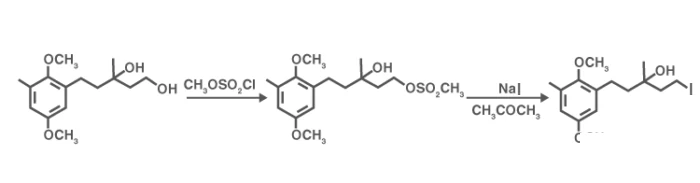
Beyond simple halogen exchange, the Finkelstein reaction has been adapted to convert alcohols into alkyl halides by first transforming the alcohol into a sulfonate ester, which then undergoes nucleophilic substitution. This two-step approach broadens the scope of the reaction in organic synthesis.
For example, the synthesis of complex molecules such as chrysochlamic acid involves such transformations, showcasing the reaction's utility in natural product synthesis.
Example Problem
Outline the two-step process to convert an alcohol into an alkyl iodide using the Finkelstein reaction principles.
Solution:
- First, convert the alcohol into a sulfonate ester (e.g., tosylate) to create a better leaving group.
- Next, treat the sulfonate ester with sodium iodide in acetone to substitute the sulfonate group with iodide via an SN2 mechanism.
Quick Reference: Key Points on the Finkelstein Reaction
| Aspect | Details |
|---|---|
| Type of Reaction | Bimolecular nucleophilic substitution (SN2) |
| Typical Reagents | Sodium iodide in acetone |
| Common Substrates | Primary alkyl chlorides or bromides |
| Driving Force | Precipitation of sodium chloride or bromide |
| Mechanism | Single-step backside attack with inversion of configuration |
| Solvent | Polar aprotic solvent (acetone) |
| Limitations | Less effective with tertiary halides due to steric hindrance |
| Modern Use | Conversion of alcohols to alkyl halides via sulfonate esters |
Glossary of Important Terms
| Term | Definition |
|---|---|
| SN2 Reaction | A bimolecular nucleophilic substitution mechanism involving a single step with inversion of stereochemistry. |
| Alkyl Halide | An organic compound containing a halogen atom bonded to an sp³ hybridized carbon. |
| Nucleophile | A species that donates an electron pair to form a chemical bond. |
| Leaving Group | An atom or group that detaches from the substrate during a substitution reaction. |
| Polar Aprotic Solvent | A solvent that lacks acidic hydrogen atoms and does not donate protons, e.g., acetone. |
| Halogen Exchange | The substitution of one halogen atom in an organic molecule with another halogen. |
| Sulfonate Ester | A compound formed by reacting an alcohol with a sulfonyl chloride, used as a leaving group. |
| Precipitation | The formation of an insoluble solid from a solution during a chemical reaction. |
| Inversion of Configuration | The change in stereochemistry at a chiral center during an SN2 reaction. |
| Allylic Position | The carbon atom adjacent to a carbon-carbon double bond. |
Frequently Asked Questions (FAQs)
What defines a Finkelstein reaction?
The Finkelstein reaction is a nucleophilic substitution where one halogen atom in an alkyl halide is replaced by another, typically using sodium iodide in acetone.
Which reagent is commonly employed in this reaction?
Sodium iodide dissolved in acetone is the standard reagent used to facilitate halogen exchange in the Finkelstein reaction.
What type of mechanism does the Finkelstein reaction follow?
It follows an SN2 mechanism, which is bimolecular and involves a single-step backside attack leading to inversion of stereochemistry.
What is the main driving force behind the reaction's progress?
The precipitation of sodium chloride or sodium bromide, which are insoluble in acetone, shifts the equilibrium towards product formation.
Can the Finkelstein reaction be used to convert alcohols directly to alkyl halides?
Not directly; alcohols are first converted into sulfonate esters, which then undergo substitution with halide ions in a Finkelstein-type reaction.