Comprehensive Guide to Ethers: Structure, Properties, and Applications
Fundamentals and Structural Characteristics of Ethers
Understanding the Basic Composition and Structure of Ethers
Ethers are organic molecules characterized by an oxygen atom connected to two carbon-containing groups, which can be either alkyl or aryl. The general representation of ethers is \( \text{R-O-R'} \), where R and R' denote these groups. The term "ether" originates from the Latin word "aether," meaning "to ignite," reflecting their flammability under standard conditions.
Structurally, ethers exhibit a bent geometry around the oxygen atom, with the C–O–C bond angle typically less than 120°, contributing to their unique chemical behavior. This bent shape arises due to the sp³ hybridization of the oxygen atom, which also influences their polarity and reactivity.

General structural formula of an ether molecule
Example Problem
Identify the functional group in the compound with the formula \( \text{CH}_3\text{-O-CH}_2\text{CH}_3 \) and describe its bonding.
Solution:
The compound \( \text{CH}_3\text{-O-CH}_2\text{CH}_3 \) contains an ether functional group, where an oxygen atom is bonded to two alkyl groups: a methyl group (\( \text{CH}_3 \)) and an ethyl group (\( \text{CH}_2\text{CH}_3 \)). The oxygen atom forms single covalent bonds with each carbon, resulting in the general ether structure \( \text{R-O-R'} \).
Physical Characteristics and Classification of Ethers
Key Physical Traits and Categorization of Ethers
Ethers display distinct physical properties such as moderate polarity due to the bent C–O–C linkage, which results in a net dipole moment. Their boiling points are generally close to those of alkanes with similar molecular weights but are significantly lower than comparable alcohols because ethers lack hydrogen bonding between molecules.
They are moderately soluble in water, as the oxygen atom can form hydrogen bonds with water molecules, although solubility decreases with increasing hydrocarbon chain length. The oxygen in ethers is sp³ hybridized, with a bond angle close to \( 109.5^\circ \).
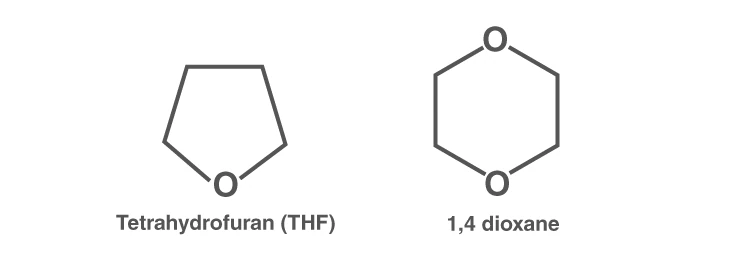
Examples of various ether molecules
Ethers are classified into two main types:
Symmetrical Ethers: Both alkyl or aryl groups attached to oxygen are identical, e.g., diethyl ether (\( \text{CH}_3\text{CH}_2\text{-O-CH}_2\text{CH}_3 \)).
Asymmetrical Ethers: The two groups attached to oxygen differ, e.g., ethyl methyl ether (\( \text{CH}_3\text{-O-CH}_2\text{CH}_3 \)).
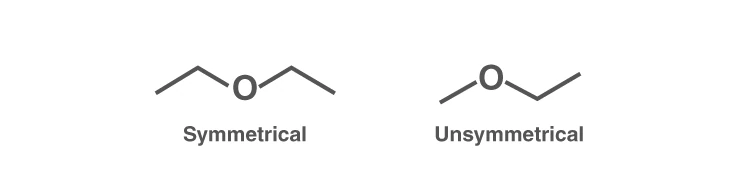
Comparison of symmetrical and asymmetrical ether structures
Example Problem
Classify the ether \( \text{CH}_3\text{-O-CH}_3 \) and explain its symmetry.
Solution:
The molecule \( \text{CH}_3\text{-O-CH}_3 \) is dimethyl ether, where both alkyl groups attached to oxygen are methyl groups. Since the two groups are identical, this ether is classified as symmetrical.
Naming Conventions and Synthesis Methods of Ethers
Systematic Naming and Common Preparation Techniques
Ethers are named by listing the two alkyl or aryl groups attached to the oxygen in alphabetical order, followed by the word "ether." For example, "ethyl methyl ether" indicates an ethyl and a methyl group bonded to oxygen. When both groups are identical, the name is simplified, such as "ethyl ether" for diethyl ether.
The IUPAC system names ethers as alkoxy alkanes, where the smaller group is named as an alkoxy substituent on the longer carbon chain. For instance, \( \text{CH}_3\text{-O-CH}_2\text{CH}_3 \) is named "methoxyethane."
Key rules for IUPAC naming include:
Identify the longest carbon chain as the parent hydrocarbon.
Convert the name of the smaller alkyl group to its alkoxy form by replacing "-yl" with "-oxy" (e.g., methyl → methoxy).
Assign locants to the alkoxy substituent based on its position on the parent chain.
Common synthetic routes for ethers include:
Dehydration of Alcohols
Under acidic conditions and controlled temperatures, primary alcohols can undergo dehydration to form ethers. For example, ethanol heated with sulfuric acid at around 393 K produces ethoxyethane (diethyl ether).
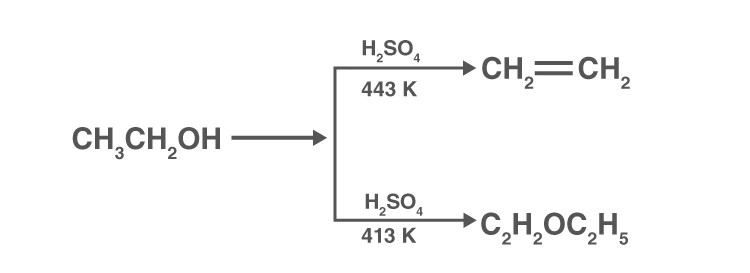
Formation of diethyl ether by dehydration of ethanol
Williamson Ether Synthesis
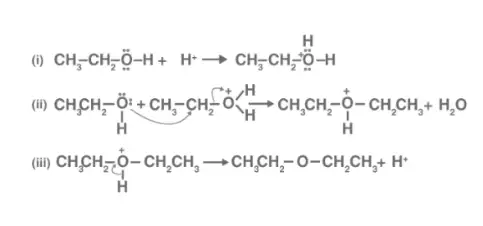
This Illustration shows three chemical reactions involved in the mechanism of an acid-catalyzed reaction involving an ether compound.
This laboratory method involves reacting an alkoxide ion with a primary alkyl halide via an SN2 mechanism to produce ethers. It is versatile for synthesizing both symmetrical and asymmetrical ethers.
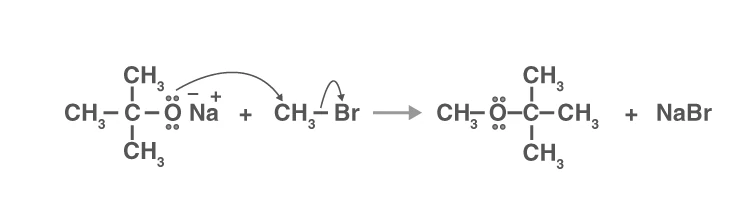
Williamson synthesis of ethers using alkoxide and alkyl halide
Example Problem
Outline the synthesis of ethoxyethane starting from ethanol using Williamson synthesis.
Solution:
Convert ethanol to sodium ethoxide by reacting with sodium metal: \( \text{C}_2\text{H}_5\text{OH} + \text{Na} \rightarrow \text{C}_2\text{H}_5\text{ONa} + \frac{1}{2} \text{H}_2 \).
React sodium ethoxide with ethyl bromide via SN2 reaction: \( \text{C}_2\text{H}_5\text{ONa} + \text{C}_2\text{H}_5\text{Br} \rightarrow \text{C}_2\text{H}_5\text{O-C}_2\text{H}_5 + \text{NaBr} \).
This yields ethoxyethane (diethyl ether) efficiently.
Chemical Behavior and Reactions of Ethers
Reactivity Patterns and Important Chemical Transformations
Ethers are generally chemically stable and resist reactions with bases, oxidizing agents, and reducing agents. However, they are susceptible to cleavage by strong acids such as hydrogen halides (HBr, HI) under elevated temperatures.
The cleavage proceeds via protonation of the ether oxygen followed by nucleophilic attack by the halide ion, resulting in alkyl halides and alcohols. For example, diethyl ether reacts with excess HI to form ethyl iodide and ethanol, with further reaction producing two moles of ethyl iodide and water.
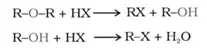
Acid-catalyzed cleavage of ether C–O bonds
Exposure of ethers to air and UV light can lead to the formation of peroxides, which are potentially explosive and require careful handling.
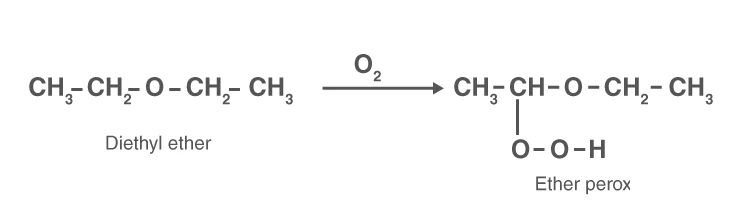
Peroxide formation in ethers under UV light
Aromatic ethers, such as anisole, activate the benzene ring towards electrophilic substitution reactions due to the electron-donating effect of the alkoxy group. These reactions include halogenation, nitration, and Friedel-Crafts alkylation or acylation, predominantly occurring at the ortho and para positions.
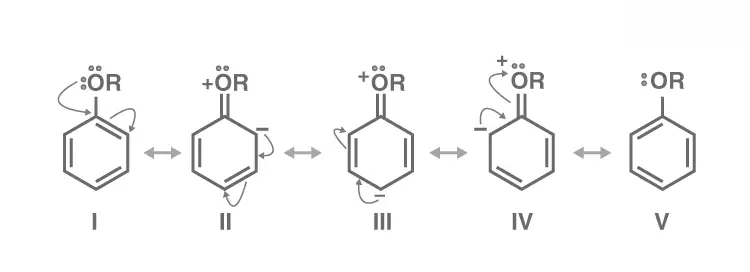
Electrophilic substitution reactions on aromatic ethers
Example Problem
Explain why anisole undergoes bromination readily without a catalyst and identify the major product.
Solution:
The methoxy group (-OCH₃) in anisole donates electron density into the benzene ring via resonance, increasing reactivity towards electrophiles.
This activation allows bromination to proceed even without a Lewis acid catalyst.
The substitution occurs mainly at the para position, yielding para-bromoanisole as the major product.
Summary Table: Essential Properties and Reactions of Ethers
Aspect | Details |
|---|---|
General Formula | \( \text{R-O-R'} \) where R and R' are alkyl or aryl groups |
Bond Angle | Approximately \( 109.5^\circ \) due to sp³ hybridization of oxygen |
Polarity | Moderate dipole moment; less polar than alcohols |
Boiling Point | Similar to alkanes of comparable mass; lower than alcohols |
Solubility | Soluble in water due to hydrogen bonding; decreases with chain length |
Classification | Symmetrical and asymmetrical ethers |
Common Preparation | Dehydration of alcohols, Williamson synthesis |
Chemical Reactivity | Stable to bases and oxidants; cleaved by strong acids; forms peroxides on exposure to air and light |
Electrophilic Substitution | Occurs in aromatic ethers at ortho and para positions |
Glossary of Key Terms Related to Ethers
Term | Definition |
|---|---|
Alkyl Group | A hydrocarbon substituent derived from an alkane by removal of one hydrogen atom |
Aryl Group | An aromatic hydrocarbon substituent derived from an aromatic ring |
Ether | An organic compound with an oxygen atom bonded to two carbon groups |
Williamson Synthesis | A method to prepare ethers by reacting alkoxides with alkyl halides |
Dehydration | Removal of water from a molecule, often to form alkenes or ethers |
Electrophilic Substitution | A reaction where an electrophile replaces a hydrogen atom in an aromatic ring |
Peroxides | Compounds containing an oxygen-oxygen single bond, often formed by ethers exposed to air |
sp³ Hybridization | Mixing of one s and three p orbitals to form four equivalent orbitals |
Symmetrical Ether | An ether with identical groups attached to oxygen |
Asymmetrical Ether | An ether with different groups attached to oxygen |
Frequently Asked Questions on Ethers
What is the general chemical formula of an ether?
The general formula of an ether is \( \text{R-O-R'} \), where R and R' are alkyl or aryl groups.
Can you provide an example of a cyclic ether?
Yes, tetrahydrofuran (THF) is a common cyclic ether with a five-membered ring containing one oxygen atom.
Are ethers soluble in water?
Ethers are moderately soluble in water because their oxygen atom can form hydrogen bonds with water molecules, but solubility decreases as the hydrocarbon chain length increases.
What is the hybridization state of the oxygen atom in ethers?
The oxygen atom in ethers is sp³ hybridized, resulting in a bent molecular geometry.
How are ethers classified based on their substituents?
Ethers are classified as symmetrical if both substituents are identical, and asymmetrical if the substituents differ.