Understanding Endothermic Reactions and Their Characteristics
Fundamentals of Heat Absorbing Chemical Reactions
Defining Endothermic Reactions and Their Physical Counterparts
Endothermic reactions are chemical processes where reactants take in heat energy from their environment to produce new substances. This heat absorption causes a noticeable drop in the temperature around the reaction site, often resulting in a cooling sensation. Not only chemical reactions but certain physical changes also exhibit endothermic behavior. For instance, when ice melts, it absorbs heat from its surroundings to transition into liquid water without altering its chemical composition.
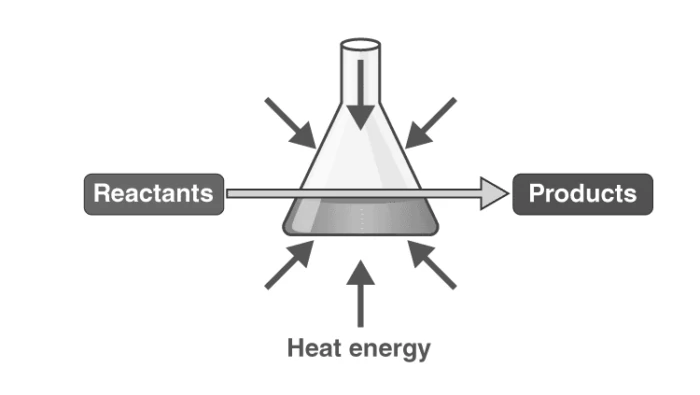
Illustration of an Endothermic Reaction
In chemical reactions, breaking bonds typically releases energy, whereas forming new bonds requires energy input. This energy exchange can manifest as heat, light, or electrical energy. Endothermic reactions specifically involve the absorption of heat to form new bonds, contrasting with exothermic reactions where heat is released due to bond breakage.
Example: Consider the process of ice melting. Although no chemical bonds are broken or formed, the ice absorbs heat from the environment to change its state from solid to liquid, demonstrating a physical endothermic process.
Contrasting Heat Absorption and Release in Reactions
Distinguishing Endothermic from Exothermic Processes
The prefixes ‘endo-’ and ‘exo-’ originate from Greek, meaning ‘inside’ and ‘outside’ respectively. This etymology reflects the core difference: endothermic reactions draw heat inward from their surroundings, while exothermic reactions expel heat outward. This fundamental distinction affects how these reactions influence their environment’s temperature.
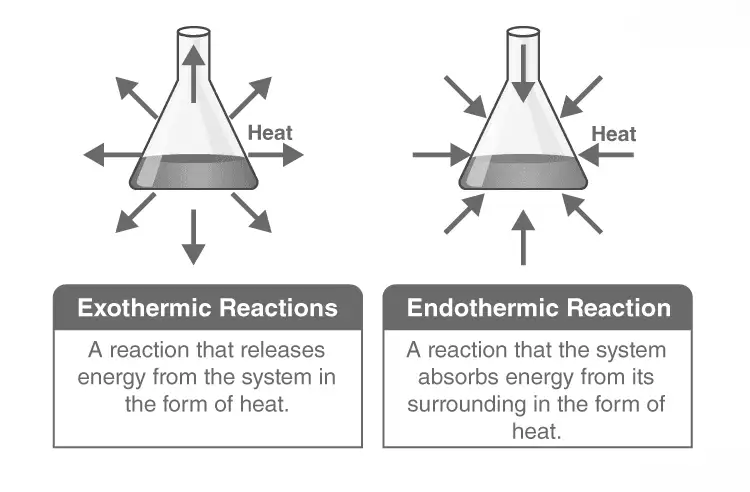
Comparison of Endothermic and Exothermic Reactions
Below is a summary highlighting key differences between these two reaction types:
Aspect | Endothermic Reaction | Exothermic Reaction |
|---|---|---|
Heat Flow | Heat absorbed from surroundings | Heat released to surroundings |
Effect on Surroundings | Temperature decreases | Temperature increases |
Bond Energy | Energy required to form bonds exceeds energy released by breaking bonds | Energy released by bond formation exceeds energy required to break bonds |
Examples | Photosynthesis, melting ice | Combustion, respiration |
Remember: Endothermic reactions always absorb heat, causing cooling, while exothermic reactions release heat, causing warming.
Real-World Applications and Examples of Endothermic Phenomena
Physical and Chemical Endothermic Processes in Daily Life
The human body utilizes endothermic processes to regulate temperature, such as sweating. When sweat evaporates from the skin, it absorbs heat, producing a cooling effect. This evaporation is a physical change involving heat absorption but no chemical reaction.
All endothermic reactions are a subset of endothermic processes, but not all endothermic processes involve chemical changes. Many involve physical transformations like melting or evaporation.
Example: Sweating cools the body by absorbing heat during the evaporation of sweat, a physical endothermic process without chemical bond changes.
Notable Chemical Endothermic Reactions
Several chemical reactions absorb heat from their surroundings, including:
Dissolving ammonium chloride in water, which dissociates into ions and cools the solution.
The dissolution of ammonium nitrate in water, used in instant cold packs, which absorbs heat and lowers temperature.
The synthesis of nitric oxide from nitrogen and oxygen gases, requiring significant heat input.
Example Problem: When 50 g of ammonium chloride dissolves in water, the temperature of the solution drops by 4°C. Calculate the amount of heat absorbed if the specific heat capacity of the solution is \(4.18 \text{ J/g}^\circ\text{C}\) and the mass of the solution is 200 g.
Solution:
The heat absorbed \(q\) can be calculated using the formula:
\[ q = m \times c \times \Delta T \]
Where:
\(m = 200 \text{ g}\) (mass of solution)
\(c = 4.18 \text{ J/g}^\circ\text{C}\) (specific heat capacity)
\(\Delta T = 4^\circ\text{C}\) (temperature change)
Substituting values:
\[ q = 200 \times 4.18 \times 4 = 3344 \text{ J} \]
Therefore, the solution absorbs 3344 joules of heat during the dissolution process.
Energy Profile of Endothermic Reactions
The energy changes during endothermic and exothermic reactions can be visualized using energy level diagrams. The activation energy represents the minimum energy required for reactants to transform into products.
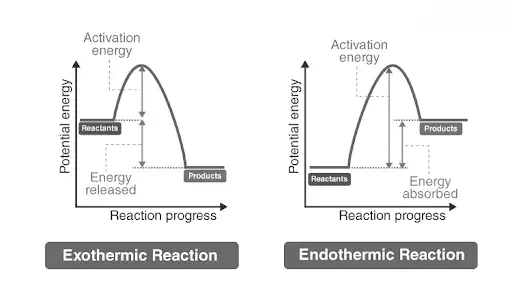
Energy level diagram illustrating endothermic reaction
In endothermic reactions, the products have higher potential energy than the reactants, indicating energy absorption. This difference corresponds to the heat taken in from the surroundings.
Example Problem: In a reaction, the potential energy of reactants is \(150 \text{ kJ/mol}\) and that of products is \(320 \text{ kJ/mol}\). Calculate the heat absorbed during the reaction.
Solution:
Heat absorbed \(= \text{Potential energy of products} - \text{Potential energy of reactants}\)
\[ = 320 - 150 = 170 \text{ kJ/mol} \]
This indicates the reaction absorbs 170 kJ of heat per mole.
Summary Table for Quick Review
Feature | Endothermic Reaction | Example |
|---|---|---|
Heat Exchange | Absorbs heat from surroundings | Dissolving ammonium chloride in water |
Effect on Surroundings | Temperature decreases | Melting ice |
Energy Profile | Products have higher potential energy | Formation of nitric oxide |
Physical or Chemical | Both physical processes and chemical reactions | Evaporation of sweat (physical), baking bread (chemical) |
Activation Energy | Energy input required to initiate reaction | Decomposition of silver bromide |
Glossary of Key Terms
Term | Definition |
|---|---|
Endothermic Reaction | A chemical reaction that absorbs heat from its surroundings. |
Exothermic Reaction | A reaction that releases heat to the surroundings. |
Activation Energy | The minimum energy required to start a chemical reaction. |
Bond Formation | The process of creating chemical bonds between atoms. |
Bond Breakage | The process of breaking chemical bonds in molecules. |
Physical Change | A change affecting the form but not the chemical composition. |
Chemical Change | A change that results in the formation of new substances. |
Heat Absorption | The process of taking in heat energy from the environment. |
Potential Energy | Stored energy in chemical bonds or position. |
Sublimation | Transition of a substance from solid to gas without passing through liquid phase. |
Frequently Asked Questions
What distinguishes an endothermic reaction from an exothermic one?
An endothermic reaction absorbs heat from its surroundings, causing cooling, whereas an exothermic reaction releases heat, causing warming.
Can physical changes be endothermic?
Yes, physical changes like melting and evaporation absorb heat without altering chemical composition, making them endothermic processes.
Why do endothermic reactions feel cold to touch?
Because they absorb heat from the surroundings, the area around the reaction loses heat, resulting in a cooling sensation.
Is sweating a chemical endothermic reaction?
No, sweating is a physical endothermic process where evaporation absorbs heat but no chemical bonds are broken or formed.
What role does activation energy play in endothermic reactions?
Activation energy is the initial energy input needed to start the reaction by overcoming the energy barrier between reactants and products.