Understanding Boiling Point Elevation in Solutions
Fundamentals of Boiling Point Elevation
Conceptual Overview and Causes
Boiling point elevation occurs when a solute is dissolved in a solvent, causing the solution to boil at a temperature higher than the pure solvent. This phenomenon arises because the addition of a non-volatile solute reduces the solvent's vapor pressure, requiring more heat to reach boiling. The effect depends solely on the number of solute particles relative to the solvent, not on the solute's chemical nature, making it a colligative property.
For instance, when salt is dissolved in water, the boiling point of the resulting solution exceeds that of pure water. The more concentrated the solute, the greater the increase in boiling temperature.
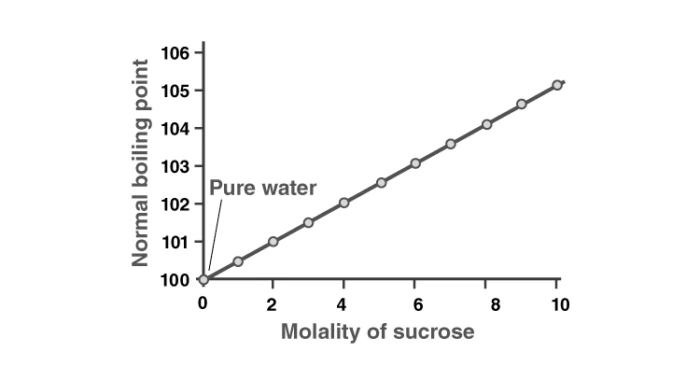
Graph illustrating boiling point rise of water with increasing sucrose concentration at 1 atm pressure
Example Problem
Calculate the boiling point of a 4 molal sugar solution in water, given that pure water boils at 100°C at 1 atm and the boiling point elevation constant for water is 0.52°C·kg/mol.
Solution:
The boiling point elevation is calculated by:
\[ \Delta T_b = K_b \times m = 0.52 \times 4 = 2.08 \text{°C} \]
Therefore, the boiling point of the solution is:
\[ 100 + 2.08 = 102.08 \text{°C} \]
Hence, the solution boils at 102.08°C.
Mechanism Behind Boiling Point Elevation
Why Does the Boiling Point Increase?
The boiling point of a liquid is the temperature at which its vapor pressure equals the external pressure. When a non-volatile solute is added, it lowers the vapor pressure of the solvent because solute particles occupy surface area and reduce solvent evaporation. Consequently, more heat is needed to raise the vapor pressure to atmospheric pressure, elevating the boiling point.
Increasing solute concentration further decreases vapor pressure, causing a larger boiling point rise. This relationship is graphically represented by the pressure versus temperature curve of the solution compared to the pure solvent.
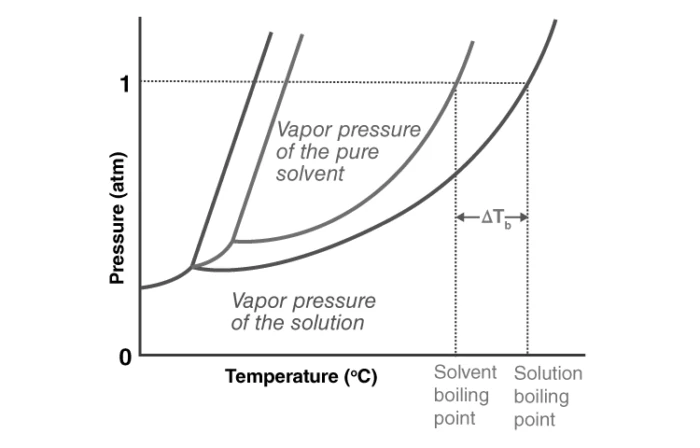
Pressure-temperature graph depicting boiling point elevation and freezing point depression
Note: The boiling point also depends on external pressure, which is why water boils below 100°C at high altitudes where atmospheric pressure is lower.
Example Problem
Explain why the boiling point of water decreases at higher altitudes.
Answer:
At higher altitudes, atmospheric pressure is lower than at sea level.
Boiling occurs when vapor pressure equals external pressure.
Lower external pressure means vapor pressure reaches it at a lower temperature.
Hence, water boils at temperatures below 100°C at high altitudes.
Quantitative Analysis of Boiling Point Elevation
Mathematical Expression and Calculation
The boiling point of a solution can be expressed as:
\[ T_{\text{boiling, solution}} = T_{\text{boiling, pure solvent}} + \Delta T_b \]
Where the elevation in boiling point, \( \Delta T_b \), is proportional to the molal concentration of the solute:
\[ \Delta T_b = i \times K_b \times m \]
Here,
\( i \) is the Van’t Hoff factor, representing the number of particles the solute dissociates into.
\( K_b \) is the ebullioscopic constant specific to the solvent, typically in °C·kg/mol.
\( m \) is the molality of the solute, moles of solute per kilogram of solvent.
This formula is most accurate for dilute solutions and non-volatile solvents.
Example Problem 1
Determine the boiling point of a 2% by weight potassium chloride (KCl) solution in water. Given: molar mass of KCl = 74.5 g/mol, \( K_b \) for water = 0.52°C·kg/mol, and \( i = 2 \) for KCl.
Solution:
Mass of KCl in 1 kg solution = 0.02 kg; mass of water = 0.98 kg.
Moles of KCl:
\[ \frac{20 \text{ g}}{74.5 \text{ g/mol}} = 0.268 \text{ mol} \]
Molality:
\[ m = \frac{0.268 \text{ mol}}{0.98 \text{ kg}} = 0.273 \text{ mol/kg} \]
Boiling point elevation:
\[ \Delta T_b = 2 \times 0.52 \times 0.273 = 0.284 \text{°C} \]
Boiling point of solution:
\[ 100 + 0.284 = 100.284 \text{°C} \]
The solution boils at approximately 100.28°C.
Example Problem 2
A non-electrolyte solute weighing 15 g is dissolved in 250 g of benzene. The solution boils at 81.5°C. Given \( K_b \) for benzene is 2.53°C·kg/mol and pure benzene boils at 80.1°C, find the molar mass of the solute.
Solution:
Boiling point elevation:
\[ \Delta T_b = 81.5 - 80.1 = 1.4 \text{°C} \]
Molality \( m \) is:
\[ m = \frac{\Delta T_b}{K_b} = \frac{1.4}{2.53} = 0.553 \text{ mol/kg} \]
Moles of solute:
\[ n = m \times \text{mass of solvent in kg} = 0.553 \times 0.25 = 0.138 \text{ mol} \]
Molar mass \( M \):
\[ M = \frac{\text{mass of solute}}{\text{moles}} = \frac{15}{0.138} = 108.7 \text{ g/mol} \]
The molar mass of the solute is approximately 108.7 g/mol.
Summary of Key Points on Boiling Point Elevation
Aspect | Details |
|---|---|
Definition | Increase in boiling point of solvent due to dissolved non-volatile solute |
Type of Property | Colligative property (depends on solute particle number, not identity) |
Formula | \( \Delta T_b = i K_b m \) |
Van’t Hoff Factor (i) | Number of particles solute dissociates into (e.g., 2 for NaCl) |
Ebullioscopic Constant (K_b) | Solvent-specific constant indicating boiling point elevation per molal concentration |
Dependence | Proportional to molality of solute |
Limitations | Less accurate for concentrated solutions and volatile solvents |
Effect of Pressure | Boiling point varies with external pressure (lower pressure lowers boiling point) |
Glossary of Important Terms
Term | Meaning |
|---|---|
Boiling Point | Temperature at which vapor pressure equals external pressure |
Colligative Property | Property depending on solute particle number, not identity |
Molality (m) | Moles of solute per kilogram of solvent |
Van’t Hoff Factor (i) | Number of particles a solute dissociates into in solution |
Ebullioscopic Constant (K_b) | Constant indicating boiling point elevation per molal concentration |
Non-volatile Solute | Substance that does not evaporate easily |
Vapor Pressure | Pressure exerted by vapor in equilibrium with its liquid |
Freezing Point Depression | Lowering of freezing point due to solute addition |
Molarmass | Mass of one mole of a substance |
Boiling Point Elevation (ΔTb) | Increase in boiling point caused by dissolved solute |
Frequently Asked Questions
What causes the boiling point of a solution to be higher than that of the pure solvent?
The addition of a non-volatile solute lowers the solvent's vapor pressure, requiring more heat to reach boiling, thus increasing the boiling point.
How does the Van’t Hoff factor affect boiling point elevation?
The Van’t Hoff factor represents the number of particles a solute dissociates into; a higher \( i \) increases the boiling point elevation proportionally.
Why is boiling point elevation considered a colligative property?
Because it depends on the number of solute particles in the solution, not their chemical identity.
Can boiling point elevation be used to determine molar mass?
Yes, by measuring the boiling point elevation and knowing the solvent properties, the molar mass of an unknown solute can be calculated.
Does boiling point elevation occur with volatile solutes?
No, the standard formula applies only to non-volatile solutes; volatile solutes complicate vapor pressure and boiling point behavior.