Understanding Electron Configurations of Atoms
Fundamentals of Electron Arrangement in Atoms
Basics of Electron Distribution and Notation
The electron configuration of an element reveals the specific arrangement of electrons within its atomic orbitals. This arrangement is expressed using a standardized notation where each subshell is denoted by its principal quantum number and subshell letter, followed by a superscript indicating the number of electrons it contains. For instance, the electron configuration of sodium is written as 1s2 2s2 2p6 3s1.
To simplify lengthy configurations, especially for elements with high atomic numbers, an abbreviated form is used. This involves replacing the sequence of fully filled subshells corresponding to a noble gas with that noble gas's symbol enclosed in square brackets. For example, sodium's abbreviated configuration is [Ne] 3s1, where neon's configuration 1s2 2s2 2p6 is represented as [Ne].
Electron configurations are crucial for determining an element's valency, predicting chemical properties of element groups, and interpreting atomic spectra. This notation system was developed following the Bohr model of the atom introduced in 1913 by Rutherford and Bohr.
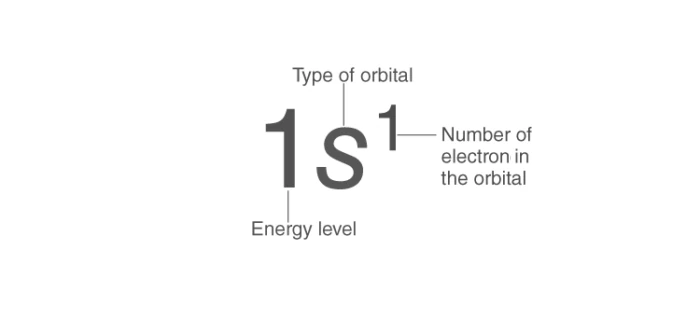
Illustration of Electron Configuration Notation
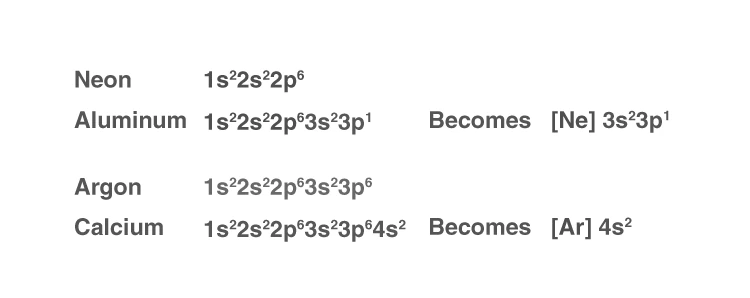
Example of Sodium's Electron Configuration
Example Problem
Write the abbreviated electron configuration for the element magnesium (atomic number 12).
Solution:
First, write the full electron configuration:
\[ 1s^2\, 2s^2\, 2p^6\, 3s^2 \]
The noble gas preceding magnesium is neon, with configuration:
\[ 1s^2\, 2s^2\, 2p^6 \]
Therefore, the abbreviated configuration is:
\[ [Ne]\, 3s^2 \]
Principles Governing Electron Filling in Atomic Orbitals
Quantum Numbers and Subshell Capacities
Electrons occupy shells defined by the principal quantum number \( n \), where the maximum electrons per shell is given by \( 2n^2 \). For example, the first shell (\( n=1 \)) can hold up to 2 electrons, the second shell (\( n=2 \)) up to 8, and so forth.
Within each shell, electrons fill subshells determined by the azimuthal quantum number \( l \), which ranges from 0 to \( n-1 \). These subshells are labeled as s (\( l=0 \)), p (\( l=1 \)), d (\( l=2 \)), and f (\( l=3 \)). The maximum electrons in a subshell is calculated by \( 2(2l + 1) \), resulting in capacities of 2, 6, 10, and 14 electrons for s, p, d, and f respectively.
Not all subshells exist for every shell; for example, 1p, 2d, and 3f orbitals do not exist because \( l \) must be less than \( n \).
Example Problem
Calculate the maximum number of electrons that can be accommodated in the third shell (\( n=3 \)) and list the subshells present.
Solution:
The maximum electrons in the third shell is:
\[ 2 \times 3^2 = 18 \text{ electrons} \]
The subshells for \( n=3 \) are:
\( l=0 \) → 3s (max 2 electrons)
\( l=1 \) → 3p (max 6 electrons)
\( l=2 \) → 3d (max 10 electrons)
Total electrons accommodated: \( 2 + 6 + 10 = 18 \), matching the shell capacity.
Rules for Electron Placement in Orbitals
Aufbau Principle and Its Exceptions
The Aufbau principle states that electrons fill atomic orbitals starting from the lowest energy level moving to higher ones. The energy order is determined by the sum of the principal and azimuthal quantum numbers. The typical filling sequence is:
\[ 1s \rightarrow 2s \rightarrow 2p \rightarrow 3s \rightarrow 3p \rightarrow 4s \rightarrow 3d \rightarrow 4p \rightarrow 5s \rightarrow \ldots \]
However, some elements like chromium and copper exhibit exceptions due to the enhanced stability of half-filled or fully filled d subshells.
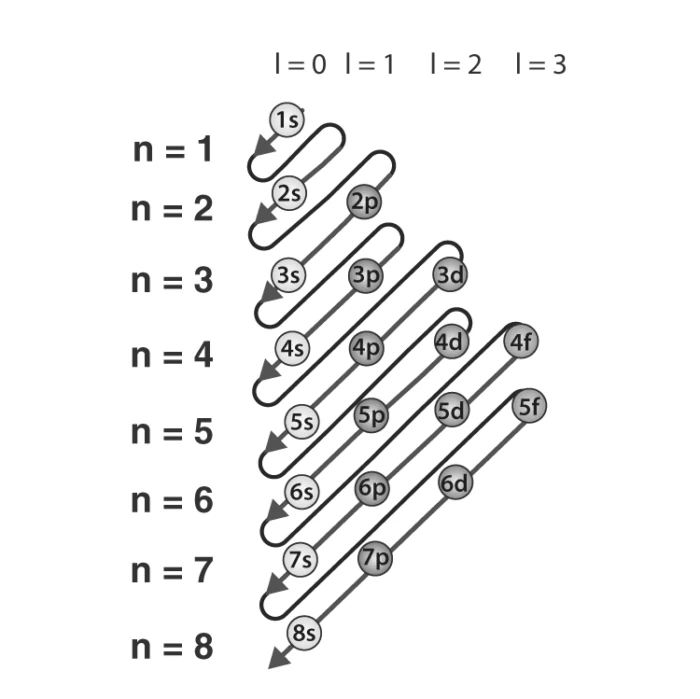
Electron Filling Order According to Aufbau Principle
Pauli Exclusion Principle
This principle asserts that no two electrons in the same atom can have identical values for all four quantum numbers. Consequently, an orbital can hold a maximum of two electrons, which must have opposite spins.
Hund’s Rule of Maximum Multiplicity
Hund’s rule dictates that electrons occupy orbitals singly within a subshell before pairing up. Additionally, all singly occupied orbitals have electrons with parallel spins to maximize total spin.
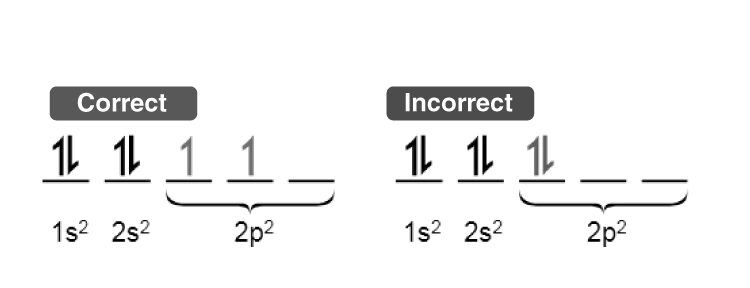
Electron Distribution Following Hund’s Rule
Example Problem
Determine the electron configuration of chromium (atomic number 24) considering the exceptions to the Aufbau principle.
Solution:
Expected Aufbau filling:
\[ [Ar]\, 4s^2\, 3d^4 \]
However, chromium's actual configuration is:
\[ [Ar]\, 4s^1\, 3d^5 \]
This is because a half-filled d subshell (3d5) provides extra stability, so one electron from 4s moves to 3d.
Examples of Electron Configurations for Selected Elements
Hydrogen Atom Configuration
Hydrogen has an atomic number of 1, meaning it contains a single electron. This electron occupies the 1s orbital, giving the configuration:
\[ 1s^1 \]
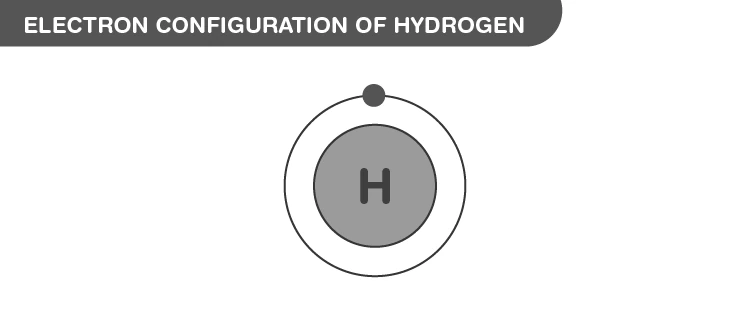
Electron Configuration of Hydrogen
Oxygen Atom Configuration
Oxygen has 8 electrons distributed as follows:
K shell: 2 electrons
L shell: 6 electrons
Its electron configuration is:
\[ 1s^2\, 2s^2\, 2p^4 \]
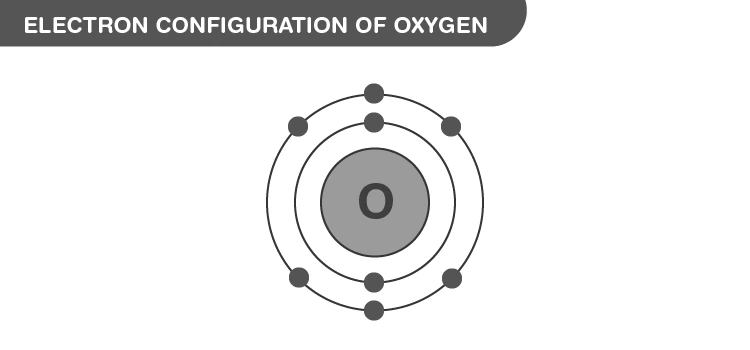
Electron Configuration of Oxygen
Chlorine Atom Configuration
Chlorine has 17 electrons arranged as:
K shell: 2 electrons
L shell: 8 electrons
M shell: 7 electrons
Its full electron configuration is:
\[ 1s^2\, 2s^2\, 2p^6\, 3s^2\, 3p^5 \]
Abbreviated form:
\[ [Ne]\, 3s^2\, 3p^5 \]
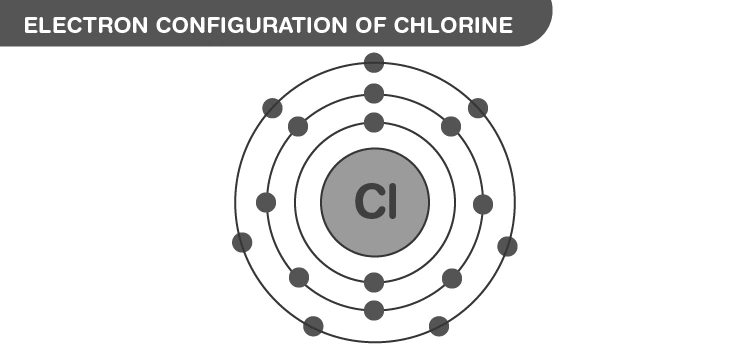
Electron Configuration of Chlorine
Example Problem
Write the electron configuration for phosphorus (atomic number 15) using the Aufbau principle.
Solution:
Phosphorus has 15 electrons. Filling order:
\[ 1s^2\, 2s^2\, 2p^6\, 3s^2\, 3p^3 \]
Abbreviated notation:
\[ [Ne]\, 3s^2\, 3p^3 \]
Summary Table for Electron Configuration Concepts
Concept | Details |
|---|---|
Maximum Electrons in Shell | \( 2n^2 \), where \( n \) is the principal quantum number |
Subshell Types | s (\( l=0 \)), p (\( l=1 \)), d (\( l=2 \)), f (\( l=3 \)) |
Max Electrons in Subshell | \( 2(2l + 1) \) |
Aufbau Principle | Electrons fill orbitals from lower to higher energy |
Pauli Exclusion Principle | Max two electrons per orbital with opposite spins |
Hund’s Rule | Orbitals in a subshell fill singly first with parallel spins |
Abbreviated Notation | Use noble gas symbol in square brackets to represent filled inner shells |
Example: Sodium | Full: \( 1s^2\, 2s^2\, 2p^6\, 3s^1 \), Abbreviated: \( [Ne]\, 3s^1 \) |
Electron Configuration Importance | Determines valency, chemical properties, and spectral characteristics |
Glossary of Key Terms
Term | Definition |
|---|---|
Electron Configuration | Arrangement of electrons in atomic orbitals |
Principal Quantum Number (n) | Indicates the shell or energy level of an electron |
Azimuthal Quantum Number (l) | Determines the subshell type (s, p, d, f) |
Subshell | A division of electron shells based on shape and energy |
Orbital | Region in space where an electron is likely to be found |
Aufbau Principle | Rule for filling electrons from lower to higher energy orbitals |
Pauli Exclusion Principle | No two electrons can have identical quantum numbers |
Hund’s Rule | Electrons fill orbitals singly with parallel spins before pairing |
Valency | Number of electrons an atom can gain, lose, or share |
Noble Gas Notation | Abbreviated electron configuration using noble gas symbols |
Frequently Asked Questions
What does electron configuration represent?
It shows how electrons are arranged in an atom's orbitals, indicating energy levels and subshell occupancy.
Which rules guide the writing of electron configurations?
The Aufbau principle, Pauli exclusion principle, and Hund’s rule collectively determine electron placement in orbitals.
Why is electron configuration important in chemistry?
It helps predict chemical behavior, valency, and grouping of elements with similar properties.
How are noble gases used in electron configuration notation?
They simplify notation by representing filled inner shells with their symbol in square brackets.
What is an example of an exception to the Aufbau principle?
Chromium's configuration is [Ar] 4s1 3d5 instead of [Ar] 4s2 3d4 due to stability of half-filled d subshell.