Comprehensive Guide to Electrolysis and Its Applications
Fundamentals of Electrolysis and Its Mechanism
Understanding the Electrolytic Process
Electrolysis is a chemical technique where ionic compounds are broken down into their elemental components by passing a direct electric current through their molten or aqueous form. In this process, positively charged ions (cations) migrate towards the cathode where they gain electrons and undergo reduction, while negatively charged ions (anions) move to the anode to lose electrons and get oxidized. Essential components for electrolysis include an electrolyte, electrodes (cathode and anode), and an external power source. Sometimes, a separator like an ion-exchange membrane is used to prevent mixing of products near the electrodes.
For instance, water containing acid or salts can be decomposed into hydrogen and oxygen gases by electrolysis. Similarly, molten sodium chloride can be split into sodium metal and chlorine gas.
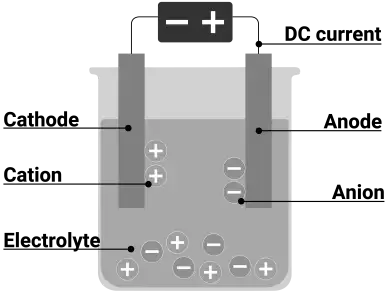
Illustration of an electrolytic cell with electrodes and electrolyte
Typically, electrolysis is conducted in an electrolytic cell containing two electrodes connected to a DC power supply and an ionic compound as the electrolyte, either molten or dissolved in a suitable solvent. Electrodes are commonly made from metals, graphite, or semiconductors, chosen based on their chemical compatibility and cost-effectiveness.
Example Problem
When an electric current passes through molten potassium bromide, identify the species discharged at the cathode and anode, and write the corresponding half-reactions.
Solution:
In molten potassium bromide, the ions present are \( \text{K}^+ \) and \( \text{Br}^- \).
At the cathode (reduction):
\[ \text{K}^+ + e^- \rightarrow \text{K} \quad \text{(Potassium metal is formed)} \]
At the anode (oxidation):
\[ 2\text{Br}^- \rightarrow \text{Br}_2 + 2e^- \quad \text{(Bromine gas is released)} \]
Thus, potassium metal deposits at the cathode, and bromine gas evolves at the anode.
Voltage Requirements and Faraday’s Principles in Electrolysis
Electrolytic Cell Potential and Overvoltage
The minimum voltage necessary to initiate electrolysis is called the decomposition potential or decomposition voltage. It corresponds to the difference in electrode potentials between the anode and cathode that allows the redox reactions to proceed. This voltage depends on the ions' tendency to gain or lose electrons, quantified by their electrode potentials.
The thermodynamically calculated voltage can be derived using the Nernst equation. However, in practice, an additional voltage called overpotential is often required to overcome kinetic barriers, especially for gas-evolving reactions like oxygen or chlorine production.
The overall cell potential is the sum of the potentials for the oxidation and reduction half-reactions. Only reactions with positive cell potentials are thermodynamically feasible. Electrolysis forces non-spontaneous reactions by applying an external voltage, converting electrical energy into chemical energy.
Faraday’s Laws Governing Electrolysis
The extent of chemical change during electrolysis is directly proportional to the quantity of electric charge passed through the electrolyte. This relationship is described by Faraday’s laws:
First Law: The mass of a substance altered at an electrode is proportional to the total electric charge passed.
Second Law: The masses of different substances liberated by the same quantity of electricity are proportional to their equivalent weights.
Mathematically, Faraday’s second law can be expressed as:
\[ \frac{M_1}{M_2} = \frac{E_1}{E_2} \]
where \( M \) is the mass of the substance and \( E \) is its equivalent weight.
Example Problem
A current of 4 amperes is passed through a solution of copper sulfate for 30 minutes. Calculate the mass of copper deposited at the cathode. (Equivalent weight of copper = 31.75 g/equiv)
Solution:
Total charge passed, \( Q = I \times t = 4 \times (30 \times 60) = 7200 \text{ C} \)
Number of equivalents deposited,
\[ n = \frac{Q}{F} = \frac{7200}{96485} \approx 0.0746 \text{ equiv} \]
Mass of copper deposited,
\[ m = n \times E = 0.0746 \times 31.75 = 2.37 \text{ g} \]
Therefore, 2.37 grams of copper will be deposited at the cathode.
Influencing Factors and Practical Uses of Electrolysis
Key Factors Affecting Electrolytic Reactions
Several parameters influence the outcome and efficiency of electrolysis:
Electrolyte State and Composition: Electrolytes must be in molten or aqueous form to allow ion mobility. Solid ionic compounds are unsuitable due to immobile ions.
Electrode Material: The chemical nature of electrodes affects the products formed. Inert electrodes like platinum or graphite do not react, while reactive electrodes may participate in the reaction.
Ion Electrode Potentials: When multiple ions are present, those with more positive redox potentials are preferentially discharged.
Overvoltage: Additional voltage required to overcome kinetic barriers can alter which species are oxidized or reduced, affecting product formation.
For example, electrolysis of aqueous copper sulfate with inert electrodes deposits copper at the cathode and evolves oxygen at the anode. However, if copper acts as the anode, it dissolves into the solution instead of producing oxygen gas.
Industrial and Experimental Applications of Electrolysis
Electrolysis is widely employed in various fields, including:
Determining Equivalent Weights: Using Faraday’s laws to calculate unknown equivalent weights by measuring deposited masses.
Extraction of Reactive Metals: Isolation of alkali and alkaline earth metals by electrolyzing their molten salts.
Metal Purification: Electrorefining metals like copper and nickel to achieve high purity.
Electroplating: Coating objects with metals such as gold, silver, or chromium for corrosion resistance and aesthetics.
Production of Pure Gases: Generating hydrogen, oxygen, and chlorine gases for industrial use.
Manufacture of Chemical Compounds: Producing substances like sodium hydroxide, potassium permanganate, and ammonium persulfate.
Electrocrystallization: Growing conductive crystals for specialized electronic applications.
Electroplating: Metal deposition on an object using electrolysis
Example Problem
An iron rod of 10 cm diameter and 1.5 m length is to be coated with a 0.02 cm thick layer of zinc by electroplating. If the current used is 30 A, calculate the mass of zinc deposited and the time required. (Density of zinc = 7.14 g/cm³, Equivalent weight of zinc = 32.8 g/equiv)
Solution:
Volume of zinc coating,
\[ V = 2 \pi r l \times \text{thickness} = 2 \times \frac{22}{7} \times \frac{10}{2} \times 150 \times 0.02 = 942.86 \text{ cm}^3 \]
Mass of zinc deposited,
\[ m = V \times \rho = 942.86 \times 7.14 = 6735.8 \text{ g} \]
Number of equivalents,
\[ n = \frac{m}{E} = \frac{6735.8}{32.8} = 205.4 \text{ equiv} \]
Total charge required,
\[ Q = n \times F = 205.4 \times 96485 = 1.981 \times 10^7 \text{ C} \]
Time required,
\[ t = \frac{Q}{I} = \frac{1.981 \times 10^7}{30} = 660333 \text{ s} \approx 183.4 \text{ hours} \]
Hence, approximately 6.7 kg of zinc will be deposited in about 183 hours.
Summary Table for Quick Revision
Concept | Key Points | Formula/Example |
|---|---|---|
Electrolysis | Decomposition of ionic compounds by electric current; cations reduced at cathode, anions oxidized at anode. | Example: \( \text{NaCl (molten)} \rightarrow \text{Na} + \text{Cl}_2 \) |
Decomposition Potential | Minimum voltage required to start electrolysis; includes overvoltage for gas evolution. | Calculated via Nernst equation and electrode potentials. |
Faraday’s First Law | Mass deposited ∝ charge passed. | \( m = \frac{Q \times E}{F} \) |
Faraday’s Second Law | Masses of substances deposited by same charge are proportional to their equivalent weights. | \( \frac{M_1}{M_2} = \frac{E_1}{E_2} \) |
Factors Affecting Electrolysis | Electrolyte state, electrode nature, ion potentials, overvoltage. | Example: Oxygen evolution suppressed by overvoltage in chloride solutions. |
Applications | Metal extraction, purification, electroplating, gas production, compound synthesis. | Electrorefining of copper; electroplating of silver. |
Glossary of Important Terms
Term | Definition |
|---|---|
Electrolysis | Process of decomposing ionic compounds using electric current. |
Cathode | Electrode where reduction occurs; cations gain electrons. |
Anode | Electrode where oxidation occurs; anions lose electrons. |
Electrolyte | Substance containing free ions that conducts electricity. |
Decomposition Potential | Minimum voltage needed to initiate electrolysis. |
Overvoltage | Extra voltage required beyond thermodynamic potential due to kinetic barriers. |
Faraday’s Laws | Quantitative laws relating electric charge to amount of substance altered. |
Equivalent Weight | Mass of substance that reacts with or supplies one mole of electrons. |
Electrorefining | Purification of metals by electrolysis. |
Electroplating | Coating an object with a metal layer using electrolysis. |
Frequently Asked Questions
What is the basic principle behind electrolysis?
Electrolysis involves passing an electric current through an ionic compound to cause chemical decomposition into elements or simpler compounds.
Why is overvoltage important in electrolysis?
Overvoltage accounts for the extra energy needed to overcome kinetic barriers, influencing which products form during electrolysis, especially for gas evolution.
How does the nature of electrodes affect electrolysis?
Reactive electrodes may participate in the reaction, altering products, while inert electrodes do not react and allow only electrolyte ions to undergo redox changes.
What are some common applications of electrolysis?
Electrolysis is used in metal extraction, purification, electroplating, production of pure gases, and manufacturing chemical compounds.
How can Faraday’s laws be used practically?
They help calculate the amount of substance deposited or liberated during electrolysis based on the electric charge passed through the electrolyte.