Understanding Standard Electrode Potential and Its Applications
Fundamentals of Electrode Potential and Standard Conditions
Concept of Electrode Potential and Its Measurement
Electrode potential refers to the voltage developed at the interface between an electrode and its surrounding electrolyte due to the tendency of the electrode to either lose or gain electrons. This potential difference arises because of the equilibrium established between the electrode and the ions in the electrolyte.
When all species involved in the half-cell reaction are at unit activity (usually 1 M concentration for solutions), the electrode potential measured under these conditions is called the standard electrode potential.
Standard electrode potentials are determined under specific conditions: temperature at 298 K, pressure at 1 atm, and 1 M concentration for all aqueous species. The notation \( E^\circ \) is used to denote these standard potentials.
Example:
Consider a copper electrode immersed in a 1 M solution of \( \text{Cu}^{2+} \) ions at 298 K and 1 atm pressure. The potential developed at this electrode under these conditions is its standard electrode potential.
Role of Standard Electrode Potential in Electrochemical Cells
Understanding Redox Reactions and Electrode Potentials
Electrochemical cells operate based on redox reactions, which consist of two half-reactions: oxidation and reduction. Oxidation occurs at the anode where electrons are lost, while reduction takes place at the cathode where electrons are gained. The flow of electrons from anode to cathode generates an electric potential difference.
While the overall cell potential can be measured using a voltmeter, the individual potential of a single half-cell cannot be directly measured. To overcome this, the standard hydrogen electrode (SHE) is used as a reference electrode with an assigned potential of 0 V.
By pairing any electrode with the SHE and measuring the cell voltage, the standard electrode potential of that electrode can be determined. The standard electrode potential is always expressed as a reduction potential.
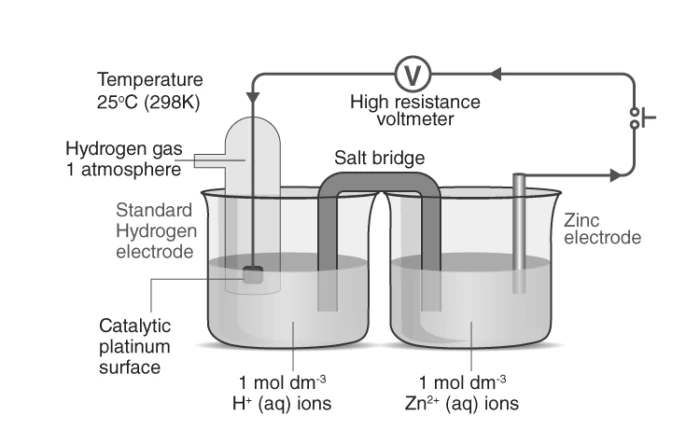
Illustration of Standard Electrode Potential Measurement Using SHE
Example:
Calculate the standard electrode potential of a zinc electrode when connected to the standard hydrogen electrode, given the cell potential is measured as 1.10 V under standard conditions.
Solution:
Since SHE has \( E^\circ = 0 \text{ V} \), the cell potential equals the electrode potential of zinc.
Therefore, \( E^\circ_{\text{Zn}^{2+}/\text{Zn}} = -1.10 \text{ V} \) (negative sign indicates zinc is oxidized).
Predicting Reaction Spontaneity Using Electrode Potentials
Relationship Between Gibbs Free Energy and Cell Potential
The spontaneity of a redox reaction is linked to the Gibbs free energy change \( \Delta G^\circ \). For a reaction to proceed spontaneously, \( \Delta G^\circ \) must be negative. This relationship is expressed as:
\[ \Delta G^\circ = -n F E^\circ_{\text{cell}} \]
where:
\( n \) = number of moles of electrons transferred
\( F \) = Faraday’s constant (\( 96485 \text{ C mol}^{-1} \))
\( E^\circ_{\text{cell}} \) = standard cell potential
The standard cell potential is calculated by subtracting the anode potential from the cathode potential:
\[ E^\circ_{\text{cell}} = E^\circ_{\text{cathode}} - E^\circ_{\text{anode}} \]
For a reaction to be spontaneous, \( E^\circ_{\text{cell}} \) must be positive, which implies:
\[ E^\circ_{\text{cathode}} > E^\circ_{\text{anode}} \]
Example:
Given the standard reduction potentials: \( E^\circ_{\text{Cu}^{2+}/\text{Cu}} = +0.34 \text{ V} \) and \( E^\circ_{\text{Zn}^{2+}/\text{Zn}} = -0.76 \text{ V} \), determine if the reaction between zinc and copper ions is spontaneous.
Solution:
Calculate the cell potential:
\[ E^\circ_{\text{cell}} = 0.34 - (-0.76) = 1.10 \text{ V} \]
Since \( E^\circ_{\text{cell}} > 0 \), the reaction is spontaneous.
Summary of Key Points on Standard Electrode Potential
Aspect | Details |
|---|---|
Definition | Potential of an electrode measured under standard conditions relative to SHE |
Standard Conditions | Temperature: 298 K, Pressure: 1 atm, Concentration: 1 M |
Reference Electrode | Standard Hydrogen Electrode (SHE) with \( E^\circ = 0 \text{ V} \) |
Measurement | Measured by pairing electrode with SHE and recording cell voltage |
Significance | Predicts spontaneity of redox reactions and strength of oxidizing/reducing agents |
Spontaneity Criterion | \( E^\circ_{\text{cell}} > 0 \) indicates spontaneous reaction |
Relation to Gibbs Free Energy | \( \Delta G^\circ = -n F E^\circ_{\text{cell}} \) |
Oxidation vs Reduction Potential | Oxidation potential is negative of reduction potential |
Good Oxidizing Agent | High positive standard reduction potential |
Good Reducing Agent | Low or negative standard reduction potential |
Glossary of Important Terms
Term | Meaning |
|---|---|
Electrode Potential | Voltage developed at the interface of an electrode and electrolyte |
Standard Electrode Potential | Electrode potential measured under standard conditions relative to SHE |
Standard Hydrogen Electrode (SHE) | Reference electrode with assigned potential of 0 V |
Redox Reaction | Chemical reaction involving simultaneous oxidation and reduction |
Anode | Electrode where oxidation occurs |
Cathode | Electrode where reduction occurs |
Faraday’s Constant (F) | Charge per mole of electrons, approximately 96485 C/mol |
Gibbs Free Energy (\( \Delta G^\circ \)) | Thermodynamic quantity indicating spontaneity of a reaction |
Oxidizing Agent | Substance that gains electrons and gets reduced |
Reducing Agent | Substance that loses electrons and gets oxidized |
Frequently Asked Questions
What is meant by electrode potential?
Electrode potential is the voltage developed at the boundary between an electrode and its electrolyte, reflecting the tendency of the electrode to gain or lose electrons.
How does standard electrode potential differ from standard cell potential?
Standard electrode potential refers to the potential of a single electrode measured against the standard hydrogen electrode, while standard cell potential is the overall voltage difference between the cathode and anode in a complete electrochemical cell.
Which factors influence the electrode potential?
Electrode potential depends on temperature, pressure, and the concentration of ions in the electrolyte surrounding the electrode.
What affects the voltage of an electrochemical cell?
Cell voltage is influenced by temperature, surface area of electrodes, and the concentration of the electrolyte solutions.
How can the cell potential be increased?
Increasing the concentration of electrolyte ions in one half-cell raises the number of charge carriers, thereby increasing the cell’s voltage potential.