Fundamentals of Electrochemistry: Energy and Chemical Transformations
Understanding Electrochemical Processes and Their Applications
Basics of Electrochemistry and Its Core Principles
Electrochemistry explores the interplay between electrical energy and chemical reactions. It focuses on processes where electrical currents either drive chemical changes or are produced by them. These reactions, known as electrochemical reactions, fall into two main categories: those where electrical energy causes chemical transformations (electrolysis) and those where chemical reactions spontaneously generate electrical energy (galvanic processes).
At the heart of electrochemistry lies the movement of electrons between substances, often involving redox reactions. These reactions typically occur in systems where charge separation and transfer happen, frequently in solutions containing ions. The study also encompasses how charges move either within a single phase or across interfaces between different chemical species.
Example Problem
Consider a reaction where electrons transfer from zinc to copper ions. Explain how electrical energy is generated in this process.
Solution: When zinc metal reacts with copper ions, zinc atoms lose electrons (oxidation) and become zinc ions, while copper ions gain electrons (reduction) to form copper metal. This electron flow from zinc to copper through an external circuit produces electrical energy, demonstrating the conversion of chemical energy into electricity.
Electrochemical Cells: Devices for Energy Conversion
Galvanic Cells: Harnessing Spontaneous Reactions
Galvanic cells transform chemical energy into electrical energy by separating oxidation and reduction reactions into two compartments called half-cells. Each half-cell contains an electrode immersed in an electrolyte solution. The electrodes serve as conductors for electron flow, while the electrolyte facilitates ion movement. The Daniell cell, a classic example, uses zinc and copper electrodes to generate electricity through a redox reaction.
In the Daniell cell, zinc undergoes oxidation releasing electrons, and copper ions gain electrons through reduction. The salt bridge, typically a U-shaped tube filled with inert electrolyte gel, maintains electrical neutrality by allowing ion flow between the half-cells, preventing charge buildup and enabling continuous current flow.
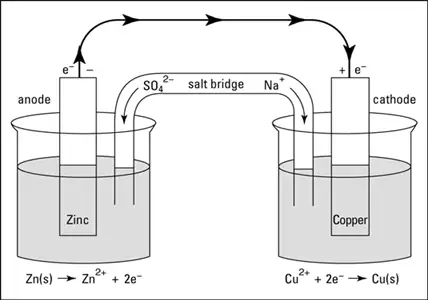
Galvanic Cell - Daniell cell
Example Problem
Write the half-reactions occurring at the electrodes of a Daniell cell and identify the direction of electron flow.
Solution:
At the anode (oxidation):
\[ \mathrm{Zn(s)} \rightarrow \mathrm{Zn^{2+}(aq)} + 2e^- \]
At the cathode (reduction):
\[ \mathrm{Cu^{2+}(aq)} + 2e^- \rightarrow \mathrm{Cu(s)} \]
Electrons flow from the zinc electrode (anode) to the copper electrode (cathode) through the external circuit, generating electric current.
Electrode Potentials and Standard Conditions
Each electrode in a galvanic cell has a characteristic tendency to lose or gain electrons, known as electrode potential. The standard electrode potential (\(E^0\)) is measured relative to the standard hydrogen electrode (SHE) under standard conditions: 1 M ion concentration, 298 K temperature, and 1 bar pressure. This potential indicates the electrode's ability to undergo oxidation or reduction.
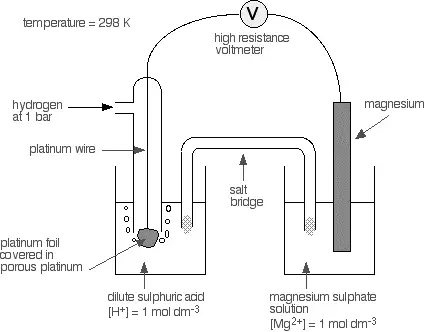
Standard Electrode Potential
Electrochemical Series and Cell Voltage
The electrochemical series arranges elements based on their standard reduction potentials, providing insight into their relative tendencies to gain electrons. The cell potential or electromotive force (emf) of a galvanic cell is the difference between the electrode potentials of the cathode and anode:
\[ E^\circ_{\text{cell}} = E^\circ_{\text{cathode}} - E^\circ_{\text{anode}} \]
A positive cell potential indicates a spontaneous reaction, while a negative value means the reaction is non-spontaneous.
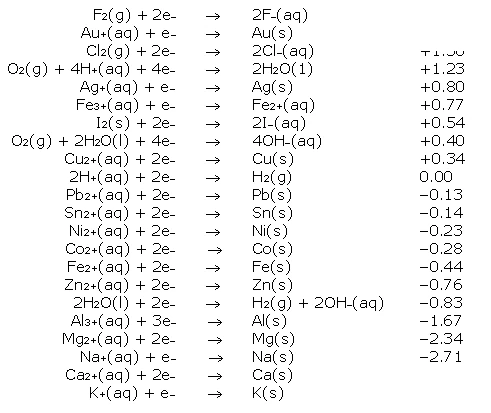
Electrochemical Series of Elements
Example Problem
Calculate the cell potential for a galvanic cell with a cathode having \(E^\circ = 0.80 \text{ V}\) and an anode with \(E^\circ = 0.34 \text{ V}\). Is the reaction spontaneous?
Solution:
\[ E^\circ_{\text{cell}} = 0.80 \text{ V} - 0.34 \text{ V} = 0.46 \text{ V} \]
Since the cell potential is positive, the reaction proceeds spontaneously.
Effect of Concentration and Temperature: Nernst Equation
The actual cell potential varies with ion concentrations and temperature. The Nernst equation relates these factors to the cell potential:
\[ E_{\text{cell}} = E^\circ_{\text{cell}} - \frac{RT}{nF} \ln \frac{[C]^c [D]^d}{[A]^a [B]^b} \]
At 298 K, this simplifies to:
\[ E_{\text{cell}} = E^\circ_{\text{cell}} - \frac{0.0591}{n} \log \frac{[C]^c [D]^d}{[A]^a [B]^b} \]
where \(n\) is the number of electrons transferred, and the brackets denote ion concentrations.
Electrolytic Cells: Driving Chemical Changes with Electricity
Principles of Electrolysis and Ion Movement
Electrolytic cells use electrical energy to induce non-spontaneous chemical reactions. Electrodes immersed in an electrolyte solution attract ions of opposite charge: cations move to the cathode for reduction, and anions move to the anode for oxidation. This process is essential in applications like metal extraction and electroplating.
For instance, molten sodium chloride undergoes electrolysis where sodium ions gain electrons at the cathode to form sodium metal, and chloride ions lose electrons at the anode to produce chlorine gas.
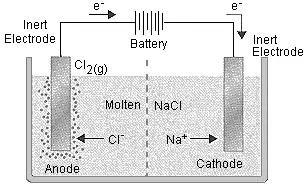
Electrolysis of Molten Sodium Chloride
Example Problem
Write the half-reactions occurring during the electrolysis of molten sodium chloride.
Solution:
At the cathode (reduction):
\[ \mathrm{Na^+} + e^- \rightarrow \mathrm{Na} \]
At the anode (oxidation):
\[ 2\mathrm{Cl^-} \rightarrow \mathrm{Cl_2} + 2e^- \]
The overall reaction is:
\[ 2\mathrm{NaCl} \rightarrow 2\mathrm{Na} + \mathrm{Cl_2} \]
Selective Ion Discharge in Electrolytic Solutions
When multiple ions are present, the ions discharged at electrodes depend on their reduction or oxidation potentials. For example, in aqueous sodium chloride solution, hydrogen ions are preferentially reduced at the cathode over sodium ions due to their higher reduction potential, producing hydrogen gas. Similarly, chloride ions are oxidized at the anode instead of hydroxide ions, releasing chlorine gas.
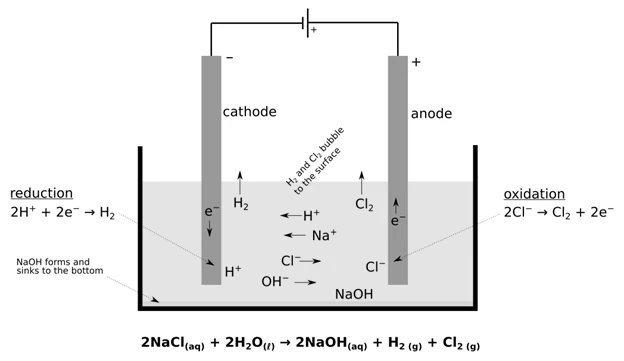
Preferential Discharge of Ions
Faraday’s Laws: Quantitative Electrolysis
Faraday’s laws quantify the relationship between electric charge and the amount of substance deposited or liberated during electrolysis.
First Law: The mass of a substance deposited is directly proportional to the total electric charge passed through the electrolyte.
\[ W = Z \times I \times t \]
where \(W\) is the mass deposited, \(I\) is current, \(t\) is time, and \(Z\) is the electrochemical equivalent.
Second Law: When the same charge passes through different electrolytes, the masses of substances deposited are proportional to their equivalent weights.
\[ \frac{W_1}{W_2} = \frac{Z_1}{Z_2} \]
Faraday’s constant \(F = 96500 \text{ C/mol}\) represents the charge of one mole of electrons.
Example Problem
A metal with valency 2 is deposited by passing a current of 0.3 A for 2 hours. The mass deposited is 0.54 g. Identify the metal if its atomic mass is unknown.
Solution:
Calculate total charge passed:
\[ Q = I \times t = 0.3 \text{ A} \times (2 \times 3600) \text{ s} = 2160 \text{ C} \]
Using Faraday’s first law:
\[ W = \frac{E \times Q}{F} \Rightarrow E = \frac{W \times F}{Q} = \frac{0.54 \times 96500}{2160} = 24.13 \text{ g/equiv} \]
Since valency \(n=2\), atomic mass \(= E \times n = 24.13 \times 2 = 48.26 \text{ g/mol}\).
The metal corresponds approximately to cadmium (atomic mass ~48 g/mol).
Summary and Key Concepts in Electrochemistry
Concept | Definition/Formula | Significance |
|---|---|---|
Electrochemical Reaction | Chemical reaction involving electron transfer | Basis for energy conversion in cells |
Galvanic Cell | Converts chemical energy to electrical energy | Used in batteries and power sources |
Electrolytic Cell | Uses electrical energy to drive chemical reactions | Applied in electroplating and metal extraction |
Standard Electrode Potential (\(E^0\)) | Measured vs. Standard Hydrogen Electrode | Predicts direction of redox reactions |
Cell Potential (\(E_{\text{cell}}\)) | \(E^\circ_{\text{cell}} = E^\circ_{\text{cathode}} - E^\circ_{\text{anode}}\) | Indicates spontaneity of reaction |
Nernst Equation | \(E_{\text{cell}} = E^\circ_{\text{cell}} - \frac{0.0591}{n} \log Q\) | Calculates cell potential under non-standard conditions |
Faraday’s First Law | \(W = Z \times I \times t\) | Relates charge to mass deposited |
Faraday’s Second Law | \(\frac{W_1}{W_2} = \frac{Z_1}{Z_2}\) | Masses deposited proportional to equivalent weights |
Salt Bridge | Completes circuit by ion flow | Maintains charge neutrality in galvanic cells |
Electrochemical Series | Arrangement of elements by \(E^0\) | Predicts redox behavior and reaction feasibility |
Glossary of Essential Electrochemistry Terms
Term | Meaning |
|---|---|
Electrolysis | Process of driving chemical reactions using electric current |
Redox Reaction | Chemical reaction involving simultaneous oxidation and reduction |
Electrode | Conductor through which electrons enter or leave the electrolyte |
Half-Cell | One compartment of an electrochemical cell containing an electrode and electrolyte |
Salt Bridge | Device allowing ion flow to maintain electrical neutrality |
Standard Hydrogen Electrode (SHE) | Reference electrode with zero potential under standard conditions |
Electromotive Force (emf) | Voltage generated by an electrochemical cell |
Faraday’s Constant | Charge of one mole of electrons, approximately 96500 C/mol |
Electrochemical Equivalent | Mass of substance deposited per unit charge |
Nernst Equation | Equation relating cell potential to ion concentrations and temperature |
Frequently Asked Questions on Electrochemistry
What is the primary role of a galvanic cell?
A galvanic cell generates electrical energy from spontaneous redox reactions by transferring electrons through an external circuit.
How does an electrolytic cell differ from a galvanic cell?
An electrolytic cell consumes electrical energy to drive non-spontaneous chemical reactions, whereas a galvanic cell produces electrical energy from spontaneous reactions.
What defines a half-cell in electrochemistry?
A half-cell consists of an electrode and its surrounding electrolyte where either oxidation or reduction occurs.
How is cell potential related to reaction spontaneity?
A positive cell potential indicates a spontaneous reaction, while a negative value means the reaction is non-spontaneous.
What information does the electrochemical series provide?
It ranks elements by their standard reduction potentials, helping predict their tendency to gain or lose electrons in redox reactions.