Fundamentals and Applications of Electrochemical Cells
Understanding Electrochemical Cells and Their Components
Defining Electrochemical Cells and Their Functionality
An electrochemical cell is a device that either produces electrical energy from chemical reactions or uses electrical energy to drive chemical changes. These cells convert chemical energy into electrical energy or vice versa, enabling various practical applications. A typical example is the standard 1.5-volt battery commonly used in household gadgets like remote controls and clocks.
Cells that spontaneously generate electric current through chemical reactions are known as galvanic or voltaic cells. Conversely, cells that require an external electric current to induce chemical reactions are called electrolytic cells.
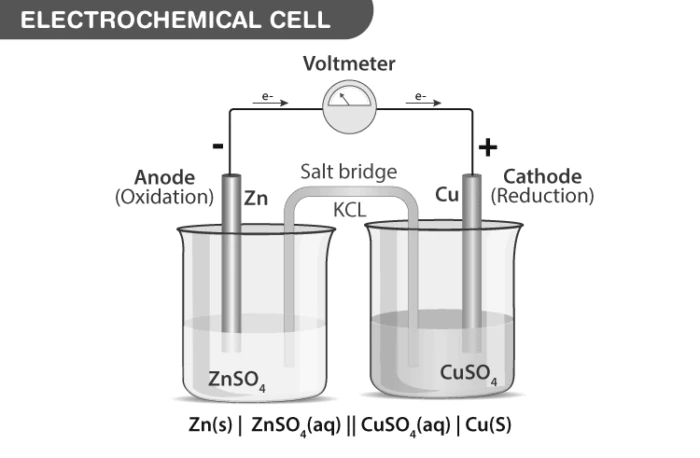
Diagram illustrating the parts of an electrochemical cell
Typically, an electrochemical cell consists of two electrodes: the anode and the cathode. By convention, the anode is placed on the left side and the cathode on the right side when representing the cell.
Example Problem
Consider a cell that converts chemical energy into electrical energy to power a small device. If the cell produces a voltage of 1.2 volts and the current drawn is 0.5 amperes, calculate the power output of the cell.
Solution:
Power \( P \) is given by the product of voltage \( V \) and current \( I \):
\[ P = V \times I \]
Substituting the values:
\[ P = 1.2 \text{ V} \times 0.5 \text{ A} = 0.6 \text{ W} \]
Therefore, the cell delivers 0.6 watts of power to the device.
Exploring Half-Cells and Electrode Potentials
Structure and Role of Half-Cells in Electrochemical Systems
Electrochemical cells are composed of two half-cells, each containing an electrode immersed in an electrolyte solution. These half-cells are connected by a salt bridge, which allows ionic movement to maintain electrical neutrality without mixing the electrolytes.
For example, a salt bridge may be a filter paper soaked in potassium nitrate or sodium chloride solution. In one half-cell, oxidation occurs, releasing electrons, while in the other, reduction takes place, accepting electrons. Both half-cells reach an equilibrium where the net voltage drops to zero, stopping the current flow.
The electrode potential measures the tendency of an electrode to gain or lose electrons when in contact with an electrolyte. These potentials are typically measured against a standard hydrogen electrode, which serves as a reference with a defined potential.
Example Problem
In a half-cell, the electrode potential is measured as 0.34 V against the standard hydrogen electrode. If the other half-cell has an electrode potential of -0.76 V, calculate the overall cell potential.
Solution:
The overall cell potential \( E_{\text{cell}} \) is the difference between the cathode and anode potentials:
\[ E_{\text{cell}} = E_{\text{cathode}} - E_{\text{anode}} \]
Assuming the half-cell with 0.34 V is the cathode and the one with -0.76 V is the anode:
\[ E_{\text{cell}} = 0.34 \text{ V} - (-0.76 \text{ V}) = 1.10 \text{ V} \]
The cell potential is 1.10 volts.
Classification and Practical Uses of Electrochemical Cells
Distinguishing Between Primary and Secondary Cells
Primary cells are single-use galvanic cells where the chemical reactions are irreversible. Once the reactants are exhausted, the cell ceases to produce electricity. These are commonly disposable batteries.
Secondary cells, or rechargeable batteries, can operate reversibly as galvanic or electrolytic cells. They can be recharged by applying an external electric current, restoring the reactants and enabling multiple uses.
Example Problem
A rechargeable battery delivers a current of 2 A for 3 hours before needing recharge. Calculate the total charge passed through the battery during this period.
Solution:
Charge \( Q \) is the product of current \( I \) and time \( t \):
\[ Q = I \times t \]
Convert time to seconds: \( 3 \text{ hours} = 3 \times 3600 = 10800 \text{ s} \)
\[ Q = 2 \text{ A} \times 10800 \text{ s} = 21600 \text{ C} \]
The total charge passed is 21,600 coulombs.
Comparing Galvanic and Electrolytic Cells
Galvanic cells generate electrical energy from spontaneous chemical reactions, while electrolytic cells consume electrical energy to drive non-spontaneous chemical reactions. The table below summarizes their key differences:
Aspect | Galvanic Cell | Electrolytic Cell |
|---|---|---|
Energy Conversion | Chemical to electrical | Electrical to chemical |
Reaction Type | Spontaneous | Non-spontaneous |
Electrode Charges | Anode (-), Cathode (+) | Anode (+), Cathode (-) |
Example | Leclanché cell | Electrolysis of molten sodium chloride |
Industrial and Everyday Applications of Electrochemical Cells
Electrolytic cells are widely used in refining metals such as copper, lead, zinc, and aluminium by electrorefining and electrowinning processes. For instance, metallic sodium is produced by electrolyzing molten sodium chloride.
Galvanic cells form the basis of many commercial batteries, including lead-acid batteries used in vehicles. Fuel cells, a special category of electrochemical cells, provide clean energy solutions in remote areas.
Quick Reference: Key Points on Electrochemical Cells
Concept | Details |
|---|---|
Electrochemical Cell | Device converting chemical energy to electrical energy or vice versa |
Galvanic Cell | Spontaneous reaction, produces electricity |
Electrolytic Cell | Non-spontaneous reaction, requires external current |
Half-Cell | Electrode immersed in electrolyte, site of oxidation or reduction |
Salt Bridge | Maintains ionic balance, completes circuit |
Primary Cell | Non-rechargeable, irreversible reactions |
Secondary Cell | Rechargeable, reversible reactions |
Electrode Potential | Measure of electrode's tendency to gain or lose electrons |
Standard Hydrogen Electrode | Reference electrode with zero potential |
Fuel Cell | Electrochemical cell producing clean energy from fuels |
Glossary of Important Terms
Term | Definition |
|---|---|
Electrochemical Cell | A device that converts chemical energy to electrical energy or vice versa. |
Galvanic Cell | An electrochemical cell that generates electricity from spontaneous chemical reactions. |
Electrolytic Cell | A cell that uses electrical energy to drive non-spontaneous chemical reactions. |
Anode | Electrode where oxidation occurs; electrons are released. |
Cathode | Electrode where reduction occurs; electrons are gained. |
Salt Bridge | A pathway that allows ion flow to maintain charge balance in the cell. |
Electrode Potential | The voltage developed at an electrode relative to a reference electrode. |
Primary Cell | A non-rechargeable battery with irreversible chemical reactions. |
Secondary Cell | A rechargeable battery with reversible chemical reactions. |
Fuel Cell | An electrochemical cell that converts fuel directly into electrical energy. |
Frequently Asked Questions
What role does the salt bridge play in an electrochemical cell?
The salt bridge completes the electrical circuit by allowing ion flow, which maintains electrical neutrality and enables continuous current flow.
How is the standard electrode potential defined?
It is the potential difference between an electrode and its electrolyte measured under standard conditions (298 K, 1 atm, 1 M concentration), using the standard hydrogen electrode as reference.
What distinguishes the cathode from the anode in an electrochemical cell?
The cathode is where reduction occurs and is positively charged in galvanic cells, while the anode is where oxidation happens and is negatively charged.
Can an anode be positively charged in any electrochemical cell?
Yes, in electrolytic cells the anode is positively charged despite oxidation occurring there, as the cell is driven by an external power source.
What are electrolytic cells used for?
They are used to drive chemical reactions such as metal extraction, electroplating, and water splitting by applying electrical energy.