Distillation Techniques and Applications
Fundamentals of Distillation and Its Scientific Basis
Understanding the Distillation Process
Distillation is a physical separation method that involves selectively boiling a component from a liquid mixture and then condensing its vapor to isolate or concentrate it. This technique leverages the differences in boiling points among the mixture's constituents to separate them effectively. It is important to emphasize that distillation does not involve any chemical transformation but purely a phase change from liquid to vapor and back to liquid.
Laboratory distillation typically operates in batch mode, processing fixed quantities of mixtures, whereas industrial distillation often runs continuously, maintaining steady feed compositions.
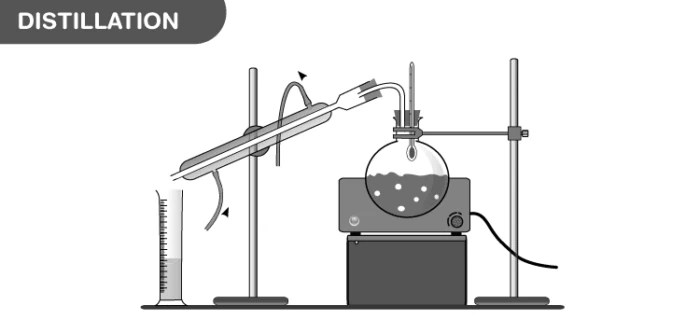
Laboratory setup for distillation process
Example Problem
A mixture contains two liquids, A and B, with boiling points of 80°C and 120°C respectively. If the mixture is heated, which component will vaporize first and why?
Solution:
Since liquid A has a lower boiling point (80°C) compared to liquid B (120°C), it will vaporize first upon heating. This is because the vapor pressure of A reaches the surrounding pressure earlier, causing it to boil before B. Thus, distillation can separate A from B by collecting the vapor rich in A.
Influence of Raoult’s and Dalton’s Laws on Distillation
The boiling point of a liquid is the temperature at which its vapor pressure equals the external pressure. This temperature varies with pressure; for instance, water boils at 100°C at sea level but at approximately 93.4°C at 1905 meters altitude due to lower atmospheric pressure.
In mixtures, the vapor pressure behavior is governed by Raoult’s law and Dalton’s law. Raoult’s law states that the partial vapor pressure of each component in an ideal mixture equals the product of its pure component vapor pressure and its mole fraction in the liquid. Dalton’s law asserts that the total pressure of a gas mixture is the sum of the partial pressures of each gas.
When heating a liquid mixture, the total vapor pressure is the sum of the partial pressures of all components, which means the mixture exhibits a single boiling point at a given composition and pressure.
Example Problem
A binary liquid mixture contains 0.6 mole fraction of component X and 0.4 mole fraction of component Y. The vapor pressures of pure X and Y at the boiling temperature are 80 kPa and 50 kPa respectively. Calculate the total vapor pressure of the mixture.
Solution:
Using Raoult’s law:
\[ P_{\text{total}} = x_X P_X^{\text{pure}} + x_Y P_Y^{\text{pure}} = (0.6)(80) + (0.4)(50) = 48 + 20 = 68 \text{ kPa} \]
Therefore, the total vapor pressure of the mixture is 68 kPa.
Limitations in Achieving Complete Purity by Distillation
At the boiling point of a liquid mixture, all volatile components vaporize simultaneously. However, the vapor composition depends on each component’s partial pressure contribution. Components with higher partial pressures tend to be enriched in the vapor phase, while those with lower partial pressures remain more in the liquid phase.
Since no component can have zero partial pressure, absolute purity of a single component through distillation alone is unattainable. Nevertheless, when one component’s partial pressure is negligible compared to others, high purity can be approached.
Example Problem
Explain why it is impossible to obtain 100% pure ethanol from an ethanol-water mixture by simple distillation.
Solution:
Both ethanol and water have non-zero vapor pressures at the boiling point.
The vapor phase contains both components due to their partial pressures.
Therefore, the distillate will always contain some water along with ethanol.
Complete separation requires additional techniques like fractional distillation or azeotropic distillation.
Varieties of Distillation Methods and Their Distinct Features
Simple Distillation: Basic Separation Technique
Simple distillation involves heating a liquid mixture until one component boils and then immediately condensing the vapor to collect the purified liquid. This method is effective when the boiling points of the components differ by at least 25°C, allowing easy separation.
The purity of the collected distillate is influenced by Raoult’s law, which governs vapor-liquid equilibrium.
Example Problem
A mixture contains two liquids with boiling points of 60°C and 90°C. Can simple distillation be used to separate them effectively? Justify your answer.
Solution:
The difference in boiling points is 30°C, which is greater than the minimum 25°C required for simple distillation. Therefore, simple distillation can be used to separate these liquids effectively.
Fractional Distillation: Enhanced Separation for Close Boiling Points
Fractional distillation is designed to separate liquid mixtures whose components have boiling points close to each other. It employs a fractionating column where multiple vaporization-condensation cycles occur, improving the purity of the distillate with each cycle. This process is also called rectification.
The apparatus includes a distilling flask, heat source, fractionating column, thermometer, condenser, and receiving flask.
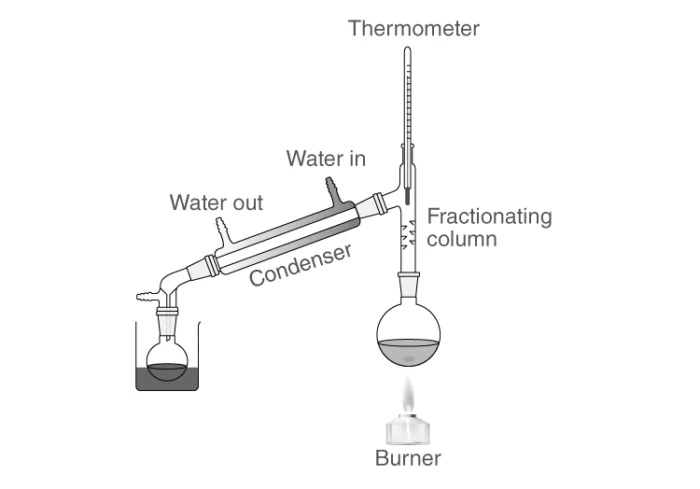
Setup for fractional distillation process
Common laboratory condensers used are Liebig and Graham condensers.
Example Problem
Explain why fractional distillation is preferred over simple distillation for separating a mixture of liquids with boiling points of 78°C and 82°C.
Solution:
The boiling points differ by only 4°C, which is too small for simple distillation.
Fractional distillation allows repeated vaporization-condensation cycles, enhancing separation.
The fractionating column provides surface area for these cycles, improving purity.
Steam Distillation: Separation of Heat-Sensitive Substances
Steam distillation is used to isolate components that decompose at high temperatures. Steam is passed through the mixture, causing vaporization at temperatures lower than the boiling points of the individual components. The vapor mixture is then condensed to obtain the desired distillate.
This method is commonly applied to extract essential oils and aromatic compounds from plants.
Example Problem
Why is steam distillation suitable for extracting essential oils from flowers?
Solution:
Essential oils are often heat-sensitive and can degrade at high temperatures.
Steam distillation lowers the effective boiling point, preventing decomposition.
Steam carries the volatile oils as vapor, which can be condensed and collected.
Vacuum Distillation: Handling High Boiling Point Liquids
Vacuum distillation reduces the surrounding pressure to lower the boiling points of liquids with high boiling temperatures. This avoids the need for excessive heating, which can cause thermal decomposition. The vapor formed under vacuum is condensed and collected as the distillate.
Example Problem
A compound boils at 250°C at atmospheric pressure but decomposes at this temperature. How can vacuum distillation help in purifying this compound?
Solution:
Lowering the pressure reduces the boiling point below 250°C.
The compound can be vaporized and distilled at a safer, lower temperature.
This prevents decomposition and allows purification.
Air-Sensitive Vacuum Distillation: Protecting Reactive Compounds
This technique is a variation of vacuum distillation used for compounds that react readily with air. After distillation under vacuum, the system is flushed with an inert gas to prevent oxidation or other reactions.
Example Problem
Why is it necessary to replace vacuum with inert gas after distilling air-sensitive compounds?
Solution:
Air-sensitive compounds can react with oxygen or moisture.
Introducing inert gas prevents exposure to reactive air components.
This preserves the purity and stability of the distilled compound.
Short Path Distillation: Efficient Purification of Small Quantities
Short path distillation is ideal for purifying small amounts of thermally unstable compounds. It operates under reduced pressure and minimizes the distance the vapor travels before condensation, reducing losses and degradation.
Example Problem
What advantage does short path distillation offer when purifying a small quantity of a heat-sensitive compound?
Solution:
Reduced pressure lowers boiling point, protecting the compound.
Short vapor path minimizes contact with apparatus surfaces, reducing loss.
Efficient for small-scale purification with minimal degradation.
Zone Distillation: Purification via Controlled Melting and Condensation
Zone distillation involves partially melting a substance in a long container and moving a heated zone along it. The vapor formed condenses in cooler regions, allowing separation of impurities. This method is useful for purifying solids and high-purity materials.
Example Problem
Describe how zone distillation can purify a solid material.
Solution:
A narrow heated zone melts part of the solid.
Impurities concentrate in the molten zone and move with it.
Pure material crystallizes behind the zone, resulting in purification.
Practical Uses and Significance of Distillation in Industry and Daily Life
Water Purification and Desalination
Distillation is widely employed in water treatment plants to remove impurities and salts from seawater, producing potable water. The process involves vaporizing water and condensing the pure vapor, leaving contaminants behind.
Example Problem
Explain why distillation is effective in desalination of seawater.
Solution:
Salt and impurities have negligible vapor pressure and remain in the liquid.
Only pure water vaporizes and is collected after condensation.
This results in fresh water free from dissolved salts.
Production of Distilled Water for Industrial Use
Distilled water is essential in applications such as lead-acid batteries and humidifiers where mineral-free water is required to prevent damage or scaling.
Purification of Alcoholic Beverages
Alcoholic drinks are refined through distillation to increase alcohol concentration and remove impurities, enhancing flavor and safety.
Extraction of Perfumes and Flavors
Essential oils and aromatic compounds are extracted from plants using distillation, preserving their fragrance and quality.
Oil Stabilization for Safe Handling
Distillation reduces the vapor pressure of crude oil, making it safer for storage and transportation by minimizing evaporation losses and fire hazards.
Separation of Atmospheric Gases
Cryogenic distillation is used industrially to separate air into nitrogen, oxygen, and argon by cooling and liquefying components at different temperatures.
Chemical Industry Applications
Distillation is a fundamental step in purifying liquid products obtained from chemical synthesis, ensuring product quality and consistency.
Example Problem
List three industrial applications of distillation and briefly explain their importance.
Solution:
Water desalination: Provides clean drinking water from seawater.
Air separation: Produces pure gases for medical and industrial use.
Petroleum refining: Separates crude oil into useful fractions like gasoline and diesel.
Quick Reference: Summary of Distillation Concepts
Distillation Type | Key Feature | Typical Use | Boiling Point Difference |
|---|---|---|---|
Simple Distillation | Single vaporization-condensation | Mixtures with large boiling point gap | > 25°C |
Fractional Distillation | Multiple vaporization-condensation cycles | Close boiling point mixtures | < 25°C |
Steam Distillation | Uses steam to vaporize heat-sensitive compounds | Essential oils extraction | N/A |
Vacuum Distillation | Reduced pressure lowers boiling points | High boiling or thermally unstable liquids | N/A |
Short Path Distillation | Minimal vapor travel distance under vacuum | Small quantities, heat-sensitive compounds | N/A |
Zone Distillation | Partial melting and moving heated zone | Purification of solids and high-purity materials | N/A |
Glossary of Key Terms in Distillation
Term | Definition |
|---|---|
Boiling Point | Temperature at which a liquid’s vapor pressure equals external pressure. |
Raoult’s Law | Partial vapor pressure of a component equals its mole fraction times pure vapor pressure. |
Dalton’s Law | Total pressure of gas mixture equals sum of partial pressures of individual gases. |
Distillate | The condensed vapor collected during distillation. |
Fractionating Column | Apparatus that facilitates multiple vaporization-condensation cycles in fractional distillation. |
Vapor Pressure | Pressure exerted by a vapor in equilibrium with its liquid at a given temperature. |
Partial Pressure | Pressure contributed by a single component in a mixture of gases. |
Vacuum Distillation | Distillation performed under reduced pressure to lower boiling points. |
Steam Distillation | Distillation using steam to vaporize components at lower temperatures. |
Zone Distillation | Purification method involving moving a heated zone through a solid. |
Frequently Asked Questions on Distillation
What is the principle behind distillation?
Distillation separates components based on differences in their boiling points by vaporizing and then condensing them.
How does pressure affect the boiling point of a liquid?
Lowering the external pressure decreases the boiling point, while increasing pressure raises it.
When should fractional distillation be used instead of simple distillation?
Fractional distillation is preferred when the boiling points of components differ by less than 25°C for better separation.
What is the advantage of steam distillation?
It allows distillation of heat-sensitive compounds at temperatures below their normal boiling points, preventing decomposition.
Why is vacuum distillation important in industry?
It enables distillation of high boiling or thermally unstable substances at lower temperatures, preserving their integrity.