Understanding Dipole Moments in Molecules
Fundamentals of Dipole Moments
Concept and Origin of Dipole Moments
A dipole moment emerges when there is a spatial separation of positive and negative charges within a system. This phenomenon is common in both ionic and covalent bonds due to differences in electronegativity between bonded atoms. The unequal sharing or transfer of electrons results in partial charges, creating an electric dipole.
Dipole moments are vector quantities, meaning they possess both magnitude and direction. The direction is conventionally taken from the negative charge center towards the positive charge center, often represented by an arrow symbol in chemical diagrams.
For example, in a molecule like hydrogen chloride (HCl), the chlorine atom is more electronegative than hydrogen, causing electron density to shift towards chlorine. This creates a dipole with partial positive charge (\( \delta^+ \)) on hydrogen and partial negative charge (\( \delta^- \)) on chlorine, separated by a distance \( d \).
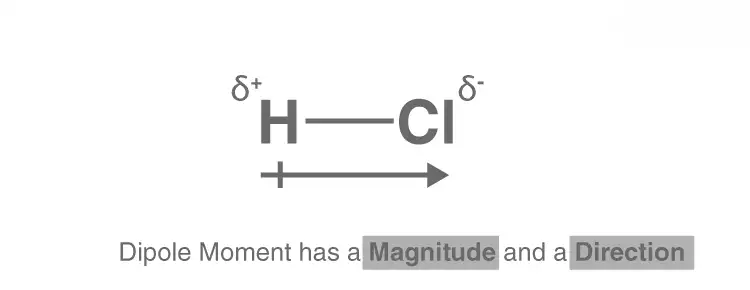
Representation of Dipole Moment in HCl Molecule
Example: Calculating Dipole Moment Vector Direction
Consider a molecule AB where atom B is more electronegative than atom A, resulting in partial charges \( \delta^+ \) on A and \( \delta^- \) on B separated by 0.12 nm. Identify the direction of the dipole moment vector.
Solution:
The dipole moment vector points from the positive charge to the negative charge. Since atom B is more electronegative, the vector points from A (\( \delta^+ \)) to B (\( \delta^- \)).
Thus, the dipole moment vector direction is from atom A to atom B along the bond axis.
Quantitative Description and Properties of Dipole Moments
Mathematical Expression and Characteristics
The dipole moment (\( \mu \)) quantifies the polarity of a bond and is calculated as the product of the magnitude of the charge separation and the distance between the charges:
\[ \mu = Q \times r \]
where \( Q \) is the magnitude of the partial charge and \( r \) is the separation distance between the charges. The unit of dipole moment is the Debye (D), where \( 1 \text{ D} = 3.33564 \times 10^{-30} \text{ C} \cdot \text{m} \).
In chemical bonds, the dipole moment can also be expressed as:
\[ \mu = \delta \times d \]
Here, \( \delta \) represents the magnitude of the partial charges \( \delta^+ \) and \( \delta^- \), and \( d \) is the distance between them. Since dipole moments are vectors, their directions are aligned along the bond axis, pointing from the positive to the negative charge.
In molecules with multiple bonds, the overall molecular dipole moment is the vector sum of all individual bond dipoles. This means that even if individual bonds are polar, their dipoles can cancel out depending on molecular geometry.
Example: Calculating Dipole Moment Magnitude
A diatomic molecule has partial charges of magnitude \( 2.0 \times 10^{-19} \text{ C} \) separated by a distance of \( 1.0 \times 10^{-10} \text{ m} \). Calculate the dipole moment in Debye units.
Solution:
Using the formula:
\[ \mu = Q \times r = (2.0 \times 10^{-19} \text{ C}) \times (1.0 \times 10^{-10} \text{ m}) = 2.0 \times 10^{-29} \text{ C} \cdot \text{m} \]
Converting to Debye:
\[ \mu = \frac{2.0 \times 10^{-29}}{3.33564 \times 10^{-30}} \approx 6.0 \text{ D} \]
The dipole moment of the molecule is approximately 6.0 Debye.
Dipole Moments in Specific Molecules and Their Implications
Dipole Moment Behavior in Linear and Bent Molecules
The molecular shape significantly influences the net dipole moment. In linear molecules like beryllium fluoride (BeF\(_2\)), the bond dipoles are equal in magnitude but oriented in opposite directions, resulting in cancellation and a net dipole moment of zero.
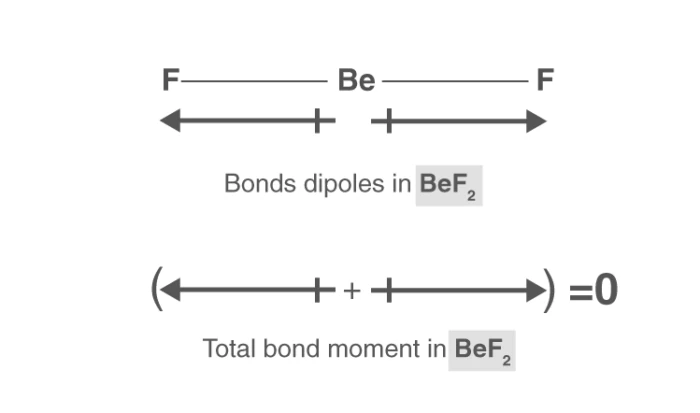
Dipole Moment Cancellation in BeF2 Molecule
Conversely, in bent molecules such as water (H\(_2\)O), the bond dipoles do not cancel due to the angular geometry caused by lone electron pairs on oxygen. This results in a net dipole moment pointing towards the oxygen atom.
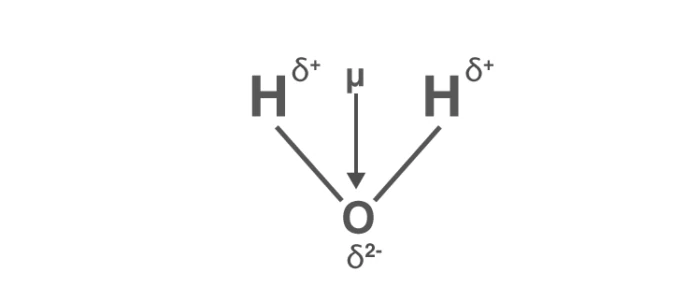
Net Dipole Moment in Water Molecule Due to Bent Shape
The bond angle in water is approximately 104.5°, and each O–H bond has a dipole moment of about 1.5 D. The resultant dipole moment of the water molecule is approximately 1.84 D.
Example: Determining Net Dipole Moment in a Bent Molecule
Given a bent molecule with two bond dipoles each of magnitude 2.0 D and a bond angle of 120°, calculate the net dipole moment.
Solution:
The net dipole moment \( \mu_{net} \) is found by vector addition:
\[ \mu_{net} = \sqrt{\mu_1^2 + \mu_2^2 + 2 \mu_1 \mu_2 \cos \theta} \]
Substituting values:
\[ \mu_{net} = \sqrt{(2.0)^2 + (2.0)^2 + 2 \times 2.0 \times 2.0 \times \cos 120^\circ} = \sqrt{4 + 4 + 8 \times (-0.5)} = \sqrt{8 - 4} = \sqrt{4} = 2.0 \text{ D} \]
The net dipole moment is 2.0 Debye.
Quick Reference: Key Points on Dipole Moments
Aspect | Details |
|---|---|
Definition | Measure of charge separation in a molecule or bond |
Nature | Vector quantity with magnitude and direction |
Unit | Debye (D), where \(1 \text{ D} = 3.33564 \times 10^{-30} \text{ C} \cdot \text{m}\) |
Formula | \( \mu = Q \times r \) or \( \mu = \delta \times d \) |
Direction | From positive to negative charge center |
Molecular Dipole | Vector sum of all bond dipoles in the molecule |
Effect of Geometry | Shape determines if bond dipoles cancel or add |
Example of Zero Dipole | Linear BeF\(_2\) molecule |
Example of Nonzero Dipole | Bent H\(_2\)O molecule |
Symbol | Greek letter \( \mu \) |
Glossary of Terms Related to Dipole Moments
Term | Meaning |
|---|---|
Dipole Moment | Measure of separation of positive and negative charges |
Electronegativity | Ability of an atom to attract electrons in a bond |
Partial Charge (\( \delta^+, \delta^- \)) | Small positive or negative charge due to unequal electron sharing |
Vector Quantity | Physical quantity with both magnitude and direction |
Bond Dipole Moment | Dipole moment associated with a single chemical bond |
Molecular Dipole Moment | Resultant dipole moment of the entire molecule |
Debye (D) | Unit of dipole moment measurement |
Bond Angle | Angle between two bonds in a molecule |
VSEPR Theory | Model predicting molecular shapes based on electron pair repulsion |
Polarity | Distribution of electrical charge leading to dipole formation |
Frequently Asked Questions (FAQs)
What defines a dipole moment in a molecule?
A dipole moment quantifies the separation of positive and negative charges within a molecule, indicating its polarity. It is calculated as the product of the charge magnitude and the distance between charges, and it has both magnitude and direction.
How does molecular shape affect the dipole moment?
The geometry of a molecule determines whether individual bond dipoles add up or cancel out. For example, linear molecules with symmetrical bonds may have zero net dipole, while bent molecules often have a nonzero dipole moment.
Why do some molecules with polar bonds have zero dipole moment?
In molecules where bond dipoles are equal in magnitude but oriented in opposite directions, such as linear BeF\(_2\), the dipoles cancel each other, resulting in a net dipole moment of zero.
What is the unit used to measure dipole moments?
Dipole moments are measured in Debye (D), where 1 Debye equals \(3.33564 \times 10^{-30} \text{ C} \cdot \text{m}\).
How is the direction of a dipole moment represented?
Dipole moments are represented by arrows pointing from the positive charge center to the negative charge center, indicating the direction of electron density shift.