Understanding Crystal Field Theory and Its Applications
Fundamentals of Crystal Field Interactions in Transition Metal Complexes
Conceptualizing Metal-Ligand Electrostatic Interactions
Crystal Field Theory (CFT) explains how the energy levels of d orbitals in transition metal ions are affected by the presence of surrounding ligands. These ligands, which are negatively charged ions or neutral molecules, create an electrostatic field that influences the metal ion's d orbitals. The theory treats ligands as point charges or dipoles, focusing on the purely ionic nature of the metal-ligand bond.
Transition metals often form coordination complexes where a central metal ion is surrounded by ligands. The spatial arrangement of these ligands and their charges cause the originally degenerate d orbitals to split into groups with different energies, altering the electronic structure and properties of the complex.
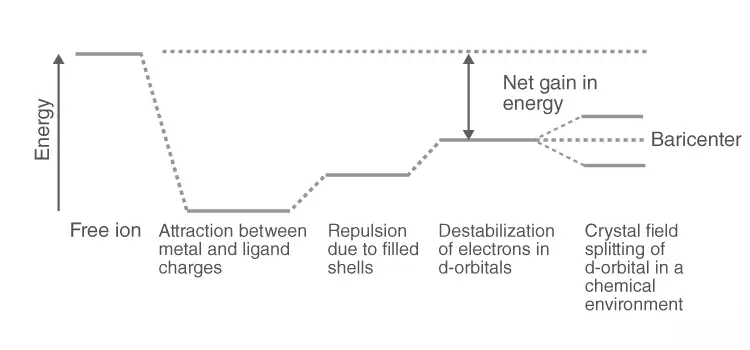
Illustration of Crystal Field Theory showing metal ion surrounded by ligands
Example: Electrostatic Effect on d Orbitals
Consider a free metal ion with five degenerate d orbitals. When six ligands approach in an octahedral geometry, the electrostatic repulsion causes the d orbitals to split into two energy levels. This splitting changes the energy of the orbitals but does not affect their total number.
This concept helps explain the color, magnetism, and stability of coordination compounds.
Energy Level Splitting and Spin States in Coordination Complexes
Mechanism of d Orbital Splitting and Its Consequences
In an isolated transition metal ion, all five d orbitals have the same energy (degenerate). However, when ligands coordinate to the metal, the symmetry of the electric field changes, causing the d orbitals to split into groups with different energies. The pattern of splitting depends on the geometry of the complex and the nature of the ligands.
For example, in an octahedral field, the \( d_{x^2-y^2} \) and \( d_{z^2} \) orbitals experience greater repulsion and thus have higher energy, while the \( d_{xy} \), \( d_{yz} \), and \( d_{xz} \) orbitals have lower energy.
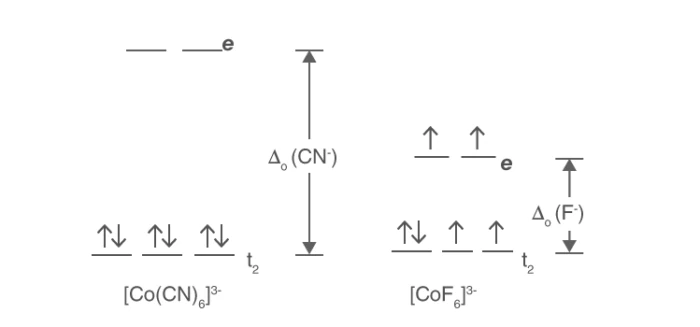
Representation of High Spin and Low Spin Complexes
The number of unpaired electrons in a complex determines whether it is high spin or low spin. Weak field ligands cause small splitting energy (\( \Delta \)) leading to high spin complexes with more unpaired electrons. Strong field ligands cause large splitting energy, resulting in low spin complexes with fewer unpaired electrons.
Example: Spin State Determination in Cobalt Complexes
Compare the complexes \([Co(NH_3)_6]^{3+}\) and \([CoF_6]^{3-}\):
\([Co(NH_3)_6]^{3+}\) has strong field ligands (NH\(_3\)) causing large splitting, resulting in a low spin complex with fewer unpaired electrons.
\([CoF_6]^{3-}\) has weak field ligands (F\(^-\)) causing small splitting, resulting in a high spin complex with more unpaired electrons.
Crystal Field Splitting Patterns in Different Geometries
Octahedral Complexes and Their Orbital Energy Distribution
In octahedral complexes, six ligands surround the metal ion along the x, y, and z axes. The \( d_{x^2-y^2} \) and \( d_{z^2} \) orbitals point directly at the ligands, experiencing greater repulsion and thus higher energy. The \( d_{xy} \), \( d_{yz} \), and \( d_{xz} \) orbitals lie between the axes and experience less repulsion, resulting in lower energy.
This splitting creates two sets of orbitals: the lower energy \( t_{2g} \) set (three orbitals) and the higher energy \( e_g \) set (two orbitals). The energy difference between these sets is denoted as \( \Delta_o \) (octahedral splitting energy).
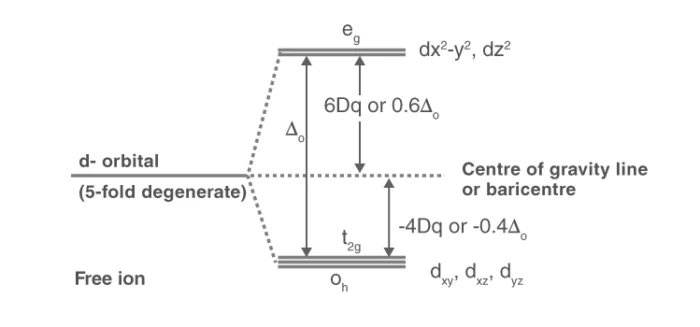
Energy splitting of d orbitals in an octahedral field
Example: Calculating Crystal Field Splitting Energy
For a \( d^4 \) octahedral complex with strong field ligands, electrons fill the \( t_{2g} \) orbitals first. If the pairing energy \( P \) is less than \( \Delta_o \), electrons pair up in the lower orbitals:
\[ \Delta_o > P \implies \text{Low spin configuration: } t_{2g}^4 e_g^0 \]
This results in fewer unpaired electrons and a more stable complex.
Orbital Splitting in Tetrahedral Complexes
Tetrahedral complexes have four ligands arranged around the metal ion, but unlike octahedral complexes, the ligands do not align directly with the \( d_{x^2-y^2} \) and \( d_{z^2} \) orbitals. Instead, the \( d_{xy} \), \( d_{yz} \), and \( d_{xz} \) orbitals experience higher energy due to greater repulsion, while the \( d_{x^2-y^2} \) and \( d_{z^2} \) orbitals have lower energy.
The splitting in tetrahedral fields is smaller than in octahedral fields because there are fewer ligands and less direct overlap. The two sets of orbitals are labeled \( t_2 \) (higher energy) and \( e \) (lower energy).
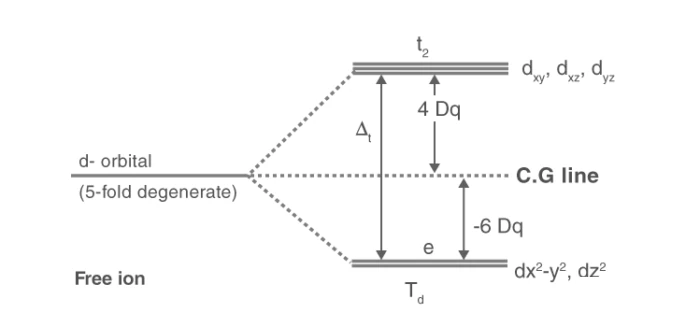
Orbital energy splitting in a tetrahedral crystal field
Example: Comparing Splitting Energies
Given that the tetrahedral splitting energy \( \Delta_t \) is approximately \(\frac{4}{9}\) of the octahedral splitting energy \( \Delta_o \), calculate \( \Delta_t \) if \( \Delta_o = 18000 \text{ cm}^{-1} \):
\[ \Delta_t = \frac{4}{9} \times 18000 = 8000 \text{ cm}^{-1} \]
This smaller splitting explains why tetrahedral complexes are usually high spin.
Quantifying Stability: Crystal Field Stabilization Energy and Spectrochemical Series
Understanding Ligand Field Stabilization Energy (LFSE)
The splitting of d orbitals leads to a net stabilization or destabilization of the complex depending on electron distribution. Electrons occupying the lower energy \( t_{2g} \) orbitals stabilize the complex by an energy of \(-4Dq\) per electron, while electrons in the higher energy \( e_g \) orbitals destabilize it by \(+6Dq\) per electron.
The total stabilization energy, called Ligand Field Stabilization Energy (LFSE), is calculated by summing these contributions. For example, a \( d^5 \) octahedral complex with three electrons in \( t_{2g} \) and two in \( e_g \) orbitals has:
\[ \text{LFSE} = 3 \times (-4Dq) + 2 \times (+6Dq) = -12Dq + 12Dq = 0 \]
Similarly, a \( d^{10} \) system has zero LFSE as all orbitals are filled.
Example: Calculating LFSE for a \( d^6 \) Low Spin Octahedral Complex
For a low spin \( d^6 \) complex, all six electrons occupy the \( t_{2g} \) orbitals:
\[ \text{LFSE} = 6 \times (-4Dq) = -24Dq \]
This significant stabilization contributes to the complex's stability.
Ordering Ligands by Field Strength: The Spectrochemical Series
Ligands differ in their ability to split d orbitals, which is summarized in the spectrochemical series. This series ranks ligands from weak field (small splitting) to strong field (large splitting):
\[ I^- < Br^- < Cl^- < SCN^- < F^- < OH^- < C_2O_4^{2-} < H_2O < NCS^- < EDTA^{4-} < NH_3 < en < CN^- < CO \]
Strong field ligands like CN\(^-\) and CO cause large splitting, favoring low spin complexes, while weak field ligands like I\(^-\) and Br\(^-\) favor high spin complexes.
Summary Table: Key Concepts of Crystal Field Theory
Concept | Description | Example |
|---|---|---|
Crystal Field Splitting | Splitting of degenerate d orbitals into groups with different energies due to ligand field | Octahedral splitting into \( t_{2g} \) and \( e_g \) orbitals |
High Spin Complex | Complex with maximum unpaired electrons due to weak field ligands | \([CoF_6]^{3-}\) |
Low Spin Complex | Complex with minimum unpaired electrons due to strong field ligands | \([Co(CN)_6]^{3-}\) |
LFSE | Energy stabilization from electron distribution in split d orbitals | \( d^6 \) low spin octahedral complex: \(-24Dq\) |
Spectrochemical Series | Order of ligands based on their field strength and splitting ability | From \( I^- \) (weak) to CO (strong) |
Glossary of Important Terms
Term | Definition |
|---|---|
Crystal Field Theory (CFT) | The model describing the effect of ligand electric fields on the energy of metal ion d orbitals. |
Ligand | An ion or molecule that donates electron pairs to a central metal ion to form a complex. |
Degenerate Orbitals | Orbitals having the same energy level in an isolated atom or ion. |
Octahedral Complex | A coordination complex with six ligands symmetrically arranged around a metal ion. |
Tetrahedral Complex | A complex with four ligands arranged around a metal ion in a tetrahedral geometry. |
High Spin Complex | A complex with maximum unpaired electrons due to small crystal field splitting. |
Low Spin Complex | A complex with minimum unpaired electrons due to large crystal field splitting. |
Crystal Field Splitting Energy (\( \Delta \)) | The energy difference between split d orbital sets caused by ligand fields. |
Ligand Field Stabilization Energy (LFSE) | The net stabilization energy from electron occupancy in split d orbitals. |
Spectrochemical Series | A list ranking ligands by their ability to split d orbital energies. |
Frequently Asked Questions
Who developed the Crystal Field Theory?
Hans Bethe introduced Crystal Field Theory in 1929 to explain the electronic structure of transition metal complexes.
What does Crystal Field Theory explain about transition metals?
CFT describes how the degeneracy of d orbitals is broken due to the electric field created by surrounding ligands, affecting properties like color and magnetism.
What are the main limitations of Crystal Field Theory?
CFT ignores covalent bonding aspects, does not consider s and p orbitals, and cannot explain differences in ligand strength fully or p bonding effects.
What advantages does Crystal Field Theory offer over Valence Bond Theory?
CFT better explains magnetic properties, orbital splitting, and the formation of high and low spin complexes, which VBT cannot adequately address.
How does the spectrochemical series influence complex properties?
The series orders ligands by field strength, determining the magnitude of orbital splitting and thus the spin state and stability of complexes.