Understanding Ionic Bonding and Its Characteristics
Fundamentals of Ionic Bond Formation
How Ionic Bonds Develop Between Atoms
An ionic bond arises when one atom transfers electrons to another, resulting in the formation of charged particles called ions. The atom that loses electrons becomes a positively charged ion, or cation, while the atom that gains electrons becomes a negatively charged ion, or anion. These oppositely charged ions attract each other through strong electrostatic forces, creating a stable ionic compound. Despite the presence of charged ions, the overall compound remains electrically neutral.
In contrast, covalent bonds form when atoms share valence electrons mutually to achieve stability. The shared electrons in such bonds are referred to as bond pairs or electron pairs.
Example: Consider a sodium atom (Na) and a chlorine atom (Cl). Sodium donates one electron to chlorine, forming Na+ and Cl- ions. These ions attract each other to form sodium chloride (NaCl), an ionic compound.
Partial Covalent Character in Ionic Bonds
Understanding the Mixed Nature of Chemical Bonds
In practical scenarios, bonds are rarely purely ionic or purely covalent. Even molecules traditionally considered covalent, like hydrogen (H2), exhibit slight ionic characteristics. Similarly, ionic bonds can display some covalent features. This phenomenon is explained by Fajans' rules, which describe factors influencing the covalent character within ionic bonds.
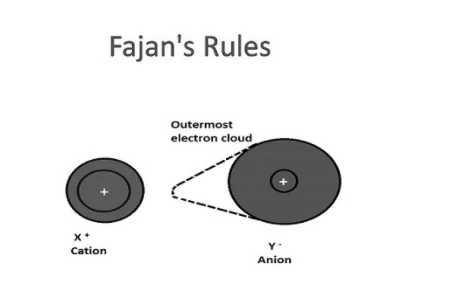
Diagram illustrating Fajans' rule and bond character
The extent of covalent character in an ionic bond depends on the size and charge of the ions involved. For instance, a small cation paired with a large anion tends to increase the covalent nature of the bond. Additionally, cations with higher positive charges enhance the covalent character by polarizing the electron cloud of the anion.
Example: Compare magnesium oxide (MgO) and sodium chloride (NaCl). Mg2+ has a higher charge and smaller size than Na+, so MgO exhibits more covalent character than NaCl.
Polarization Effects and Their Role in Bond Character
How Ion Polarization Influences Bonding
Cations with small size and high charge, such as transition metal ions with electronic configurations like (n-1)dxns0, have strong polarizing power. They distort the electron cloud of the anion, pulling electron density closer and increasing covalent character. In contrast, cations with noble gas configurations (ns2np6), such as alkali or alkaline earth metals, have weaker polarizing effects.
This polarization leads to a distortion of the anion's electron cloud, creating a partial sharing of electrons similar to covalent bonding. The overall covalent character in an ionic bond is thus determined by three factors: the polarizing power of the cation, the polarizability of the anion, and the degree of distortion of the anion's electron cloud.
Example: Consider aluminum ion (Al3+) and iodide ion (I-). Al3+ is small and highly charged, strongly polarizing I-, which increases the covalent character of the AlI3 bond.
Quick Reference: Ionic vs Covalent Bond Characteristics
Aspect | Ionic Bond | Covalent Bond |
|---|---|---|
Electron Interaction | Complete transfer of electrons | Mutual sharing of electrons |
Types of Ions | Cations and anions | No ions formed |
Bond Strength | Strong electrostatic attraction | Shared electron pairs hold atoms |
Bond Character | Mostly ionic with some covalent character | Mostly covalent with slight ionic character |
Polarization Effect | Significant in small, highly charged cations | Not applicable |
Glossary of Key Terms
Term | Definition |
|---|---|
Cation | A positively charged ion formed by loss of electrons. |
Anion | A negatively charged ion formed by gain of electrons. |
Electrostatic Force | Attraction between oppositely charged ions. |
Polarization | Distortion of an anion's electron cloud by a cation. |
Polarizing Power | The ability of a cation to distort an anion's electron cloud. |
Polarizability | The ease with which an anion's electron cloud can be distorted. |
Fajans' Rule | Guidelines predicting covalent character in ionic bonds. |
Bond Pair | Shared pair of electrons in a covalent bond. |
Transition Metals | Elements with partially filled d orbitals, often highly polarizing. |
Electron Configuration | Distribution of electrons in atomic orbitals. |
Frequently Asked Questions
What defines an ionic bond?
An ionic bond is formed when one atom transfers electrons to another, creating oppositely charged ions that attract each other strongly.
Can ionic bonds have covalent properties?
Yes, ionic bonds often exhibit partial covalent character due to polarization effects, especially when small, highly charged cations distort the electron cloud of large anions.
What factors increase the covalent character in ionic bonds?
Smaller cation size, higher cation charge, and larger anion size increase polarization, thereby enhancing covalent character in ionic bonds.
How does Fajans' rule help in understanding bonding?
Fajans' rule predicts the degree of covalent character in ionic bonds based on ion size and charge, explaining why some ionic bonds behave more like covalent bonds.
Why are transition metal cations more polarizing?
Transition metal cations have small sizes and high charges with partially filled d orbitals, making them more effective at distorting anion electron clouds.