Understanding Chemical Equilibrium and Its Dynamics
Fundamentals of Chemical Equilibrium
Concept and Characteristics of Equilibrium
Chemical equilibrium is a condition in which the concentrations of reactants and products remain constant over time, indicating no net change in the system's composition. This steady state occurs when the forward and reverse reaction rates are equal, resulting in a dynamic balance where reactions continue but without altering overall concentrations.
Graphically, this can be represented by plotting concentration versus time, where the curves for reactants and products level off, signifying equilibrium.
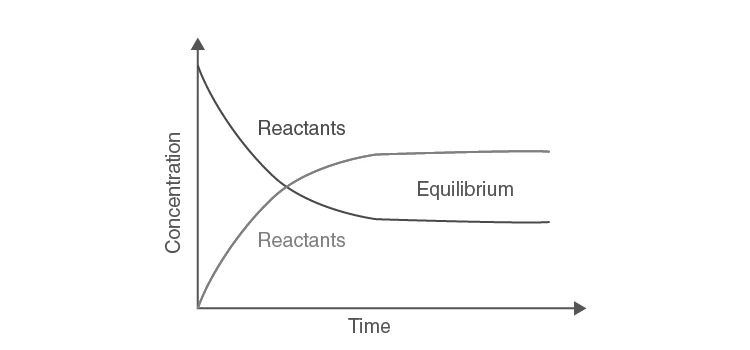
Concentration changes over time reaching chemical equilibrium
Because molecules continuously convert between reactants and products at equal rates, this state is termed dynamic equilibrium, emphasizing ongoing molecular activity despite no observable change.
Example Problem
Consider a reaction where the forward and reverse rates become equal after some time. If initially, the concentration of reactants is 0.5 M and products is 0 M, explain what happens to these concentrations at equilibrium.
Solution:
Initially, reactants convert to products, increasing product concentration and decreasing reactant concentration.
As products form, the reverse reaction rate increases.
At equilibrium, the forward and reverse rates equalize, so concentrations stabilize.
Thus, both reactant and product concentrations remain constant, though reactions continue dynamically.
Classification of Chemical Equilibria
Equilibria in Uniform Phases
When all reactants and products exist in the same physical state, the system exhibits homogeneous equilibrium. This can be further categorized based on molecular counts:
Reactions where the number of product molecules equals that of reactants, e.g., \( \mathrm{H_2(g) + I_2(g) \rightleftharpoons 2HI(g)} \).
Reactions where product and reactant molecule counts differ, e.g., \( \mathrm{2SO_2(g) + O_2(g) \rightleftharpoons 2SO_3(g)} \).
Equilibria Across Different Phases
Heterogeneous equilibrium involves reactants and products in distinct phases, such as solids and gases coexisting. Examples include:
\( \mathrm{CO_2(g) + C(s) \rightleftharpoons 2CO(g)} \)
\( \mathrm{CaCO_3(s) \rightleftharpoons CaO(s) + CO_2(g)} \)
Example Problem
Identify whether the reaction \( \mathrm{N_2(g) + 3H_2(g) \rightleftharpoons 2NH_3(g)} \) represents homogeneous or heterogeneous equilibrium and justify.
Solution:
All reactants and products are gases.
Since all species are in the same phase, this is a homogeneous equilibrium.
Influences on the Position of Equilibrium
Impact of Concentration Changes
According to Le Chatelier’s principle, altering the concentration of reactants or products disturbs the equilibrium, prompting the system to adjust and counteract the change. Adding reactants drives the reaction forward, consuming the excess, while removing products shifts equilibrium to replenish them.
Pressure and Volume Effects
Pressure changes primarily affect gaseous equilibria where the number of moles differs between reactants and products. Increasing pressure favors the side with fewer gas molecules, while decreasing pressure favors the side with more. For solids and liquids, pressure changes have negligible impact due to their incompressibility.
Temperature Variations
The effect of temperature depends on the reaction's enthalpy change (\( \Delta H \)):
For exothermic reactions (\( \Delta H < 0 \)), increasing temperature decreases the equilibrium constant, shifting equilibrium towards reactants.
For endothermic reactions (\( \Delta H > 0 \)), higher temperature increases the equilibrium constant, favoring product formation.
Temperature changes also influence reaction rates, but catalysts can accelerate both forward and reverse reactions equally without shifting equilibrium.
Role of Catalysts and Inert Gases
Catalysts speed up the attainment of equilibrium by lowering activation energy but do not alter the equilibrium position. Adding inert gases at constant volume does not affect equilibrium since they do not participate in the reaction.
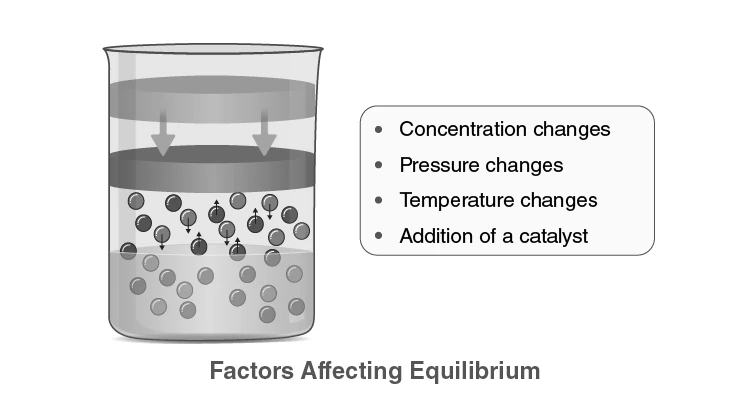
Factors influencing chemical equilibrium according to Le Chatelier’s principle
Example Problem
For the reaction \( \mathrm{2SO_2(g) + O_2(g) \rightleftharpoons 2SO_3(g)} \), predict the effect on equilibrium if the pressure is increased.
Solution:
Reactants have 3 moles of gas, products have 2 moles.
Increasing pressure favors the side with fewer moles, i.e., products.
Therefore, equilibrium shifts towards \( \mathrm{SO_3} \) formation.
Practical Applications and Problem Solving in Equilibrium
Industrial Significance of Equilibrium
Chemical equilibrium principles are vital in optimizing industrial processes such as:
Haber Process: Synthesis of ammonia from nitrogen and hydrogen, where low temperature, high pressure, and iron catalyst maximize yield.
Contact Process: Production of sulfuric acid involving the equilibrium between sulfur dioxide and sulfur trioxide.
Equilibrium Constant and Reaction Direction
The equilibrium constant (\( K \)) quantifies the ratio of product to reactant concentrations at equilibrium. Comparing the reaction quotient (\( Q \)) with \( K \) predicts the direction in which the reaction will proceed to reach equilibrium.
Example Problem 1
The equilibrium constant \( K_P \) for \( \mathrm{N_2(g) + 3H_2(g) \rightleftharpoons 2NH_3(g)} \) is \( 2.0 \times 10^{-5} \) atm\(^{-2}\) at 450°C. Calculate the new \( K_P \) at 550°C if the reaction enthalpy is -22 kcal/mol.
Solution:
The relation between equilibrium constants at two temperatures is given by:
\[ \log K_{P2} = \frac{-\Delta H}{2.303 R} \left(\frac{1}{T_2} - \frac{1}{T_1}\right) + \log K_{P1} \]
Where:
\( \Delta H = -22000 \text{ cal/mol} \)
\( R = 1.987 \text{ cal/mol·K} \)
\( T_1 = 723 \text{ K} \) (450°C)
\( T_2 = 823 \text{ K} \) (550°C)
\( K_{P1} = 2.0 \times 10^{-5} \)
Calculate the temperature term:
\[ \frac{1}{T_2} - \frac{1}{T_1} = \frac{1}{823} - \frac{1}{723} = -0.000168 \text{ K}^{-1} \]
Calculate the logarithmic term:
\[ \log K_{P2} = \frac{-(-22000)}{2.303 \times 1.987} \times (-0.000168) + \log(2.0 \times 10^{-5}) \]
\[ = \frac{22000}{4.574} \times (-0.000168) + (-4.699) \]
\[ = 4810.58 \times (-0.000168) - 4.699 = -0.808 - 4.699 = -5.507 \]
Therefore,
\[ K_{P2} = 10^{-5.507} = 3.11 \times 10^{-6} \text{ atm}^{-2} \]
The equilibrium constant decreases with temperature increase for this exothermic reaction.
Example Problem 2
For the reaction \( \mathrm{N_2(g) + 3H_2(g) \rightleftharpoons 2NH_3(g)} \), given concentrations: \([N_2] = 0.05 \text{ M}\), \([H_2] = 0.12 \text{ M}\), and equilibrium constant \( K = 0.05 \), determine the reaction quotient \( Q \) and predict the direction of the reaction.
Solution:
Assuming initial ammonia concentration is zero,
\[ Q = \frac{[NH_3]^2}{[N_2][H_2]^3} = \frac{0}{0.05 \times (0.12)^3} = 0 \]
Since \( Q < K \), the reaction will proceed forward, forming more ammonia until equilibrium is reached.
Quick Reference Summary
Factor | Effect on Equilibrium | Example |
|---|---|---|
Concentration | Shift towards side that consumes added substance | Adding \( \mathrm{H_2} \) shifts \( \mathrm{N_2 + 3H_2 \rightleftharpoons 2NH_3} \) forward |
Pressure | Favors side with fewer gas moles | Increasing pressure favors \( \mathrm{SO_3} \) in \( \mathrm{2SO_2 + O_2 \rightleftharpoons 2SO_3} \) |
Temperature | Exothermic: increase shifts left; Endothermic: increase shifts right | Raising temperature decreases \( K \) for exothermic reactions |
Catalyst | Speeds up equilibrium attainment, no shift | Iron catalyst in Haber process |
Inert Gas | No effect at constant volume | Adding argon gas |
Glossary of Key Terms
Term | Definition |
|---|---|
Chemical Equilibrium | State where forward and reverse reaction rates are equal, concentrations remain constant. |
Dynamic Equilibrium | Equilibrium with continuous molecular interconversion but no net concentration change. |
Homogeneous Equilibrium | Equilibrium involving reactants and products in the same phase. |
Heterogeneous Equilibrium | Equilibrium involving reactants and products in different phases. |
Le Chatelier’s Principle | System adjusts to counteract changes in concentration, pressure, or temperature. |
Equilibrium Constant (K) | Ratio of product to reactant concentrations at equilibrium. |
Reaction Quotient (Q) | Ratio of product to reactant concentrations at any point, used to predict reaction direction. |
Exothermic Reaction | Reaction releasing heat (\( \Delta H < 0 \)). |
Endothermic Reaction | Reaction absorbing heat (\( \Delta H > 0 \)). |
Catalyst | Substance that speeds up reaction without being consumed or changing equilibrium position. |
Frequently Asked Questions
How does temperature affect the equilibrium constant in exothermic reactions?
Increasing temperature decreases the equilibrium constant, shifting equilibrium towards reactants.
What role does a catalyst play in chemical equilibrium?
A catalyst accelerates both forward and reverse reactions equally, helping the system reach equilibrium faster without changing its position.
Does adding an inert gas affect the equilibrium state?
No, adding an inert gas at constant volume does not change the equilibrium since it does not participate in the reaction.
What is meant by the forward reaction?
The forward reaction is the process where reactants convert into products.
What is the backward reaction in equilibrium?
The backward reaction is the conversion of products back into reactants, occurring simultaneously with the forward reaction at equilibrium.