Understanding Collision Theory and Reaction Kinetics
Fundamentals of Collision Theory in Chemical Reactions
Principles Behind Molecular Collisions and Reaction Rates
Chemical reactions occur when reactant molecules collide with sufficient energy and proper orientation. The collision theory, formulated by Max Trautz and William Lewis in the early 20th century, models molecules as hard spheres that must physically collide to react. This theory helps quantify how often molecules collide and how these collisions influence reaction rates.
The frequency of collisions per unit volume per second, denoted as \( Z \), is a key factor in determining how fast a reaction proceeds. For a bimolecular reaction involving reactants \( P \) and \( Q \), the reaction rate can be expressed as:
\[ \text{Rate} = Z_{PQ} \rho e^{-\frac{E_a}{RT}} \]
Here, \( Z_{PQ} \) is the collision frequency between \( P \) and \( Q \), \( \rho \) is the steric factor accounting for molecular orientation, \( E_a \) is the activation energy, \( R \) is the universal gas constant, and \( T \) is the absolute temperature.
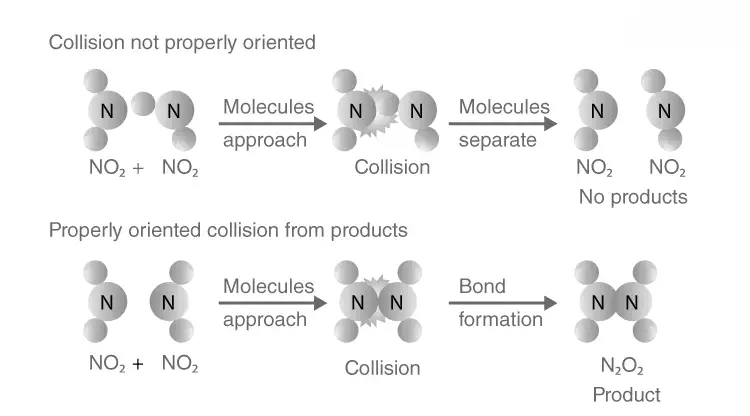
Illustration of Collision Theory of Chemical Reactions
Not all collisions lead to product formation. Only those collisions where molecules have enough energy to overcome the activation barrier and are oriented correctly result in effective collisions. This explains why activation energy and molecular orientation are crucial in reaction kinetics.
Example Problem
Consider a reaction between molecules \( A \) and \( B \) with a collision frequency \( Z_{AB} = 5 \times 10^{10} \text{ collisions/s·L} \), steric factor \( \rho = 0.4 \), activation energy \( E_a = 60 \text{ kJ/mol} \), temperature \( T = 350 \text{ K} \), and gas constant \( R = 8.314 \text{ J/mol·K} \). Calculate the rate constant factor \( k \) ignoring units.
Solution:
First, convert activation energy to joules: \( E_a = 60,000 \text{ J/mol} \).
Calculate the exponential term:
\[ e^{-\frac{E_a}{RT}} = e^{-\frac{60000}{8.314 \times 350}} = e^{-20.6} \approx 1.12 \times 10^{-9} \]
Now, calculate the rate constant factor:
\[ k = Z_{AB} \times \rho \times e^{-\frac{E_a}{RT}} = 5 \times 10^{10} \times 0.4 \times 1.12 \times 10^{-9} = 22.4 \]
Thus, the rate constant factor \( k \) is approximately 22.4 (in appropriate units).
Role of Activation Energy in Chemical Reactions
Understanding the Energy Barrier for Reactant Transformation
Activation energy is the minimum energy threshold that reacting molecules must surpass to transform into products. This concept, introduced by Svante Arrhenius, explains why not all molecular collisions result in a reaction. Molecules must collide with enough kinetic energy to break existing bonds and form new ones.
Reactions with low activation energy can proceed at room temperature, while those with higher activation energy require heating or catalysts to proceed efficiently.
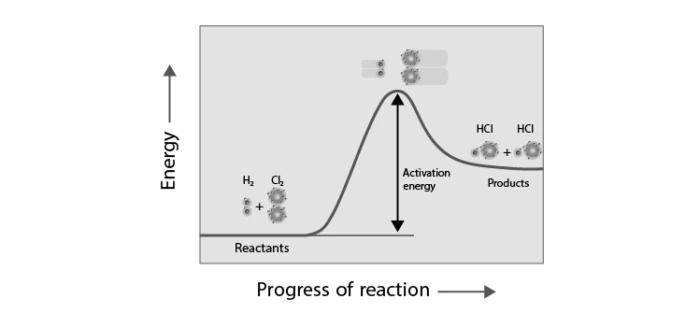
Graphical representation of Activation Energy in reactions
Example Problem
A reaction has an activation energy of \( 75 \text{ kJ/mol} \). Calculate the fraction of molecules that have enough energy to react at \( 298 \text{ K} \). Use \( R = 8.314 \text{ J/mol·K} \).
Solution:
Convert activation energy to joules: \( E_a = 75000 \text{ J/mol} \).
Calculate the fraction using the Arrhenius factor:
\[ f = e^{-\frac{E_a}{RT}} = e^{-\frac{75000}{8.314 \times 298}} = e^{-30.2} \approx 8.9 \times 10^{-14} \]
This means only a very small fraction of molecules have sufficient energy to react at room temperature.
Temperature Influence and the Arrhenius Equation
Quantifying How Temperature Affects Reaction Rates
Temperature significantly impacts how quickly reactions occur. Generally, increasing temperature raises the reaction rate, often doubling or tripling it for every 10 K rise. This effect is captured mathematically by the Arrhenius equation:
\[ k = A e^{-\frac{E_a}{RT}} \]
Here, \( k \) is the rate constant, \( A \) is the frequency factor representing the number of collisions with correct orientation, \( E_a \) is the activation energy, \( R \) is the gas constant, and \( T \) is the absolute temperature.
The temperature coefficient, defined as the ratio of rate constants at two temperatures, typically ranges between 2 and 3:
\[ \text{Temperature coefficient} = \frac{k_{T+10}}{k_T} \approx 2 \text{ to } 3 \]
Example Problem
The rate constant of a reaction at 300 K is \( 1.5 \times 10^{-3} \text{ s}^{-1} \). If the activation energy is \( 50 \text{ kJ/mol} \), estimate the rate constant at 310 K. Use \( R = 8.314 \text{ J/mol·K} \).
Solution:
Calculate the ratio of rate constants using Arrhenius equation:
\[ \frac{k_{310}}{k_{300}} = e^{\frac{E_a}{R} \left(\frac{1}{300} - \frac{1}{310}\right)} = e^{\frac{50000}{8.314} \times (0.00333 - 0.00323)} = e^{6.04} \approx 420 \]
Calculate \( k_{310} \):
\[ k_{310} = 420 \times 1.5 \times 10^{-3} = 0.63 \text{ s}^{-1} \]
The rate constant increases significantly with a 10 K rise in temperature.
Quick Reference Summary
Term | Definition | Symbol/Unit |
|---|---|---|
Collision Frequency | Number of collisions per second per unit volume | \( Z \), collisions/s·L |
Activation Energy | Minimum energy required for reaction | \( E_a \), kJ/mol |
Steric Factor | Probability of correct molecular orientation | \( \rho \), dimensionless |
Rate Constant | Proportionality constant in rate law | \( k \), varies |
Frequency Factor | Collision frequency with proper orientation | \( A \), varies |
Gas Constant | Universal constant in gas laws | \( R = 8.314 \text{ J/mol·K} \) |
Temperature | Absolute temperature scale | \( T \), K |
Effective Collision | Collision leading to product formation | — |
Ineffective Collision | Collision without product formation | — |
Temperature Coefficient | Ratio of rate constants at two temperatures | Dimensionless (usually 2–3) |
Glossary of Key Terms
Term | Meaning |
|---|---|
Activation Energy | Minimum energy required for reactants to form products |
Collision Frequency | Number of collisions per unit volume per second |
Steric Factor | Fraction of collisions with correct molecular orientation |
Effective Collision | Collision that results in product formation |
Ineffective Collision | Collision that does not lead to reaction |
Frequency Factor | Pre-exponential factor in Arrhenius equation |
Rate Constant | Constant relating reaction rate to reactant concentration |
Arrhenius Equation | Mathematical expression relating rate constant and temperature |
Temperature Coefficient | Ratio of rate constants at two different temperatures |
Universal Gas Constant | Constant \( R = 8.314 \text{ J/mol·K} \) used in gas laws and kinetics |
Frequently Asked Questions
How does collision theory explain reaction rates?
Collision theory states that molecules must collide with sufficient energy and proper orientation to react. The rate depends on how often these effective collisions occur.
What distinguishes effective collisions from ineffective ones?
Effective collisions have enough energy and correct orientation to form products, while ineffective collisions do not lead to reaction despite contact.
Is the Arrhenius equation applicable to all reaction orders?
Yes, the Arrhenius equation relates the rate constant to temperature and activation energy regardless of reaction order.
What is the significance of activation energy?
Activation energy is the energy barrier that reactants must overcome to transform into products, determining the reaction's feasibility.
Where is the Arrhenius equation commonly used?
It is used to predict how temperature changes affect reaction rates and to calculate activation energies from experimental data.