Fundamental Particles Constituting Atoms
Unveiling the Building Blocks of Matter
Introduction to Subatomic Particles
Atoms, once thought to be indivisible units of matter, were later found to be composed of smaller entities known as subatomic particles. These particles are the fundamental constituents that define the structure and properties of atoms. The three main types of subatomic particles are protons, electrons, and neutrons, each playing a unique role within the atom.
Scientific advancements in the late 19th and early 20th centuries overturned the belief that atoms were the smallest units, leading to the discovery of these particles. Understanding their characteristics is essential for grasping atomic behavior and chemical interactions.
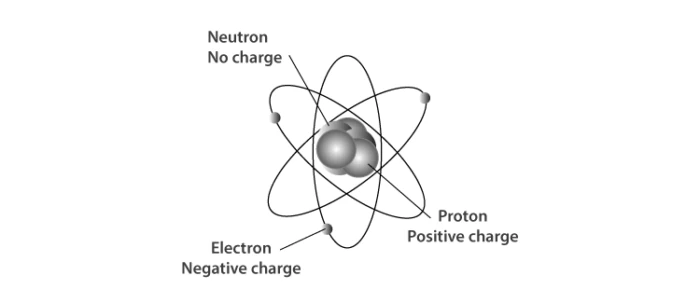
Illustration of the three primary subatomic particles
Characteristics and Discovery of Protons
Properties and Historical Background of Protons
Protons are positively charged particles residing in the nucleus of an atom, paired with neutrons to form the dense core known as the nucleus. The number of protons determines the atomic number and thus the identity of an element. Ernest Rutherford is credited with discovering the proton through his pioneering experiments.
Protons can be generated by removing an electron from a hydrogen atom, effectively leaving behind a proton. Their mass is approximately \(1.673 \times 10^{-24}\) grams, and they carry a positive charge of \(+1.602 \times 10^{-19}\) Coulombs.
Example: Calculate the total positive charge in Coulombs of an atom containing 15 protons.
Given that each proton has a charge of \(+1.602 \times 10^{-19}\) C, the total charge \(Q\) is:
\[ Q = 15 \times 1.602 \times 10^{-19} = 2.403 \times 10^{-18} \text{ C} \]
Thus, the atom's nucleus carries a total positive charge of \(2.403 \times 10^{-18}\) Coulombs.
Exploring the Nature of Electrons
Discovery and Role of Electrons in Atoms
Electrons are negatively charged particles that orbit the nucleus in various energy levels. They are crucial in chemical bonding and ion formation, as atoms gain or lose electrons to form ions. J. J. Thomson discovered the electron and was the first to measure its charge and mass accurately.
The mass of an electron is significantly smaller than that of a proton, approximately \(\frac{1}{1836}\) of a proton's mass, making it nearly negligible in comparison. Each electron carries a charge of \(-1.602 \times 10^{-19}\) Coulombs, balancing the positive charge of protons in a neutral atom.
Example: Determine the net charge of an atom with 12 protons and 10 electrons.
The total positive charge from protons is:
\[ Q_{+} = 12 \times 1.602 \times 10^{-19} = 1.9224 \times 10^{-18} \text{ C} \]
The total negative charge from electrons is:
\[ Q_{-} = 10 \times (-1.602 \times 10^{-19}) = -1.602 \times 10^{-18} \text{ C} \]
The net charge \(Q_{net}\) is:
\[ Q_{net} = Q_{+} + Q_{-} = 1.9224 \times 10^{-18} - 1.602 \times 10^{-18} = 3.204 \times 10^{-19} \text{ C} \]
This atom carries a positive charge of \(3.204 \times 10^{-19}\) Coulombs, indicating it is a positively charged ion.
Understanding Neutrons and Their Significance
Neutral Particles in the Atomic Nucleus
Neutrons are electrically neutral particles found alongside protons in the nucleus. Their presence explains the variation in atomic masses among isotopes of the same element. James Chadwick discovered neutrons in 1932 through experiments involving alpha particle bombardment of beryllium.
Neutrons have a mass nearly equal to that of protons, approximately \(1.675 \times 10^{-24}\) grams, but carry no electric charge. Their neutrality plays a vital role in stabilizing the nucleus by offsetting the repulsive forces between positively charged protons.
Example: An isotope of an element has 20 protons and a mass number of 45. Calculate the number of neutrons in this isotope.
The number of neutrons \(N\) is given by:
\[ N = \text{Mass number} - \text{Number of protons} = 45 - 20 = 25 \]
Therefore, this isotope contains 25 neutrons in its nucleus.
Summary of Key Subatomic Particle Properties
Particle | Charge | Mass (grams) | Location in Atom | Discoverer |
|---|---|---|---|---|
Proton | +1.602 × 10⁻¹⁹ C | 1.673 × 10⁻²⁴ | Nucleus | Ernest Rutherford |
Electron | -1.602 × 10⁻¹⁹ C | 9.109 × 10⁻²⁸ (approx.) | Orbiting nucleus | J. J. Thomson |
Neutron | 0 (neutral) | 1.675 × 10⁻²⁴ | Nucleus | James Chadwick |
Glossary of Essential Terms
Term | Definition |
|---|---|
Atom | The smallest unit of matter that retains the properties of an element. |
Proton | A positively charged subatomic particle found in the nucleus. |
Electron | A negatively charged particle orbiting the nucleus. |
Neutron | A neutral particle located in the nucleus alongside protons. |
Nucleus | The dense central core of an atom containing protons and neutrons. |
Isotope | Atoms of the same element with different numbers of neutrons. |
Ion | An atom or molecule with a net electric charge due to loss or gain of electrons. |
Atomic Number | The number of protons in an atom's nucleus, defining the element. |
Mass Number | The total number of protons and neutrons in an atom's nucleus. |
Quark | Fundamental particles that make up protons and neutrons. |
Common Questions About Subatomic Particles
What are the main types of subatomic particles?
The primary subatomic particles are electrons (negatively charged), protons (positively charged), and neutrons (neutral). Together, they form the structure of atoms.
Which subatomic particle is the smallest?
Quarks, which compose protons and neutrons, are considered the smallest known subatomic particles.
Are there particles smaller than atoms?
Yes, atoms are made up of subatomic particles such as protons, neutrons, and electrons, which are smaller than atoms themselves.
Is a photon smaller than an atom?
A photon is a quantum of electromagnetic radiation and is smaller than an atom, but it is not a particle with mass or size in the traditional sense.
Does a photon have a physical size?
Photons are considered to have no rest mass or defined size; they are quantum particles of light energy.