Comprehensive Overview of Chromic Acid
Fundamental Characteristics and Molecular Arrangement of Chromic Acid
Essential Properties and Chemical Nature
Chromic acid, chemically represented as \( \mathrm{H_2CrO_4} \), is an oxide of chromium that naturally occurs and exhibits strong acidic behavior. It shares similarities with sulfuric acid (\( \mathrm{H_2SO_4} \)) in terms of acidity, although only the first proton dissociates readily in aqueous solutions. The compound often exists as a mixture, typically prepared by combining concentrated sulfuric acid with dichromate salts, resulting in a blend that includes chromium trioxide solids.
Another related species is dichromic acid (\( \mathrm{H_2Cr_2O_7} \)), which is the fully protonated form of the dichromate ion (\( \mathrm{Cr_2O_7^{2-}} \)). This form can be obtained by adding chromium trioxide (\( \mathrm{CrO_3} \)) to molecular chromic acid, and it plays a significant role in oxidation reactions.
Visualizing the Molecular Structure
The molecular geometry of chromic acid features chromium centrally bonded to oxygen atoms, forming a tetrahedral arrangement similar to sulfuric acid. This structure underpins its strong acidic and oxidizing properties.
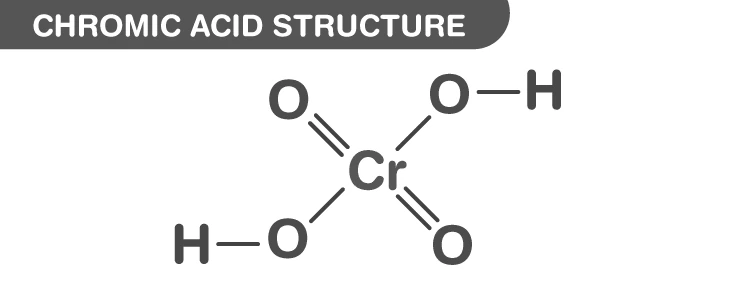
Molecular structure of chromic acid (\( \mathrm{H_2CrO_4} \))
Example: Calculating the Molar Mass of Chromic Acid
Determine the molar mass of chromic acid (\( \mathrm{H_2CrO_4} \)) given atomic masses: H = 1 g/mol, Cr = 52 g/mol, O = 16 g/mol.
Solution:
The molar mass is calculated by summing the atomic masses of all atoms in the formula:
\[ (2 \times 1) + (1 \times 52) + (4 \times 16) = 2 + 52 + 64 = 118 \text{ g/mol} \]
Thus, the molar mass of chromic acid is \( 118 \text{ g/mol} \).
Applications and Chemical Behavior of Chromic Acid
Industrial and Laboratory Uses
Chromic acid serves as a crucial intermediate in chromium electroplating, enhancing the durability and appearance of metal surfaces. It is also employed in the manufacture of ceramic glazes and colored glass, contributing to their aesthetic and functional qualities.
In laboratory settings, a mixture known as chromosulfuric acid or sulfochromic acid acts as a potent oxidizing agent, commonly used to clean glassware by removing organic residues. Additionally, chromic acid has been utilized in the restoration of brass instruments due to its ability to brighten raw brass surfaces.
Historically, chromic acid found use in hair dye formulations during the 1940s, although such applications have declined due to safety concerns.
Oxidation Reactions in Organic Chemistry
Chromic acid solutions are powerful oxidizers capable of converting primary alcohols into aldehydes and secondary alcohols into ketones, while tertiary alcohols and ketones remain largely unaffected. During these oxidation processes, the characteristic orange color of chromic acid fades to a brownish-green hue, indicating the reaction progress.
Variants of chromic acid reagents include the Jones reagent, which is a mixture of chromic acid in aqueous sulfuric acid and acetone. This reagent selectively oxidizes primary and secondary alcohols to carboxylic acids and ketones, respectively, without significantly affecting unsaturated bonds.
Other derivatives such as pyridinium chlorochromate (PCC) are synthesized from chromium trioxide and pyridinium chloride, enabling the oxidation of primary alcohols to aldehydes under milder conditions.
Example: Oxidation of a Secondary Alcohol
Predict the product when 2-butanol is treated with chromic acid.
Solution:
2-butanol is a secondary alcohol. Chromic acid oxidizes secondary alcohols to ketones.
The oxidation reaction is:
\[ \mathrm{CH_3CH(OH)CH_2CH_3} \xrightarrow[\text{}]{\mathrm{H_2CrO_4}} \mathrm{CH_3COCH_2CH_3} \]
The product formed is 2-butanone (a ketone).
Example: Role of Chromic Acid in Brass Instrument Repair
Explain why chromic acid is used to restore the shine of brass instruments.
Answer:
Chromic acid acts as a strong oxidizing agent that removes tarnish and corrosion from brass surfaces.
It chemically brightens the metal by oxidizing surface impurities.
This process restores the original luster and extends the instrument's lifespan.
Safety Considerations and Handling Precautions for Chromic Acid
Health Risks and Toxicity
Chromic acid and related hexavalent chromium compounds, including chromium trioxide and chromates, are highly toxic and carcinogenic. Exposure to these substances can cause severe health issues, necessitating strict safety protocols during handling.
Due to their hazardous nature, chromic acid oxidation processes are generally restricted to specialized industries such as aerospace, avoiding widespread industrial use.
Reactivity and Emergency Measures
Chromic acid is a powerful oxidizer and can react violently with organic materials, potentially causing fires or explosions. In case of skin contact or chemical burns, immediate treatment involves rinsing with water followed by application of a dilute sodium thiosulfate solution to neutralize the acid.
Example: Neutralizing a Chromic Acid Spill
Describe the steps to safely neutralize a small chromic acid spill in a laboratory.
Answer:
First, dilute the spill area with plenty of water to reduce acid concentration.
Apply a reducing agent such as sodium metabisulfite or sodium thiosulfate carefully to neutralize the acid.
Ensure proper ventilation and wear protective equipment throughout the process.
Dispose of the neutralized waste according to hazardous waste protocols.
Quick Reference: Key Facts About Chromic Acid
Aspect | Details |
|---|---|
Chemical Formula | \( \mathrm{H_2CrO_4} \) |
Related Compound | Dichromic acid (\( \mathrm{H_2Cr_2O_7} \)) |
Physical Appearance | Orange-red solid or solution |
Acid Strength | Strong acid, first proton dissociates easily |
Common Uses | Chromium plating, ceramic glazes, glass coloring, laboratory cleaning |
Organic Chemistry Role | Oxidizes primary alcohols to aldehydes/carboxylic acids, secondary alcohols to ketones |
Health Hazards | Toxic, carcinogenic, strong oxidizer |
Safety Measures | Use protective gear, neutralize spills with sodium thiosulfate |
Historical Use | Hair dye component in 1940s |
Environmental Impact | Restricted industrial use due to toxicity |
Glossary of Important Terms
Term | Definition |
|---|---|
Chromic Acid | A strong acid with formula \( \mathrm{H_2CrO_4} \), used as an oxidizing agent. |
Dichromic Acid | Fully protonated form of dichromate ion, \( \mathrm{H_2Cr_2O_7} \). |
Oxidation | Chemical process involving loss of electrons or increase in oxidation state. |
Jones Reagent | Chromic acid in aqueous sulfuric acid and acetone, used for alcohol oxidation. |
Pyridinium Chlorochromate (PCC) | A chromium-based reagent that oxidizes primary alcohols to aldehydes. |
Chromium Trioxide | CrO3, a solid chromium oxide used to prepare chromic acid. |
Hexavalent Chromium | Chromium in +6 oxidation state, highly toxic and carcinogenic. |
Reducing Agent | Substance that donates electrons in a chemical reaction, reducing another species. |
Carcinogenic | Having the potential to cause cancer. |
Oxidizing Agent | Substance that accepts electrons, causing oxidation of another compound. |
Frequently Asked Questions
What are the primary industrial applications of chromic acid?
Chromic acid is mainly used in chromium plating, ceramic glaze production, colored glass manufacturing, and laboratory glassware cleaning due to its strong oxidizing properties.
How is chromic acid typically synthesized in the laboratory?
It is prepared by mixing sodium or potassium dichromate with concentrated sulfuric acid, forming a paste that yields chromic acid upon thorough mixing.
Which substances are effective for neutralizing chromic acid spills?
After diluting with water, reducing agents like sodium metabisulfite, sodium thiosulfate, or sodium sulfite are used to safely neutralize chromic acid.
Why is chromic acid considered hazardous to health?
Because it contains hexavalent chromium, chromic acid is toxic and carcinogenic, posing serious health risks upon exposure.
Can chromic acid oxidize all types of alcohols?
Chromic acid oxidizes primary and secondary alcohols but does not affect tertiary alcohols or ketones significantly.