Comprehensive Guide to Chromatography Techniques and Applications
Fundamental Concepts Behind Chromatographic Separation
Understanding the Core Mechanism of Chromatography
Chromatography is a sophisticated method used to separate and analyze components within a mixture. It involves two phases: a stationary phase, which can be solid or liquid, and a mobile phase, which is typically a liquid or gas that moves through or over the stationary phase. The components in the mixture interact differently with these phases based on their chemical properties, such as polarity and solubility. This differential interaction causes each component to travel at a unique rate, resulting in their separation.
Each separated component emerges from the stationary phase at a distinct time known as the retention time. This time is characteristic for each substance under specific conditions and is recorded by detectors to produce a chromatogram, a graphical representation of the separation process.
Example Problem
A mixture containing three compounds is passed through a chromatographic column. The retention times recorded are 2.5 minutes, 4.0 minutes, and 6.5 minutes respectively. Explain how these retention times help in identifying the components.
Solution:
Retention time is unique for each compound under fixed conditions.
The compound with retention time 2.5 minutes elutes first, indicating it interacts least with the stationary phase.
The compound with 6.5 minutes retention time interacts most strongly and elutes last.
By comparing these times with known standards, each component can be identified.
Varieties of Chromatographic Techniques and Their Principles
Adsorption Chromatography: Selective Surface Binding
Adsorption chromatography separates substances based on their varying degrees of adhesion to the surface of a solid adsorbent. When a mobile phase passes over the stationary adsorbent, components with stronger adsorption remain longer, moving slower than those with weaker adsorption. This difference in movement leads to the separation of mixture components.
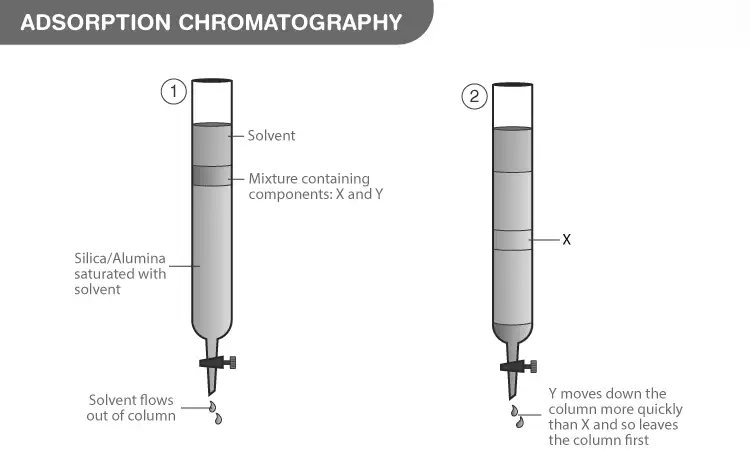
Diagram depicting Adsorption Chromatography
Example Problem
In an adsorption chromatography experiment, two compounds A and B are separated. Compound A travels 3 cm while compound B travels 5 cm on the adsorbent surface. Which compound has higher adsorption affinity and why?
Solution:
Compound A travels a shorter distance, indicating stronger adsorption to the stationary phase.
Compound B moves further, showing weaker adsorption.
Therefore, compound A has a higher affinity for the adsorbent surface.
Thin Layer Chromatography: Rapid Separation on a Coated Plate
Thin Layer Chromatography (TLC) employs a glass or plastic plate coated with a thin layer of adsorbent like silica gel or alumina. A small spot of the mixture is applied near the base of the plate, which is then placed in a solvent chamber. The solvent ascends the plate by capillary action, carrying the components at different rates depending on their affinity for the stationary phase and solubility in the solvent.
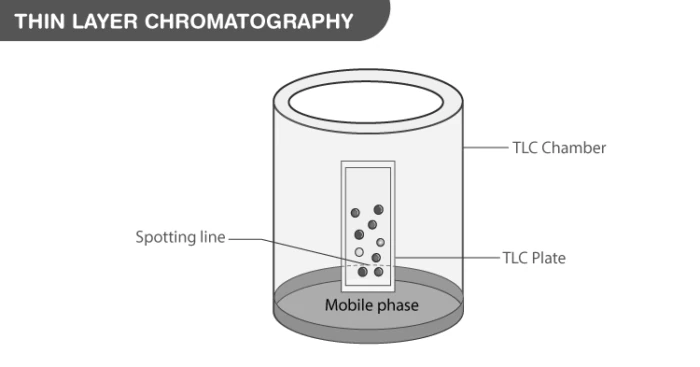
Thin Layer Chromatography illustrating component separation
Example Problem
A TLC plate shows a solvent front that has moved 8 cm and a compound spot that has moved 5 cm from the baseline. Calculate the retention factor (Rf) for the compound.
Solution:
\[ R_f = \frac{\text{Distance travelled by compound}}{\text{Distance travelled by solvent}} = \frac{5 \text{ cm}}{8 \text{ cm}} = 0.625 \]
The Rf value of 0.625 helps in identifying the compound by comparison with known standards.
Column Chromatography: Separation via Packed Adsorbent Columns
Column chromatography involves packing a glass tube with an adsorbent material. The mixture is applied at the top, and a solvent (eluant) is allowed to flow down the column. Components with stronger adsorption to the stationary phase move slower and elute later, while those with weaker adsorption elute earlier. This technique is widely used for purifying compounds on a preparative scale.
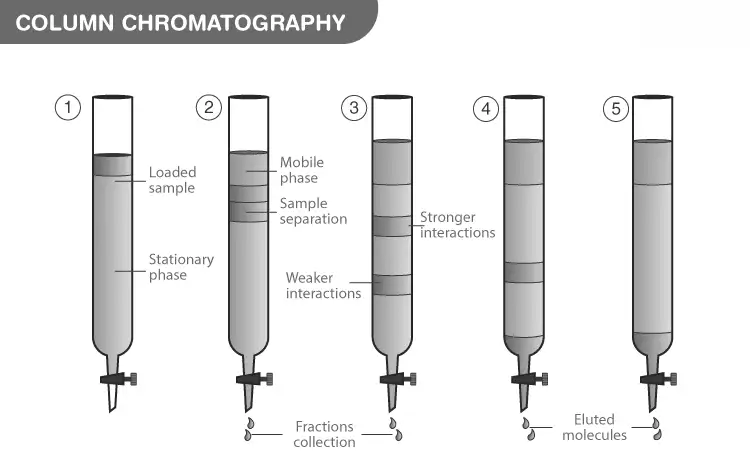
Column Chromatography setup showing separation of mixture components
Example Problem
In a column chromatography experiment, three compounds are separated. Compound X elutes after 10 minutes, compound Y after 5 minutes, and compound Z after 15 minutes. Which compound has the strongest interaction with the stationary phase?
Solution:
Compound Z elutes last at 15 minutes, indicating the strongest adsorption.
Compound Y elutes first, showing the weakest interaction.
Compound X has intermediate retention.
Partition Chromatography: Separation Based on Solubility Differences
Partition chromatography separates components by their differential solubility between two immiscible phases: a stationary liquid phase and a mobile phase. Paper chromatography is a common example, where chromatography paper acts as the stationary phase and a solvent mixture as the mobile phase. Components partition between these phases and move at different rates, resulting in separation.
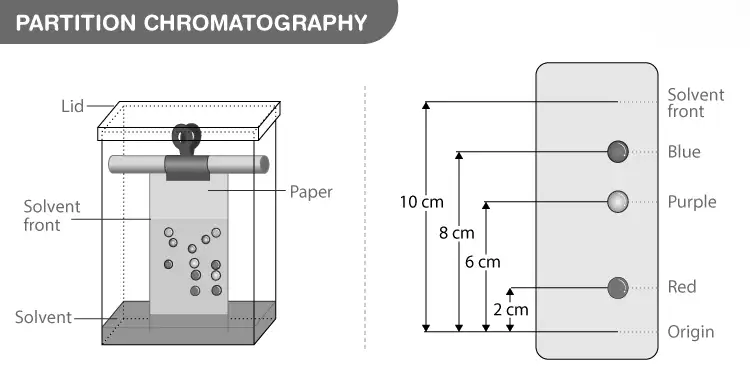
Partition Chromatography using chromatography paper
Example Problem
In paper chromatography, a spot travels 4 cm while the solvent front moves 10 cm. Calculate the Rf value and explain its significance.
Solution:
\[ R_f = \frac{4 \text{ cm}}{10 \text{ cm}} = 0.4 \]
The Rf value of 0.4 is characteristic of the compound under the given conditions.
It helps in identifying unknown substances by comparison with known Rf values.
Specialized Extraction and Practical Uses of Chromatography
Selective Extraction of Organic Compounds from Mixtures
Differential extraction is a technique used to isolate organic compounds from aqueous mixtures by exploiting their solubility differences. An organic solvent immiscible with water is added, forming two layers. The compound preferentially dissolves in the organic layer, which can be separated using a separating funnel. The organic solvent is then removed by distillation or evaporation to recover the pure compound. Continuous extraction is employed when the compound's solubility in the organic solvent is low.
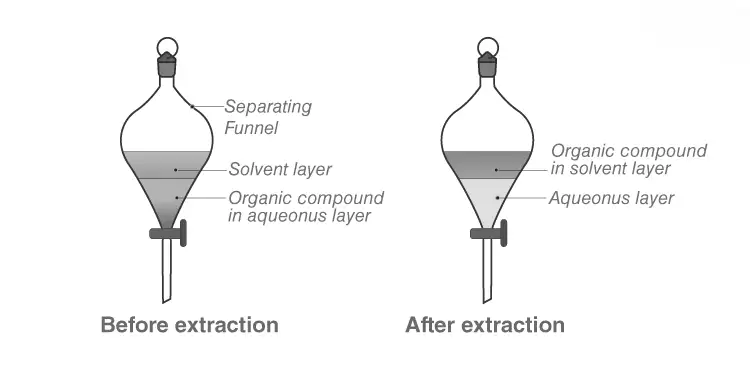
Illustration of Differential Extraction process
Example Problem
A mixture contains an organic compound soluble in ether but insoluble in water. Describe how differential extraction can be used to separate this compound from the aqueous mixture.
Solution:
Add ether to the aqueous mixture in a separating funnel.
Shake and allow layers to separate; the organic compound dissolves in the ether layer.
Separate the ether layer and evaporate the solvent to obtain the pure compound.
Chromatography in Protein Purification and Analysis
Chromatography plays a vital role in biochemistry for isolating and purifying proteins from complex biological samples. Since proteins coexist with lipids, nucleic acids, and other molecules, chromatographic techniques help separate the target proteins based on their physical and chemical properties. Techniques such as ion exchange, affinity, size exclusion, and reversed-phase chromatography are commonly employed to achieve high purity and facilitate detailed analysis.
Example Problem
Explain why affinity chromatography is particularly useful for purifying a specific protein from a cell lysate.
Solution:
Affinity chromatography uses a stationary phase with ligands that specifically bind the target protein.
Non-target proteins do not bind and are washed away.
The target protein is then eluted by changing conditions, resulting in high purity.
Quick Reference: Summary of Chromatography Techniques
Technique | Stationary Phase | Mobile Phase | Separation Basis | Common Use |
|---|---|---|---|---|
Adsorption Chromatography | Solid adsorbent | Liquid or gas | Adsorption affinity | Purification of organic compounds |
Thin Layer Chromatography (TLC) | Silica gel/alumina coated plate | Solvent mixture | Adsorption and solubility | Qualitative analysis and purity check |
Column Chromatography | Packed adsorbent column | Eluant solvent | Adsorption strength | Preparative separation and purification |
Partition Chromatography | Liquid stationary phase (e.g., paper) | Solvent mixture | Partition coefficient | Separation of polar compounds |
Differential Extraction | Two immiscible liquid layers | Organic solvent and aqueous phase | Solubility differences | Isolation of organic compounds from aqueous mixtures |
Glossary of Key Chromatography Terms
Term | Definition |
|---|---|
Adsorbent | A solid material on which substances adhere during chromatography. |
Eluant | The solvent or gas that moves through the stationary phase carrying components. |
Retention Time | The time a component takes to pass through the chromatographic system. |
Retention Factor (Rf) | The ratio of distance traveled by a compound to the distance traveled by the solvent front in TLC or paper chromatography. |
Stationary Phase | The phase that remains fixed in place during chromatography. |
Mobile Phase | The phase that moves through or over the stationary phase, carrying components. |
Chromatogram | A graphical output showing detector response versus retention time. |
Partition Coefficient | The ratio of concentrations of a compound in two immiscible phases at equilibrium. |
Differential Extraction | A method to separate compounds based on their solubility in two immiscible liquids. |
Affinity Chromatography | A technique using specific binding interactions to isolate target molecules. |
Frequently Asked Questions About Chromatography
What is the fundamental principle behind chromatography?
Chromatography separates components based on their differential interactions with a stationary phase and a mobile phase, causing them to move at different rates.
How is the retention factor (Rf) value useful in chromatography?
The Rf value helps identify compounds by comparing the distance traveled by the compound to the solvent front under specific conditions.
Where is chromatography commonly applied?
Chromatography is widely used in industries for purifying substances, detecting contaminants, analyzing mixtures, and in biochemical research for protein purification.
What distinguishes adsorption chromatography from partition chromatography?
Adsorption chromatography separates based on surface adhesion to a solid phase, while partition chromatography separates based on solubility differences between two liquid phases.
Why is differential extraction important in chemical separation?
It allows selective isolation of organic compounds from aqueous mixtures by exploiting their solubility in immiscible solvents, facilitating purification.